Advance Agni Missile with MIRV System
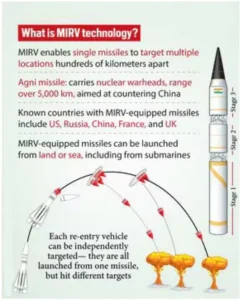
Context: DRDO has successfully conducted a flight trial of an Advanced Agni missile equipped with a Multiple Independently Targeted Re-Entry Vehicle (MIRV) system.
- This was the second known test of the advanced Agni-5, also referred to as ‘Mission Divyastra’, an MIRV-capable iteration of Agni-5.
UPSC Online Courses
Agni 5 Missile
- Agni-5 is India’s long-range nuclear-capable intercontinental-range ballistic missile (ICBM-class) designed for strategic deterrence and advanced strike capability.
- Developer: Developed by Defence Research and Development Organisation (DRDO) under the Integrated Guided Missile Development Programme.
- Range: Has a strike range of over 5,000 km, enabling coverage of distant strategic targets.
- Stages: It is a surface to surface, three-stage solid-fuel missile.
- Launch Platform: Can be launched from a road-mobile canisterised platform, improving survivability and rapid deployment.
- Strategic Role: Strengthens India’s credible minimum deterrence and second-strike nuclear capability.
- First Test: Successfully first tested in 2012 from Odisha.
Multiple Independently Targeted Re-Entry Vehicle (MIRV) System
- Multiple Independently Targeted Re-Entry Vehicle (MIRV) is a missile technology that enables a single ballistic missile to carry multiple warheads.
- Global Leaders: MIRV technology was first developed by the USA, later followed by the Soviet Union, UK, France, and China.
- Key Features:
-
- Independent Targeting: Each warhead can strike a different target independently after being released in flight.
- MIRV systems can also deploy decoys and penetration aids to evade enemy missile defence systems.
- Significance:
- Strategic Advantage: MIRV significantly enhances a country’s deterrence capability and strike efficiency.
- Defence Penetration: The system helps overcome missile defence shields by deploying multiple warheads simultaneously.
- Payload Flexibility: MIRV-equipped missiles can carry nuclear or conventional payloads depending on strategic requirements.
National Panchayat Awards 2025
Context: National Panchayat Awards 2025 were announced by the Ministry of Panchayati Raj to recognise excellence in grassroots governance and sustainable rural development.
Highlights of the National Panchayat Awards 2025
- A total of 42 Panchayats from across India were selected, with Karnataka winning the highest number of awards (6), followed by Andhra Pradesh and Odisha (5 each).
- Assessment: Awards are linked to the Panchayat Advancement Index (PAI) 2.0, promoting transparent and data-driven assessment.
- Cash Prize: Winning Panchayats will receive financial incentives ranging from ₹50 lakh to ₹5 crore under the Rashtriya Gram Swaraj Abhiyan.
About the National Panchayat Awards
- Nodal Ministry: Administered annually by the Ministry of Panchayati Raj.
- Scheme Linkage: Institutionalised under the Incentivization of Panchayats component of the revamped Rashtriya Gram Swaraj Abhiyan (RGSA).
- Focus Areas: Promote inclusive, participatory, transparent, and sustainable rural governance through community-led initiatives.
- SDG Alignment: Since 2023, the awards framework has been aligned with the nine themes of Localization of Sustainable Development Goals (LSDGs).
- Categories of Awards:
-
- Deen Dayal Upadhyay Panchayat Satat Vikas Puraskar: Recognises outstanding Gram Panchayats for their performance across 9 Localisation of Sustainable Development Goals (LSDGs) themes.
- Nanaji Deshmukh Sarvottam Panchayat Satat Vikas Puraskar: Best-performing Panchayats at the District, Block, and Gram Panchayat levels on an overall basis.
- Atma Nirbhar Panchayat Special Award: Gram Panchayats for their efforts towards mobilization and augmentation of Own Source of Revenue.
- Climate Action Special Panchayat Award: Gram Panchayats for achieving Net-Zero carbon emissions and usage of renewable sources of energy.
- Panchayat Kshamta Nirmaan Sarvottam Sansthan Puraskar: For Institutions who have provided institutional support to GPs in achieving LSDGs.
Rabindranath Tagore
Context: PM Modi paid heartfelt tributes to Gurudev Rabindranath Tagore on the occasion of Pochishe Boishakh.
About Rabindranath Tagore
- Rabindranath Tagore (1861–1941), popularly known as ‘Gurudev’, ‘Kabiguru’, and ‘Biswakabi’ was a poet, philosopher, novelist, dramatist, painter, composer, and social reformer from Bengal.
- Pochishe Boishakh: Pochishe Boishakh refers to the 25th day of the Bengali month of Boishakh, celebrated as the birth anniversary (7th May) of Rabindranath Tagore.
- Pochishe Boishakh is also a poem written by Rabindranath Tagore on his birthday (1922).
- Nobel Prize: He became the first non-European Nobel laureate in Literature in 1913 for his work Gitanjali.
- Bengal Renaissance: Tagore was a leading figure of the Bengal Renaissance, promoting humanism, modernism, and cultural reform through literature and education.
- Educational Contributions: He founded Visva-Bharati University at Santiniketan in 1921, promoting holistic and global education beyond rote learning.
- National Anthems: He composed India’s national anthem “Jana Gana Mana” and Bangladesh’s national anthem “Amar Sonar Bangla.”
- Protest Against Colonial Rule: In 1919, he renounced his British knighthood (awarded in 1915) in protest against the Jallianwala Bagh Massacre.
- Literary Works: His major literary works include Gitanjali, Ghare Baire (The Home and the World), Gora, and Char Adhyay.
- Where the Mind is Without Fear: His famous poem Where the Mind is Without Fear (Chitto Jetha Bhayshunyo), included in Gitanjali, envisioned an India free from fear, ignorance, and narrow divisions.
- Ekla Chalo Re: Written during the Swadeshi Movement in 1905, encouraged individuals to continue their struggle courageously even without public support.
- Views on Nationalism: Tagore strongly criticised aggressive nationalism and believed that humanity should transcend narrow patriotism and rigid borders.
- His famous idea was: “Patriotism cannot be our final spiritual shelter; my refuge is humanity.”
Chief of Defence Staff (CDS)
Context: The Government has appointed Lieutenant General NS Raja Subramani (Retd) as the new Chief of Defence Staff (CDS) and Secretary, Department of Military Affairs.
- He will be the third person to assume the post after Gen Bipin Rawat and Gen Anil Chauhan.
About Lt Gen NS Raja Subramani
- Previous Key Appointments: Currently serving as Military Adviser at the National Security Council Secretariat.
- Earlier served as Vice Chief of the Army Staff.
- Also served as General Officer Commanding-in-Chief of the Indian Army Central Command.
- Major Command Appointments: He commanded 16 Garhwal Rifles in counter-insurgency operations in Assam under Operation Rhino.
- Commanded 168 Infantry Brigade in Jammu & Kashmir.
- Led 17 Mountain Division in the Central Sector.
- Commanded 2 Corps, the Indian Army’s premier strike corps on the Western Front
UPSC Online Coaching
About the Chief of Defence Staff (CDS)
- The Chief of Defence Staff (CDS) is the highest-ranking military officer in India and serves as the principal military adviser to the Government on Tri-Service matters.
- Establishment: The post was created in 2019 to promote jointness, integration, and coordination among the Army, Navy, and Air Force.
- Appointment Authority: Appointed by the Appointments Committee of the Cabinet.
- Eligibility: Can be selected from Army, Navy, or Air Force.
- Order of Precedence: The CDS ranks 12th in the Indian order of precedence, equivalent to the three service chiefs.
- Rank and Status: Holds the rank of a four-star General equivalent to Service Chiefs.
- Role:
- Principal Military Adviser to Raksha Mantri.
- Permanent Chairman of Chiefs of Staff Committee (CoSC).
- Secretary of Department of Military Affairs (DMA) in Ministry of Defence.
- Duties:
- Promotion of Jointness: Enhances coordination in operations, logistics, and training.
- Defence Planning: Oversees integrated acquisition and capability planning.
- Tri-Service Administration: Administers joint organisations and agencies.
- Strategic Role: Advises the Nuclear Command Authority.
- Military Reforms: Drives theatre command reforms and modernisation.
- Limitations of CDS:
- No Operational Command: Operational control remains with Service Chiefs.
- No Independent Combat Powers: Cannot independently deploy forces or order operations.
- Limited Financial Authority: Major capital acquisitions remain outside CDS control.
- Significance of the CDS:
- Integrated Military Advice: Provides unified advice to civilian leadership.
- Tri-Service Coordination: Strengthens cooperation among armed forces.
- Efficient Resource Utilisation: Reduces duplication in defence infrastructure and expenditure.
- Improved Crisis Response: Enables faster strategic decision-making.
- Global Alignment: Aligns India with advanced military systems globally.
ICGS ACHAL
Context: Recently, the Indian Coast Guard (ICGS) commissioned ICGS Achal at Goa Shipyard Limited.
About ICGS ACHAL
- Classification: The Indian Coast Guard Ship (ICGS) Achal is a new-generation Adamya-class Fast Patrol Vessel (FPV) of the Indian Coast Guard.
- Meaning of the Name: The name “Achal” means “firm”, symbolising steadfast commitment towards maritime security.
- Construction Programme: It is the fifth vessel in a series of eight Fast Patrol Vessels being constructed by Goa Shipyard Limited for the Indian Coast Guard.
- Operational Control: It will function under the administrative and operational control of the Commander, Coast Guard Region (North West).
Features of ICGS ACHAL
- Propulsion: Powered by two 3000 kW advanced diesel engines.
- Speed and Endurance: Capable of achieving a top speed of 27 knots with an operational endurance of 1500 nautical miles.
- Advanced Technologies: Equipped with an Integrated Bridge System, Integrated Machinery Control System, and Automated Power Management System.
- Indigenous Content: Incorporates nearly 60% indigenous content, reflecting India’s growing self-reliance in defence manufacturing.
- Dual Certification: Holds dual-class certification from the American Bureau of Shipping (ABS) and the Indian Register of Shipping (IRS).
Functions of ICGS ACHAL
- Maritime Surveillance: Undertakes coastal and offshore surveillance operations.
- Interdiction Operations: Supports interdiction and anti-smuggling missions.
- Search and Rescue: Conducts Search and Rescue (SAR) operations at sea.
- Pollution Response: Assists in marine pollution response and environmental protection.
About ICGS
- The Indian Coast Guard (ICG) is India’s maritime law enforcement and search-and-rescue agency to protect the nation’s maritime interests and ensure safety at sea.
- Establishment: It was established in August 1978 and functions under the Ministry of Defence.
- Jurisdiction: It exercises jurisdiction over India’s territorial waters, contiguous zone, and Exclusive Economic Zone (EEZ).
India–Algeria Defence Meet
Context: India and Algeria held their first Joint Commission on Defence Cooperation in New Delhi to strengthen bilateral strategic and military engagement.
Key Highlights of India–Algeria Defence Commission Meeting
- Defence Cooperation Framework: Both countries signed the Rules of Procedure to guide implementation of the India–Algeria Defence Memorandum of Understanding signed in 2024.
- Areas of Collaboration: Discussions focused on military training, joint exercises, defence industry cooperation, medical collaboration and institutional defence engagement.
- Strategic Significance: The meeting reflected India’s expanding defence diplomacy in Africa and diversification of strategic partnerships in the Mediterranean region.
Click to Know UPSC Coaching Centres in India
About Algeria
- Algeria, officially the People’s Democratic Republic of Algeria, is the largest country in Africa with Algiers as its capital city.
- Location: Maghreb region of North Africa along the Mediterranean coast.
- Algeria is bordered by:
- Mediterranean Sea in the north
- Tunisia and Libya in the east
- Niger in the southeast
- Mali and Mauritania in the southwest
- Morocco and Western Sahara in the west
- Geography
- Desert Dominance: The Sahara Desert covers more than 80% of Algeria’s total land area.
- Mountain Ranges: Major mountain systems include the Tell Atlas, Saharan Atlas and Hoggar (Ahaggar) Mountains.
- Highest Peak: Mount Tahat in the Hoggar Mountains is the highest peak in Algeria.
- River System: The Chelif River is the longest river in Algeria.
- Climate: Mediterranean climate along the coast with hot dry summers and mild rainy winters, while the Sahara region remains extremely hot and arid.
- Vegetation: Northern Algeria contains cork oak and pine forests, whereas desert vegetation in the south includes palm oases, shrubs and drought-resistant grasses.
 11 May 2026