Recently, the World Meteorological Organization (WMO), in collaboration with the UK Met Office, released the Global Annual-to-Decadal Climate Update (2026–2030).
- The report warns that global average surface temperatures will persist at or near record-breaking thresholds over the next five years, driven by accelerating anthropogenic greenhouse gas emissions and an impending cyclical El Niño system.
UPSC Online Coaching
Key Statistical Projections (2026–2030)
The report outlines critical quantitative thresholds regarding immediate global temperature anomalies:
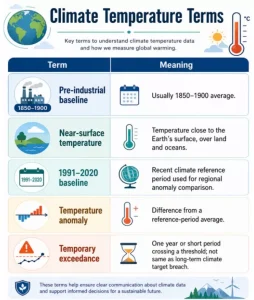
- Temperature Range: Annual global mean near-surface temperatures between 2026 and 2030 are predicted to hover between 1.3°C and 1.9°C above the pre-industrial baseline (1850–1900 average).
- Breaking the 2024 Record: There is an 86% probability that at least one individual year within this five-year window will surpass 2024 as the hottest year ever officially recorded.
- Temporary 1.5°C Breach: There is a 91% chance that the global mean near-surface temperature will temporarily spike past 1.5°C above pre-industrial levels for at least one year.
- Five-Year Mean Threshold: The report notes a 75% probability that the cumulative five-year average (2026–2030) as a whole will exceed the 1.5°C threshold.
- The 2°C Barrier: It remains exceptionally unlikely (less than 1% chance) that any individual year before 2030 will breach 2.0°C warming above pre-industrial limits.
Climate Drivers- The El Niño Impact
The sharp upward spike in projected near-term warming is closely tied to Pacific Ocean macro-dynamics:
- Cyclical Transition: The report identifies a strong baseline trend toward El Niño conditions developing by the end of 2026, dominating the central tropical Pacific (Niño 3.4 region) through 2027 and 2028.
- Compounding Mechanism: While greenhouse gas accumulation drives long-term baselines, El Niño releases massive oceanic heat into the atmosphere, making 2027 the highest-probability candidate for unprecedented record temperatures.
IPCC’s 1.5°C Goal
- Paris Climate Agreement Target: The 2015 Paris Agreement set the goal of limiting long-term global warming to 1.5°C above pre-industrial levels to avoid severe climate impacts.
- Climate Commitments: Countries must submit updated Nationally Determined Contributions (NDCs) for 2031–2035, aiming to meet the 1.5°C target.
Implications of 1.5°C Breach
- Increased Extreme Weather Events: Breaching 1.5°C will intensify heatwaves, droughts, cyclones, and floods, severely affecting vulnerable populations, agriculture, and infrastructure.
- Biodiversity Loss: Coral reefs and Arctic ecosystems face irreversible damage; species extinction rates will rise due to habitat loss and temperature stress.
- Sea-Level Rise & Glacial Melting: Accelerated melting of polar ice and glaciers will lead to faster sea-level rise, threatening coastal communities and small island nations.
- Food & Water Insecurity: Disrupted monsoon patterns, reduced crop yields, and declining freshwater availability will exacerbate global hunger and conflict over resources.
|
Regional Variations & Hydro-Meteorological Anomalies
Global warming is not uniform; the report highlights severe regional disparities:
- Arctic Amplification: Temperature anomalies across the Arctic are forecast to average 2.8°C above the 1991–2020 baseline during the next five northern hemisphere extended winters—warming 3.5 times faster than the global average.
- Vicious Albedo Feedback Loop: Rapidly rising polar temperatures will trigger drastic reductions in summer sea-ice concentrations across the Barents, Bering, and Okhotsk seas, reducing the planet’s albedo effect (solar reflection capacity) and accelerating global heat absorption.
- Shifting Precipitation Patterns:
- Wet Anomalies (Higher Rainfall): Forecasted for the Sahel, Northern Europe, Alaska, and Siberia.
- Dry Anomalies (Deficit/Drought): High probability of persistent dry anomalies over the Amazon basin, increasing the threat of destructive wildfires.
Understanding the Legal Framework
A critical conceptual distinction highlighted by the WMO is how a temporary spike differs from a formal treaty violation:
- The 1.5°C Goal: Under the Paris Agreement (COP21, 2015), signatory states pledged to hold global temperature increases well below 2°C, while actively pursuing efforts to cap it at 1.5°C.
- The Long-Term Metric: A temporary exceedance (such as in 2024 at 1.55°C or the projected spikes between 2026 and 2030) does not constitute a legal breach of the Paris Agreement.
- The Definition of a Breach: The international climate treaty evaluates warming based on long-term climatological averages sustained over approximately 20 to 30 years.
- Implications for Climate Action: While a temporary breach is not a formal treaty violation, it indicates the world is rapidly exhausting its remaining carbon budget.
- Every fractional increment (0.1°C) of added warming significantly diminishes regional climate adaptation capacities and escalates the frequency of extreme, multi-hazard weather events.
Click to Know UPSC Offline Courses
About World Meteorological Organization (WMO)
- Genesis & Status: Established on March 23, 1950 (celebrated as World Meteorological Day), it originated from the 1873 International Meteorological Organization and is now a specialized agency of the United Nations headquartered in Geneva, Switzerland.
- Core Mandate: It serves as the dedicated global voice on the state and behavior of the Earth’s atmosphere, its interaction with the land and oceans, the climate it produces, and the resulting distribution of water resources.
- Data Policy: It coordinates and mandates the free and unrestricted exchange of real-time meteorological data, satellite observation tracks, and hydro-meteorological products across its 193 member states and territories.
- Key Institutional Links: In 1988, the WMO co-founded the Intergovernmental Panel on Climate Change (IPCC) alongside the United Nations Environment Programme (UNEP) to evaluate global climate change risks.
- Flagship Publications: It publishes authoritative, globally recognized climate assessments, most notably the annual State of the Global Climate Report and the Greenhouse Gas Bulletin.
- India Connection: India is a founding member; the India Meteorological Department (IMD) in New Delhi serves as a WMO-designated Regional Specialized Meteorological Centre (RSMC), responsible for tracking, forecasting, and naming tropical cyclones across the North Indian Ocean.
|
 30 May 2026