COSOP 2026–2033: IFAD’s Strategic Framework for Rural Development in India

13 May 2026

COSOP 2026–2033: IFAD’s Strategic Framework for Rural Development in India

The Government of India and the International Fund for Agricultural Development (IFAD) launched a new Country Strategic Opportunities Programme (COSOP) 2026–2033 to strengthen India’s rural economy. 
COSOP 2026–2033

  • IFAD and NABARD signed a strategic partnership agreement to further strengthen rural finance systems and support innovation in agricultural and allied sectors. 
  • The strategy aligns with the vision of Viksit Bharat@2047.

About COSOP 2026-2033

  • A Country Strategic Opportunities Programme (COSOP) is a medium- to long-term strategic framework prepared by the International Fund for Agricultural Development (IFAD) for its partnership with a member country. 

Best Online Coaching for UPSC

About International Fund for Agricultural Development (IFAD)

  • IFAD is a specialized agency of the United Nations established in 1977.
  • Headquarters: Rome
  • Objective: Eradicate rural poverty and hunger through investments in agriculture and rural development.
  • Focus Areas:
    • Rural livelihoods
    • Women’s empowerment
    • Agricultural transformation
    • Financial inclusion
    • Climate resilience

Key Features

  • Focus Areas:  Enhancing the social, economic, and climate resilience of rural communities; 
    • Strengthening knowledge systems to scale proven development models across India and other countries of the Global South. 
  • Strengthening Grassroot Institutions: It places strong emphasis on strengthening grassroots institutions such as:
    • COSOP 2026–2033Self-Help Groups (SHGs), 
    • Farmer Producer Organisations (FPOs), and cooperatives
    • These institutions will connect rural communities with Finance, Technology, Infrastructure and Markets.
  • Knowledge Sharing and South-South Cooperation: India will act as a knowledge leader by sharing successful rural development models with countries in:
    • Africa
    • Southeast Asia
    • Latin America

About Rural Economy

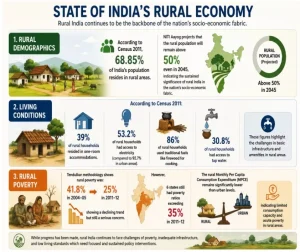
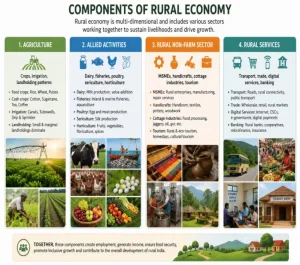
  • The rural economy refers to the economic activities and livelihood systems operating in rural areas, primarily dependent on agriculture and allied sectors. 
  • It includes farming, animal husbandry, fisheries, forestry, cottage industries, handicrafts, and rural services. 

COSOP 2026–2033

Challenges in India’s Rural Economy

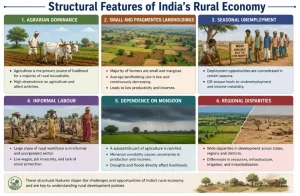
  • Structural Constraints in Agriculture: India’s rural economy continues to face deep structural bottlenecks such as fragmented and uneconomic landholdings, low agricultural productivity, and excessive dependence on monsoon rainfall. 
    • According to the Agriculture Census and NITI Aayog assessments, the majority of farmers are small and marginal cultivators with limited capacity to invest in mechanisation, irrigation, storage, and modern technology, resulting in low incomes and vulnerability to shocks.
  • Rural Unemployment and Agrarian Distress: Persistent rural unemployment, disguised employment in agriculture, and declining profitability of farming have intensified agrarian distress across many regions of India. 
  • Climate Vulnerability and Ecological Stress: India’s rural economy remains highly vulnerable to climate change-induced challenges such as frequent droughts, floods, erratic rainfall, soil degradation, and increasing water scarcity. 
    • As emphasized in the National Action Plan on Climate Change (NAPCC) and Economic Survey, climate variability adversely affects agricultural productivity, food security, and rural livelihoods, particularly in rain-fed and ecologically fragile regions.
  • Weak Rural Institutions and Market Access: Limited access to institutional credit, inadequate rural infrastructure, weak market linkages, and uneven performance of cooperatives and Farmer Producer Organisations (FPOs) continue to constrain rural transformation. 
  • Inadequate Rural Infrastructure: Deficiencies in rural infrastructure such as poor road connectivity, limited cold storage facilities, unreliable electricity supply, weak digital infrastructure, and inadequate irrigation networks continue to hinder rural economic growth. 
    • Government assessments under schemes like Pradhan Mantri Gram Sadak Yojana (PMGSY) and PM Gati Shakti emphasize that infrastructure gaps increase transaction costs, reduce market access, and constrain diversification of rural livelihoods.
  • Financial Exclusion and Limited Access to Formal Credit: A significant section of rural households, especially small farmers, tenant cultivators, women, and landless labourers, still face difficulties in accessing affordable institutional credit and financial services.
  • Low Level of Rural Industrialisation and Non-Farm Employment: The rural economy remains excessively dependent on agriculture due to inadequate growth of rural industries, agro-processing units, and non-farm employment opportunities. 
  • Human Development Deficits in Rural Areas: Poor quality of education, inadequate healthcare infrastructure, malnutrition, and skill gaps continue to weaken human capital formation in rural India

Significance of COSOP 2026–2033 for India

  • Economic: The COSOP 2026–2033 framework is expected to enhance rural incomes and generate sustainable employment opportunities by promoting diversified livelihoods, value addition, and better market integration. 
    • By encouraging market-oriented agriculture, rural enterprises, and stronger Farmer Producer Organisations (FPOs), the programme supports the Government’s objective of transforming subsistence farming into a more productive, competitive, and income-oriented rural economy.
  • Social:The programme places strong emphasis on women empowerment through Self-Help Groups (SHGs) therefore it  promotes inclusive development in economically and socially backward regions by improving access to finance, skills, technology, and livelihood opportunities for vulnerable communities.
  • Environmental: The strategy supports climate-resilient agriculture, sustainable natural resource management, and adaptive livelihood systems to address the growing challenges of climate change. 
    • Through improved water management, climate-smart farming practices, and resilient value chains, the programme aims to enhance the adaptive capacity of rural communities against droughts, floods, and ecological degradation.
  • Strategic: The COSOP framework strengthens India’s soft power by showcasing successful rural development models such as SHGs, digital agriculture, cooperative governance, and inclusive rural finance to countries of the Global South. 
    • It positions India as an important development partner in South-South cooperation and reinforces its role as a knowledge leader in sustainable and inclusive rural transformation.
  • Institutional: The COSOP framework reinforces the role of grassroots institutions such as Self-Help Groups (SHGs), Farmer Producer Organisations (FPOs), and cooperatives in rural development. 
    • Strengthening these community-based institutions can improve collective bargaining power, promote decentralised and participatory rural governance.
  • Financial: Through collaboration with institutions such as National Bank for Agriculture and Rural Development (NABARD), the programme seeks to deepen rural financial systems and improve access to institutional credit for farmers, women entrepreneurs, and rural enterprises.
  • Supporting the Vision of Viksit Bharat@2047: The COSOP 2026–2033 aligns with India’s broader developmental vision of achieving inclusive, sustainable, and resilient growth under Viksit Bharat@2047. 

How Artificial Intelligence (AI) is Catalysing Rural Development?

  • Improving Agricultural Productivity through Precision Farming: Artificial Intelligence is helping farmers make data-driven decisions by analysing soil conditions, weather patterns, crop health, and pest attacks in real time.
    • AI-enabled advisory systems, satellite imagery, and sensor-based technologies support precision farming, leading to higher productivity, reduced input costs, and efficient use of water and fertilisers.
  • Strengthening Weather Forecasting and Climate Resilience: AI-based climate and weather prediction models are improving the accuracy of rainfall forecasts, drought warnings, flood alerts, and crop-risk assessments. 
  • Expanding Access to Credit and Financial Inclusion: AI is enabling faster and more inclusive rural financial services through digital credit scoring, fraud detection, and customised loan assessments for farmers and rural entrepreneurs. 
  • Enhancing Market Linkages and Price Discovery: AI-powered digital platforms help farmers access real-time information on market prices, demand trends, logistics, and storage facilities. 
    • Such technologies reduce information asymmetry, improve bargaining power, and connect farmers directly with buyers, processors, and e-commerce platforms, thereby strengthening agricultural value chains and reducing exploitation by intermediaries.
  • Supporting Rural Healthcare Delivery: AI is improving healthcare access in rural areas through telemedicine, AI-assisted diagnostics, disease surveillance, and mobile health applications. 
    • AI tools can help identify diseases at early stages, support remote consultations, and improve healthcare delivery in areas facing shortages of doctors and medical infrastructure.
  • Improving Rural Education and Skill Development: AI-enabled educational platforms are providing personalised learning, multilingual content, and remote skill training opportunities for rural students and youth.
    • Digital learning systems supported by AI can bridge educational gaps, improve literacy and employability, and support rural workforce participation in emerging sectors.

Way Forward

  • Strengthen digital rural infrastructure to improve access to e-governance, digital payments, agri-advisory services, telemedicine, and online education in rural areas.
  • Improve last-mile delivery of schemes through better administrative coordination, real-time monitoring, social audits, and greater involvement of Panchayati Raj Institutions and local communities.
  • Expand climate-smart agriculture by promoting drought-resistant crops, micro-irrigation, crop diversification, precision farming, and sustainable natural resource management.
  • Enhance rural skill development aligned with local economic needs in sectors such as agro-processing, food technology, handicrafts, renewable energy, and digital services.
  • Promote agro-processing and value chains to increase farmers’ income through storage facilities, food processing industries, cold chains, branding, and better market linkages.
  • Ensure convergence among SHGs, FPOs, cooperatives, and government schemes to create integrated rural development ecosystems and improve access to credit, markets, technology, and institutional support.

Click to Know UPSC Coaching Centres in India

Government Initiatives to Support Rural Development

Scheme/Initiative Ministry Objective Key Features/Impact
DAY-NRLM (Deendayal Antyodaya Yojana – National Rural Livelihood Mission) Ministry of Rural Development Poverty reduction through self-employment and SHGs Promotes women Self-Help Groups (SHGs), financial inclusion, rural entrepreneurship
PMGSY (Pradhan Mantri Gram Sadak Yojana) Ministry of Rural Development Improve rural connectivity Construction of all-weather rural roads connecting villages to markets, schools, and hospitals
PMAY-G (Pradhan Mantri Awas Yojana – Gramin) Ministry of Rural Development Rural housing for poor households Financial assistance for pucca houses with basic amenities
DDU-GKY (Deen Dayal Upadhyaya Grameen Kaushalya Yojana) Ministry of Rural Development Rural skill development and employment Skill training for rural youth linked with placement opportunities
PM-KISAN (Pradhan Mantri Kisan Samman Nidhi) Ministry of Agriculture & Farmers Welfare Income support to farmers ₹6,000 annual DBT support to eligible farmers 
PMFBY (Pradhan Mantri Fasal Bima Yojana) Ministry of Agriculture & Farmers Welfare Crop insurance and risk reduction Insurance coverage against crop failure, natural calamities, and pests
PMKSY (Pradhan Mantri Krishi Sinchai Yojana) Ministry of Agriculture Improve irrigation efficiency “Per Drop More Crop”; promotes micro-irrigation and water conservation
e-NAM (National Agriculture Market) Ministry of Agriculture Improve agricultural marketing Digital platform integrating agricultural mandis across India
Formation & Promotion of FPOs Ministry of Agriculture Strengthen collective farming and marketing Supports Farmer Producer Organisations with credit and market access
KUSUM Scheme Ministry of New & Renewable Energy Solarization of agriculture Solar pumps and renewable energy support for farmers
PM Formalisation of Micro Food Processing Enterprises (PM-FME) Ministry of Food Processing Industries Promote rural agro-processing Financial and technical support for micro food enterprises
National Social Assistance Programme (NSAP) Ministry of Rural Development Social security for vulnerable groups Pensions for elderly, widows, and disabled rural citizens

Check Out UPSC CSE Books

Visit PW Store

online store 1

Explore UPSC Foundation Course

Need help preparing for UPSC or State PSCs?

Connect with our experts to get free counselling & start preparing

Aiming for UPSC?

Download Our App

      
Quick Revise Now !
AVAILABLE FOR DOWNLOAD SOON
UDAAN PRELIMS WALLAH
Comprehensive coverage with a concise format
Integration of PYQ within the booklet
Designed as per recent trends of Prelims questions
हिंदी में भी उपलब्ध
Quick Revise Now !
UDAAN PRELIMS WALLAH
Comprehensive coverage with a concise format
Integration of PYQ within the booklet
Designed as per recent trends of Prelims questions
हिंदी में भी उपलब्ध

<div class="new-fform">


    </div>

    Subscribe our Newsletter
    Sign up now for our exclusive newsletter and be the first to know about our latest Initiatives, Quality Content, and much more.
    *Promise! We won't spam you.
    Yes! I want to Subscribe.