April 23, 2026 marks 40 years since the 1986 “triple veto” in the United Nations Security Council (UNSC), an episode that continues to inform debates on veto power and UNSC reform.
Best Online Coaching for UPSC
About the 1986 Incident
On April 23, 1986, a rare instance of a “triple veto” occurred when three permanent members blocked a resolution condemning the United States’ air strikes on Libya (Operation El Dorado Canyon).
- The Catalyst: The US conducted strikes following the bombing of a West Berlin (Germany) discotheque, which it attributed to Libyan state-sponsored terrorism.
- The Draft Resolution: Introduced by countries aligned with the Non-Aligned Movement (NAM), the resolution sought to formally condemn the military action.
- The Voting Outcome: The resolution received nine affirmative votes, fulfilling the minimum requirement for adoption.
- The Exercise of Veto: Despite majority support, the United States, United Kingdom, and France simultaneously exercised their veto power.
- This episode remains a primary example of power politics overriding majority will, highlighting the structural asymmetry of global governance.
About United Nations Security Council (UNSC)
- The UNSC is one of the six principal organs of the United Nations, tasked with maintaining international peace and security, authorizing peacekeeping operations, and imposing sanctions.
- Composition and Decision-Making:
- Total Members: 15 (5 Permanent members or P5; 10 Non-permanent members elected for two-year terms).
- The Permanent Five (P5): United States, United Kingdom, France, Russia, and China.
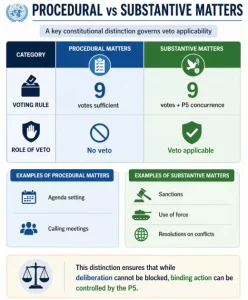
- The Decision Rule: Adoption requires at least 9 affirmative votes & the absence of a veto by any P5 member.
- The Veto Power: The veto power allows any P5 nation to block substantive resolutions regardless of majority support. While often criticized, it was established post-World War II with a specific strategic rationale:
- The Veto Mechanism: Under Article 27 of the UN Charter, all substantive decisions require the concurring votes of the permanent members.
- Strategic Privilege: The veto was established to ensure that the UN would not authorize actions that could lead to a direct military confrontation between the world’s major nuclear powers.
- Great Power Inclusion: Ensures major powers remain within the UN framework, preventing them from bypassing the system through unilateralism.
- Stability Mechanism: Reduces the risk of direct confrontation among nuclear-armed powers, contributing to global stability.
- Consensus Principle: Embodies the principle of great power consensus in international decision-making.
Legal Basis of the Veto
- Charter Provision (Article 27): Article 27 of the UN Charter governs UNSC voting, requiring 9 affirmative votes plus concurrence of permanent members for substantive decisions.
- Interpretation of Concurrence: The term “concurrence” has been interpreted as absence of a negative vote, meaning any P5 member can block a resolution through veto.
- Procedural vs Substantive Distinction: A critical distinction exists between procedural matters (no veto applicable) and substantive matters (veto applicable), ensuring deliberation cannot be blocked but decisions can be controlled.
- Party to Dispute Clause: Article 27(3) expects a party to a dispute to abstain in certain cases under Chapter VI, but this has had limited practical impact on restraining veto use.
- Legality vs Legitimacy: The veto is legally valid but normatively contested, reflecting a system that prioritizes great-power consensus over majority rule.
- Entrenchment via Article 108: Article 108 (amendment procedure) makes veto reform difficult, as any Charter amendment requires ratification by all P5 members, effectively giving them control over reform itself.
- Double Veto Mechanism: The “Double Veto” exploits ambiguity in the United Nations Charter on procedural vs. substantive matters. A P5 member can first veto classification and then veto the resolution, ensuring complete control over agenda and outcomes.
|
| The Veto Power: Stability vs. Stagnation |
| The Case for the Veto |
The Case Against the Veto |
- Prevents Great Power Conflict: Ensures the UN does not authorize actions that could lead to direct war between nuclear powers.
|
- Democratic Deficit: A single nation (or a trio, as in 1986) can nullify the will of the majority, undermining democratic legitimacy.
|
- Institutional Realism: Acknowledges that the UN needs the participation of the most powerful nations to remain viable.
|
- Geopolitical Paralysis: The Council often becomes ineffective during humanitarian crises if a P5 member or its ally is a party to the conflict.
|
- Consensus Building: In theory, it forces P5 members to negotiate middle-ground solutions to avoid a total stalemate.
|
- Anachronistic Structure: The P5 reflects the world of 1945, failing to account for the rise of Global South powers.
|
Modern Update- The “Veto Initiative” (2022)
A significant improvisation in global governance occurred in April 2022 to address these challenges:
- The Resolution: The UN General Assembly now mandates that whenever a veto is cast, the Assembly must meet within 10 working days.
- Accountability: The P5 member who used the veto must appear before the General Assembly to justify their decision, increasing transparency and moral pressure.
Click to Know UPSC Offline Courses
India’s Perspective and Reform Advocacy
As a founding member and a leading voice for the Global South, India views the 1986 triple veto as evidence that the UNSC is structurally imbalanced.
- The G4 Initiative: India partners with Germany, Japan, and Brazil to push for an expansion of permanent membership.
- L.69 Group Leadership: Beyond G4, India leads the L.69 Group (40+ developing nations), advocating Global South representation, reflecting a push for equitable multilateralism and democratic global governance.
- Core Demands: India advocates for permanent representation for emerging economies and a reform of the veto system, including restricting its use in cases of mass atrocities.
- The Strategic Argument: India asserts that for the UNSC to remain relevant, it must reflect contemporary geopolitical realities and provide equitable representation for the developing world.
Conclusion
The 1986 UNSC triple veto highlights the enduring tension between power and democratic principles. It underscores the urgent need for a more representative, accountable, and effective Security Council that aligns with 21st-century realities rather than post-war legacies.
 23 Apr 2026