Recent discourse has highlighted that India’s position in global GDP rankings is often used as an indicator of economic progress; however, this may distort the understanding of the underlying structural realities of the Indian economy.
- According to the latest World Economic Outlook (WEO) released by the International Monetary Fund (IMF), the Indian economy slid to 6th-largest in the world, with Japan, UK overtaking it.
- Earlier, India was ranked at 4th Position.
UPSC Online Courses
About Gross Domestic Product (GDP)
- Gross Domestic Product (GDP) is the total value of all final goods and services produced within the domestic territory of a country during a specific period (usually a year).
- It is the most widely used indicator of economic performance.
- Real GDP growth for 2025-26 is estimated at 7.6%, higher than the 7.1% recorded in 2024-25.
- Base Year for GDP Estimates: It has been revised from 2011–12 to 2022–23 to better reflect India’s evolving economic structure.
- The revised GDP series strengthens estimation by integrating new, improved data sources such as ASUSE, PLFS, GST, PFMS etc.
- Types of GDP:
- Nominal GDP:
- Measured at current prices
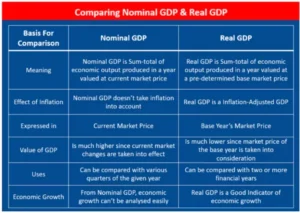 Includes inflation effects
- Real GDP:
- Measured at constant (base-year) prices
- Reflects actual growth in output
- GDP at Market Price vs Factor Cost:
- GDP at Market Price (GDP MP): Includes taxes – subsidies
- GDP at Factor Cost (GDP FC): Income earned by factors of production
Why Rankings Can Be Misleading (The “Measurement” Problem)
India’s global ranking in nominal GDP is influenced by:
- Exchange Rate Movements: Depreciation of the Indian Rupee (INR) against the USD reduces India’s GDP value in dollar terms.
- Thus, rankings may decline even without any real fall in domestic output.
- Statistical Revisions: Changes in GDP calculation methodology can alter historical estimates.
- This affects comparability and may reshape growth narratives without actual structural change.
- Therefore, changes in nominal GDP rankings do not necessarily reflect real economic transformation.
Major Concerns and Challenges that need to be Tackled
The focus on “position” has shifted attention away from these deep-seated problems:
- K-Shaped Growth Pattern: This describes a divergent economic recovery where different sections of society move in opposite directions.
- The top 1% of the population now captures nearly 22.6% of national income, while the lower and middle-income groups experience stagnant wages and rising costs.
- The Jobless Growth Phenomenon: Historically, high GDP growth led to high job creation. Today, India’s Employment Elasticity (the responsiveness of job growth to GDP growth) is near zero.
- The economy is growing, but it is not generating the 8 million jobs required annually for the youth.
- Incomplete Structural Transformation: In a healthy development model, labor moves from Agriculture to Manufacturing and then to Services.
- India has bypassed the manufacturing stage; the sector’s share of employment has remained stagnant at ~12% for decades.
- Consequently, workers are moving from farms into low-end, unproductive service jobs.
- Distress-Driven Self-Employment: A rise in “entrepreneurship” is often cited as a positive. However, in India, much of the self-employment is driven by distress.
- People take up small-scale, informal work not by choice, but because formal-sector jobs are unavailable.
- Welfare as a Compensatory Mechanism: The fact that the poorest decile depends on state welfare transfers for 80% of their purchasing power is a sign of market failure.
- It proves that the economy is failing to provide enough “market-led” income through fair wages.
- Regional Economic Fragmentation: India’s growth is geographically skewed. Just five southern states contribute roughly 30% of the national GDP.
- This leaves the Northern and Eastern regions trapped in a cycle of low productivity, poor industrialization, and high outward migration.
UPSC Online Preparation
Key Terms
- Nominal Gross Domestic Product (GDP):
- Nominal GDP refers to the total value of goods and services produced within a country, measured at current market prices in United States Dollar (USD) terms.
- Key Features:
- Price Effect Included: Reflects changes due to both output (quantity) and price (inflation).
- Current Price Measure: Uses prevailing market prices of the same year.
- Overstates Growth: During inflation, it may show higher growth even if actual production hasn’t increased much.
- K-Shaped Recovery: A situation where the economy recovers unevenly; the wealthy and tech-enabled sectors thrive (upward arm of the K), while the unorganized sector and low-wage earners continue to decline (downward arm of the K).
- Employment Elasticity: A technical measure of how many jobs are created for every unit of economic growth. A declining elasticity suggests that the economy is becoming more capital-intensive and less reliant on human labor.
- Structural Transformation: The process by which an economy shifts its labor force from low-productivity sectors (like subsistence farming) to high-productivity sectors (like modern manufacturing).
- Distress Employment: Employment that is taken up for survival rather than growth, usually characterized by low pay, no social security, and poor working conditions.
- Fiscal Compensation: When the state uses budgetary spending (welfare) to make up for the fact that the private economy is not paying workers enough to survive.
|
Way Forward
To move from a “Large Economy” to a “Developed Economy,” India needs to focus on Structure rather than Rank:
- Reviving Labor-Intensive Industries: The government must prioritize sectors like textiles, leather, and food processing. Unlike capital-intensive tech or heavy industry, these sectors can act as a “sponge” for surplus labor from rural areas.
- Targeting Employment Elasticity: Success should be measured by how many quality jobs are created for every percentage of GDP growth, rather than just the GDP percentage itself.
- Bridging the Regional Divide: Large-scale infrastructure and industrial incentives should be directed toward Eastern and Northern India to ensure that growth is geographically inclusive.
- Moving from Welfare to Wages: While welfare is a necessary safety net, the long-term goal must be wage-led growth, where citizens earn enough through the market to sustain themselves without permanent state dependence.
Click to Know UPSC OnlyIAS Coaching Centres
Conclusion
To move beyond a superficial interpretation of growth, India must shift its focus from aggregate GDP size to structural health. A “developed” status depends not on surpassing other nations in total output, but on improving employment elasticity, reducing income inequality, and ensuring a balanced sectoral transformation.
 23 Apr 2026