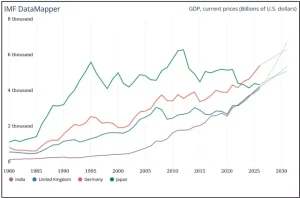
According to the latest World Economic Outlook (WEO) released by the International Monetary Fund (IMF), the Indian economy slid to 6th-largest in the world, with Japan, UK overtaking it.
- Earlier, India was ranked at 4th Position.
UPSC Online Coaching
More on News
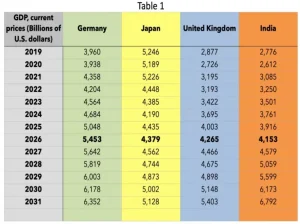
- According to the latest WEO, in 2026 India’s gross domestic product will be around $4.15 trillion (up from $3.92 trillion in 2025) while the UK’s GDP will be $4.27 trillion (up from $4 trillion in 2025) and Japan’s GDP would actually fall from $4.48 trillion in 2025 to $4.38 trillion in 2026.
- When the IMF calculates its rankings in US dollar terms, it uses two data points:
- One, a country’s GDP in the local currency and two, the exchange rate with the dollar to arrive at a dollar figure.
- On both these counts, India has suffered significant setbacks in the last twelve months.
Reasons For India’s Rank Slide
- GDP Estimates: India updated its GDP estimates with a new base in February 2026. The new GDP estimates essentially showed that the previous GDP series was overestimating India’s GDP.
- In rupee terms, India’s GDP for 2025-26 was rolled back from Rs 357 trillion (or lakh crore) to Rs 345 trillion.
- Depreciation of the Indian Rupee: The Indian rupee has significantly depreciated against the US dollar over the past year.
- A weaker rupee reduces the dollar value of India’s GDP even if real economic output remains unchanged.
- This exchange rate movement has therefore contributed to a lower dollar-denominated GDP.
- Relative Strength of the US Dollar: The US dollar itself has weakened against currencies such as the British pound and Japanese yen.
- This has made economies like the UK and Japan appear relatively larger in dollar terms.
- Consequently, the gap between India and these economies has widened in IMF rankings.
Policy & Strategic Implications for India’s Slide in Ranking
- Exchange Rate Stability: India needs to ensure stability in the rupee–dollar exchange rate to reduce volatility in GDP measured in dollar terms.
- A stable currency helps improve global investor confidence and reduces fluctuations in external trade valuation.
- It also prevents artificial distortions in India’s global economic ranking.
- Boosting Export Competitiveness: India must enhance export-led growth to strengthen its external sector.
- Focus should be on improving:
- Product quality and global standards
- Logistics efficiency and supply chain resilience
- Integration into global value chains
- A stronger export base reduces dependence on domestic demand cycles.
 Attracting FDI and Reducing External Vulnerability: India should focus on attracting stable and long-term Foreign Direct Investment (FDI).
-
- Key measures include:
- Ease of doing business reforms
- Policy predictability and regulatory stability
- Development of infrastructure and industrial corridors
- Higher FDI reduces reliance on volatile capital flows and strengthens external resilience.
- Strengthening Manufacturing Growth (Make in India): Expansion of manufacturing capacity is essential for sustainable growth.
- It helps in:
- Job creation and income generation
- Reducing import dependence
- Increasing export potential
- Initiatives like Make in India and Production Linked Incentive (PLI) schemes are critical drivers.
- Expanding Services Exports: India must further leverage its strength in the services sector.
- Key areas include:
- IT and software services
- Financial and business services
- Digital economy and knowledge-based exports
- Services exports provide high-value foreign exchange earnings and improve current account stability.
Click to Explore UPSC Offline Coaching
Conclusion
- India’s strategic focus should be on macroeconomic stability, export competitiveness, investment attraction, and sectoral diversification.
- These measures will strengthen India’s position not only in IMF rankings but also in real economic power and global influence.
 18 Apr 2026