The Supreme Court of India warned that it may deploy paramilitary forces to curb illegal sand mining in the National Chambal Gharial Sanctuary if states fail to act within a month.
- It directed Madhya Pradesh, Rajasthan, and Uttar Pradesh to take concrete measures to protect the ecologically fragile sanctuary.
Best Online Coaching for UPSC
Key Highlights of Supreme Court Guidelines
- Installation of CCTV Camera: Install high-resolution and Wi-Fi enabled CCTV cameras in areas affected by sand mining and ensure that live visuals from these cameras are fed directly to the offices of the district police chiefs and divisional forest officers.
- Use of GPS Devices: Madhya Pradesh and Rajasthan should initiate a pilot project to install GPS tracking devices on vehicles used for mining in Morena and Dholpur districts.
- The data from these devices must be accessible to the District Magistrates and the police.
- Vehicle Seizure: Any vehicle or machinery found involved in illegal mining must be seized immediately and all those involved prosecuted without delay.
- Joint Patrolling: The States have also been directed to constitute joint patrol teams in districts in and around the sanctuary.
- Policy & Legal Measures: Formulation of a uniform Standard Operating Procedure (SOP)
- SOP to address:
- Organized and violent mining activities
- Inter-state coordination
About Illegal Sand Mining
- It refers to the unauthorized extraction of sand from riverbeds, floodplains, coastal areas, and other ecosystems without regulatory approval.
- It often violates environmental norms, mining laws, and sustainable extraction limits.
- Policies and Regulations:
- Environment Protection Act (1986): Provides overarching safeguards for environmental protection.
- Environmental Impact Assessment (EIA) Notification (2016): Mandates District Survey Reports (DSRs) and replenishment studies for sustainable sand mining.
- Sustainable Sand Mining Management Guidelines (2016): Focus on scientific management and monitoring of sand mining practices.
Major Causes of Illegal Sand Mining
- High Demand from Construction Sector: Rapid urbanisation, infrastructure projects, and housing demand have led to exponential growth in sand consumption.
- Natural river sand is preferred due to its better quality for concrete, increasing pressure on riverbeds.
- Weak Enforcement of Mining Regulations: Despite laws, implementation remains poor due to lack of manpower and monitoring mechanisms. Illegal miners exploit loopholes in licensing and surveillance systems.
- Nexus Between Administration and Sand Mafias: A strong nexus between local officials, politicians, and mining mafias enables illegal activities to continue. Corruption leads to selective enforcement or deliberate inaction.
- Lack of Affordable Alternatives: Alternatives like manufactured sand (M-sand) are either not widely available or are perceived as costly. This leads to continued dependence on natural river sand.
- Poor Inter-State Coordination: Rivers often flow across multiple states, but lack of coordination leads to regulatory gaps. Illegal miners exploit jurisdictional confusion between states.
UPSC Coaching Classes
International Framework Associated with Sand Mining
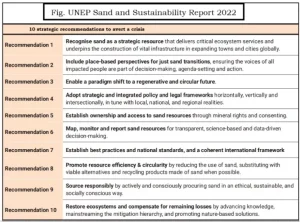
- United Nations Environment Programme (UNEP): UNEP highlights sand as a strategic natural resource and publishes global reports (e.g., Sand and Sustainability) advocating sustainable extraction and governance.
- United Nations General Assembly (UNGA): UNGA resolutions emphasise sustainable resource management and call for international cooperation to address environmental degradation, including sand mining.
- United Nations Sustainable Development Goals (SDGs): Sand mining is indirectly linked to SDGs such as:
- SDG 6 (Clean Water and Sanitation)
- SDG 12 (Responsible Consumption and Production)
- SDG 14 (Life Below Water)
- SDG 15 (Life on Land)
|
Indian Government Initiatives for Sustainable Sand Mining
- Mines and Minerals (Development and Regulation) Act, 1957 (MMDR Act):
- Sand is classified as a minor mineral, and regulation is largely under State Governments.
- The Act empowers states to frame rules for mining, transportation, and storage of sand.
- Sustainable Sand Mining Management Guidelines, 2016:
- Issued by the Ministry of Environment, Forest and Climate Change to ensure environmentally sustainable and scientific mining.
- Focus on river ecology protection, controlled extraction, and monitoring mechanisms.
- Enforcement and Monitoring Guidelines for Sand Mining, 2020 (EMGSM):
- Introduced to strengthen monitoring, surveillance, and curb illegal mining.
- Promotes use of technology such as satellite imagery and remote sensing for tracking mining activities.
- Sand Mining Framework (2022): Prepared by the Ministry of Mines in consultation with States.
- Aims to ensure sustainability, transparency, affordability, and availability of sand.
- District Survey Report (DSR): Mandatory identification of sand-bearing areas, replenishment rates, and environmentally sensitive zones before granting mining leases.
- Environmental Clearance Mechanism: Mining projects require clearance from the State Environment Impact Assessment Authority (SEIAA) based on scientific assessment.
- Ensures limits on extraction depth, quantity, and ecological safeguards.
Way Forward
- Strengthening Enforcement and Accountability: There is a need to enhance enforcement capacity of regulatory authorities through better manpower, training, and resources.
- Fixing clear accountability of officials will reduce administrative apathy and corruption.
 Technology-Driven Surveillance: Adoption of modern technology can ensure real-time monitoring and transparency. Tools such as:
-
- CCTV cameras in mining hotspots
- GPS tracking of transport vehicles
- Drones and satellite imagery
- Promotion of Sustainable Alternatives: Encouraging the use of manufactured sand (M-sand) and recycled construction materials can reduce pressure on natural sand.
- Community Participation and Local Monitoring: Involving local communities can act as an effective grassroots surveillance mechanism.
- Awareness campaigns can promote environmental stewardship.
- Enhancing Inter-State Coordination: Since rivers flow across states, there is a need for coordinated river basin management. States should develop uniform policies and joint enforcement mechanisms.
Click to Know UPSC OnlyIAS Coaching Centres
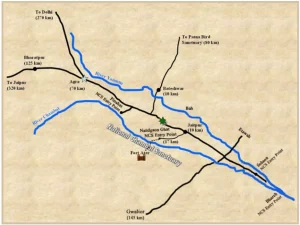
About National Chambal Sanctuary
- Established in 1979, it is the first and only tri-state protected area (Rajasthan, Madhya Pradesh, and Uttar Pradesh) in the country.
- Biodiversity: Harbors nearly 90% of the world’s remaining wild Gharial population and endangered Ganges River Dolphins.
- Other Important species are Marsh crocodile (mugger), Red-crowned roof turtle, Smooth-coated otter, striped hyena.
- The site is designated as an Important Bird Area (IBA), highlighting its significance for avian conservation.
- It has been proposed for inclusion under the Ramsar Convention and is also a candidate for UNESCO World Heritage Site status.
- Additionally, it is classified as an IUCN Category IV protected area, focusing on habitat and species management under the International Union for Conservation of Nature.
|
 18 Apr 2026