India is witnessing early and intense heatwaves in April 2026, with temperatures crossing 40°C in several states.
- The India Meteorological Department has issued heat alerts in central and south India, including in Vidarbha, Chhattisgarh, Odisha, Telangana and Kerala.
- Status of Heatwaves In India
- A World Bank report in November 2022 warned that by 2030, over 160-200 million people across India could be exposed to lethal heat waves annually.
UPSC Online Classes
About Heat Wave
- About: A Heat Wave is a period of abnormally high temperatures, more than the normal maximum temperature that occurs during the summer months from March to July usually in the North- Western belt of India.
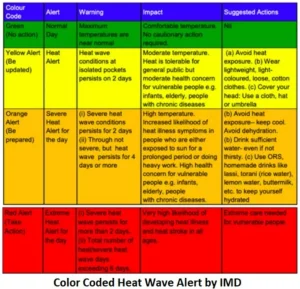
- Criteria by Indian Meteorological Department (IMD):
- Maximum Temperature Condition : A station should record at least 40°C for Plains and at least 30°C for Hilly regions
- a) Based on Departure from Normal
- Heat Wave: Departure from normal temperature is 4.5°C to 6.4°C
- Severe Heat Wave: Departure from normal temperature of the station is more than 6.4°C
- b) Based on Actual Maximum Temperature
- Heat Wave: When actual maximum temperature ≥ 45°C
- Severe Heat Wave: When actual maximum temperature ≥47°C
- If the above criteria met at least in 2 stations in a Meteorological sub-division for at least two consecutive days and it declared on the second day.
Government Initiative Regarding Heat Waves
- Climate Hazards and Vulnerability Atlas of India: The atlas provides a range of vulnerability with risks ranging from nil, low, moderate, high and very high categories for every Indian district with regards to major weather events.
- India’s Cooling Action Plan: It provides a long-term vision to address the cooling requirement of various sectors.
- Model Heat Action Plan: It has been released by the National Disaster Management Authority (NDMA) to provide hyperlocal warning systems, vulnerability mapping of cities, and climate-resilient housing policies.
|
How do Heatwaves are formed?
- Persistent high-pressure system: Sinking air compresses and warms, preventing cloud formation.
- Clear skies: Maximum solar radiation reaches the Earth’s surface, causing continuous heating.
- Dry soil conditions: Reduced evaporation lowers natural cooling and raises land temperature.
- Hot and dry winds: Winds like the loo intensify already high temperatures.
- Urban Heat Island effect: Concrete surfaces and low green cover make cities hotter than nearby rural areas.
- Climate change: Rising global temperatures increase the frequency and intensity of heatwaves.
Reason for Current Heat Waves/ High Temperatures (2026): The following primary factors are driving the current extreme heat:
- Increasing Intensity and Spread of Pre-Monsoon Heatwaves: Pre-monsoon heatwaves are a regular feature in India, but their frequency, duration, and spatial extent are increasing.
- They are now arriving earlier (April instead of May–June) and covering larger regions simultaneously.
- This trend reflects broader climate change patterns, leading to prolonged exposure to extreme heat and higher risks to health, agriculture, and livelihoods.
- El Niño Effect: Warming in the Pacific Ocean weakens the Indian monsoon, leading to higher temperatures.
- Weak Western Disturbances: The absence of winter and spring rainfall has removed a natural cooling effect.
- Weak Convective Currents: A lack of local air rising and condensing into clouds has prevented natural afternoon cooling.
- Urban Heat Islands: Concrete and asphalt in cities trap heat during the day and fail to release it at night, keeping urban areas hotter than surroundings.
- Wet Bulb Temperature: A deadly combination of high heat and high humidity that prevents sweat from evaporating, making even 35°C lethal.
UPSC Online Coaching
What are Heat Action Plans (HAPs)?
- Heat Action Plans are early warning and response strategies designed to reduce the impact of extreme heat on human health and livelihoods.
- They are implemented at city, district, and state levels.
- Guided by agencies like the National Disaster Management Authority and inputs from the India Meteorological Department.
- Key Components of HAPs
- Early Warning Systems: Heat alerts and forecasts
- Public Awareness Campaigns: Advisories on hydration, avoiding peak heat
- Health System Preparedness: Cooling centres, hospital readiness
- Inter-agency Coordination: Between health, labour, and disaster departments
Issues with Current Heat Action Plans (HAPs)
- Reactive Approach: Heat Action Plans largely adopt a reactive approach, focusing on short-term emergency measures such as alerts and advisories rather than long-term prevention.
- For Example: The Election Commission of India extended polling hours during elections to address heat exposure, reflecting a temporary adjustment instead of structural planning.
- Inadequate Funding: HAPs suffer from insufficient and non-dedicated funding, constraining long-term adaptation initiatives.
- Several cities lack funds for interventions like cool roofs, water stations, and urban greening.
- Neglect of Informal Workers: There is a lack of enforceable heat-safety regulations for workers in the informal sector, increasing their vulnerability.
- Construction and agricultural workers continue working during peak heat hours without legal protection or mandated rest periods.
- Lack of Urban Regreening: Cities like Delhi have lost significant green cover, worsening the Urban Heat Island effect.
Urban areas can be 4–7°C hotter than nearby rural regions due to lack of trees and green spaces.
- Weak Institutional Coordination: Multiple agencies (health, disaster management, urban bodies) work in silos, leading to poor implementation of HAPs.
- For example, lack of coordination between municipal bodies and health departments delays timely response during heatwaves.
- Limited Data and Early Warning Systems: Many cities lack localized, real-time heat data and ward-level risk mapping.
- This results in generalized advisories instead of targeted interventions for high-risk groups and areas.
Impacts of Rising Heatwaves in India
- Night-time Heat Stress and Healthcare Burden: Warmer nights also delay physiological recovery, increasing the local health-care burden.
- Coastal Vulnerability and Urban Heat Island Effect: Local conditions in coastal areas, in particular, could be worse due to humidity and the urban heat island effect.
- Increased Cardiovascular Mortality Risk: Persistently high heat is linked to a significantly higher risk of death from cardiovascular causes.
- Loss of Labour Productivity: Some 247 billion work-hours were lost in 2024 to heat, according to The Lancet Countdown Global Report, with workers in construction and agriculture the most affected.
- Agricultural Stress and Food Security Concerns: Heat stress is an ongoing concern for farmers during the rabi harvest. Hot weather accelerates crop maturity, threatening food security and feeding inflationary pressure.
Click to Know UPSC Offline Courses
Way Forward
- Columbia Coalition: India is encouraged to join this group of 50+ countries to access climate adaptation finance, technology transfer, and support for moving away from fossil fuels.
- Mobile Health Units: Deploy mobile clinics in heatwave-prone areas to provide on-site treatment for heatstroke, dehydration, and related illnesses
- Cities like Ahmedabad have used outreach vans during extreme heat to reduce hospital burden and avoid long travel for vulnerable groups.
- Urban Re-greening: Promote mandatory tree plantation, green roofs, cool roofs, and permeable pavements to reduce surface temperatures and the Urban Heat Island effect.
- Hyderabad has implemented cool roof programs, lowering indoor temperatures by 2–5°C in low-income housing.
- Heat-Safety Legislation: Enact laws mandating rest breaks, shaded worksites, access to water, and rescheduling of work hours during extreme heat.
- States like Odisha restrict outdoor work during peak afternoon hours, reducing heat-related illnesses among laborers.
- Early Warning Systems & Heat Alerts: Develop localized, real-time heat forecasts with ward-level alerts to warn people in advance.
- Incorporation of Nature-Based Solutions: There is a need to focus on integrating nature-based solutions such as strategic placement of green spaces and the development of blue infrastructure into HAPs to mitigate the impacts of extreme heat.
- Accountability and Transparency: Create an online national repository of HAPs that is regularly updated and tailored to regional needs to improve transparency and accountability in heatwave management.
 24 Apr 2026