The River Basin Management (RBM) Scheme promotes basin-level planning for sustainable water resource management and will continue to run from 2026–27 to 2030–31 with a ₹2183 crore fully government-funded outlay.
- In the previous phase, covering 2021–22 to 2025–26, the total budget allocation for the scheme was ₹1276 crore.
Best Online Coaching for UPSC
About River Basin Management (RBM) Scheme
- It is a comprehensive scheme for the management, protection, improvement, and sustainable use of water resources across river basins.
Key Features
- Aim: To facilitate integrated planning, investigation, and development of water resources at the river basin level, including both surface water and groundwater systems.
- Approach: It emphasizes integrated planning and development of water resources to ensure optimal utilization
- Nodal Ministry: Ministry of Jal Shakti.
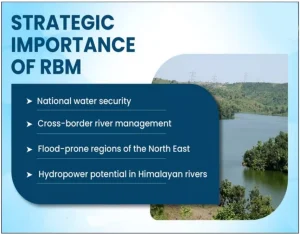
- Geographical Scope and Priority Areas: The RBM Scheme primarily focuses on strategically important and water-rich but underdeveloped regions, particularly:
- North Eastern Region river basins.
- Indus Basin in Jammu & Kashmir / Ladakh.
- Key basins such as Brahmaputra, Barak, Teesta, and Indus.
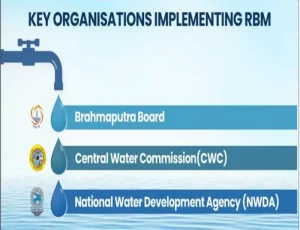
Duties of Brahmaputra Board
The Board undertakes:
- Anti-erosion works in critical areas (e.g., protection of Majuli Island and other vulnerable areas).
- Drainage development schemes.
- Construction of raised platforms in flood-prone areas.
- Development and Management of Water Resources for sustainable use. (Scientific dissemination of water management practices of indigenous people and Springshed management works).
- Capacity building in Water Resources Management/Development (Training of Officers of NER and Brahmaputra Board at NEHARI).
|
- Institutional Framework:
- Brahmaputra Board Component: The Brahmaputra Board plays a key role in basin-level planning and flood management in the North Eastern Region.
- Its major functions include:
- Surveys & investigations, and to formulate a Master Plan-
- Periodically revise, whether in whole or in part.
- For the control of floods, prevention of bank erosion, and improvement of drainage therein with due regard to the development and utilisation of water resources for irrigation, hydropower, navigation, and other beneficial purposes.
- Investigation of Water Resources Development Scheme (IWRDS): The IWRDS component is implemented through:
- Central Water Commission (CWC): Under the RBM Scheme, the Central Water Commission undertakes surveys, investigations, and preparation of Detailed Project Reports (DPRs) for water resource projects.
- National Water Development Agency (NWDA): The NWDA component focuses on water resource planning at the national level, particularly under the Interlinking of Rivers (ILR) programme.
Key Areas of Action
- Basin Planning: Basin planning forms the foundation of the framework and involves the preparation and periodic updating of river basin master plans.
- These plans provide a long-term roadmap for the development, utilization, and conservation of water resources within each basin.
 Survey and Investigation: Extensive survey and investigation work is undertaken to support informed decision-making.
 -
- This includes field investigations such as drilling and drifting operations, hydrological and topographical surveys, and the collection of primary and secondary data required for the preparation of master plans and Detailed Project Reports (DPRs).
- Project Development: Project development focuses on the preparation of DPRs for multipurpose water resource projects.
- It also includes planning for flood and erosion management, drainage development, and other initiatives to ensure systematic project implementation.
- Flood and Erosion Management: Specialized measures are implemented to reduce the impact of floods and riverbank erosion in vulnerable areas.
- These include anti-erosion works, flood control measures, and bio-engineering interventions aimed at protecting communities, infrastructure, and agricultural land.
- Drainage Development: Drainage development activities are carried out to improve water flow and address waterlogging in drainage-congested regions.
- These efforts help enhance land productivity and support better water management in both rural and urban areas.
- Community-Based Interventions: Community-based initiatives play an important role in strengthening local water management practices.
- These include promoting improved water use among local and tribal communities, along with activities such as spring shed management and the development of water bodies and basin ecosystems.
Click to Know UPSC Offline Courses
Progress and Milestones under RBM Scheme (2021-26)
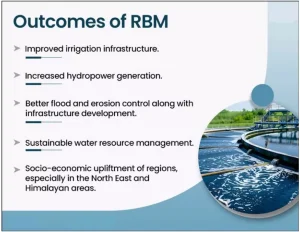
- Flood and Erosion Management (Brahmaputra Board)
- Implementation of anti-erosion and flood management works in vulnerable areas of the North East.
- Protection works undertaken in critical locations such as Majuli Island (Assam) along with other erosion-prone stretches of the Brahmaputra.
- Construction of raised platforms to provide shelter during floods.
- Community-Oriented Interventions:
- Implementation of spring shed management and water body development in hilly regions of the North East.
- Initiatives aimed at improving water availability and local water management practices among rural and tribal communities, and popularizing the best indigenous practices with scientific improvement.
- Strengthening Technical Capacity:
- Adoption of modern technologies in survey and planning, such as Geographic Information System (GIS) and remote sensing, Light Detection and Ranging (LiDAR) and drone-based surveys, and advanced hydrological modelling tools.
- Improved accuracy and efficiency in DPR preparation and basin studies.
 20 Apr 2026