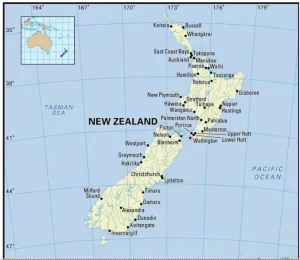
India and New Zealand signed a fast-tracked FTA in April 2026 to boost trade, investment, and mobility; it awaits ratification before coming into force.
Best Online Coaching for UPSC
Key Provisions of India–New Zealand FTA

- Tariff Liberalisation: New Zealand grants 100% duty-free access to Indian exports, while India liberalises ~95% imports but excludes sensitive sectors like dairy and agriculture.
- Investment Cooperation: The pact includes a $20 billion investment commitment over 15 years targeting infrastructure, manufacturing, startups, and renewables with accountability provisions.
- Services & Mobility: India gains access to 118 service sectors, 5,000 work visas annually, and extended post-study work rights of up to 3–4 years.
- Agriculture Safeguards: TRQs, MIP safeguards, and a Joint Agriculture Productivity Council balance limited market access with protection of domestic farmers.
- Trade Facilitation: Faster customs (24–48 hours), Sanitary and Phytosanitary Measures (SPS)/Technical Barriers to Trade (TBT) easing, and strict Rules of Origin ensure smoother, transparent, and secure trade flows.
About Free Trade Agreements (FTAs)
- Free Trade Agreements (FTAs) are treaties between two or more countries designed to reduce or eliminate barriers to trade in goods and services, such as tariffs, quotas, and non-tariff measures.
- These agreements facilitate easier market access, boost economic growth, protect intellectual property, and often include provisions for investment.
- Example: The U.S. maintains 14 FTAs with 20 countries, including agreements with Canada, Mexico, Australia, and South Korea.
Key Aspects of FTAs
- Purpose: To enhance trade by removing customs duties and reducing non-tariff barriers (e.g., technical regulations).
- Coverage: Frequently include goods (industrial/agricultural), services (banking, telecommunications), investment, and intellectual property rights.
- Rules of Origin: FTAs contain specific rules to determine which products qualify for preferential treatment, ensuring the benefits apply to signatory countries.
- Types: Can be bilateral (two countries) or multilateral/regional (multiple countries).
|
Significance of India–New Zealand FTA
- Boost to Exports & MSMEs: Zero-duty access enhances competitiveness in textiles, leather, engineering goods.
- Strengthens labour-intensive sectors and employment generation
- Strategic Indo-Pacific Engagement: Deepens ties with a developed economy in Oceania region
- Supports rules-based trade amid global uncertainty
- Integration with Global Value Chains: Cheaper inputs (e.g., coking coal, wood) reduce production costs
- Enhances India’s role in manufacturing and supply chains
- People-to-People & Knowledge Linkages: Promotes student mobility, skilled migration, cultural exchange
- Expands global footprint of AYUSH and traditional knowledge
Key India FTA/CEPA Countries & Blocs
- United Arab Emirates (UAE): Comprehensive Economic Partnership Agreement (CEPA) signed in May 2022.
- Australia: Economic Cooperation and Trade Agreement (ECTA) signed in December 2022.
- European Free Trade Association (EFTA) States (Iceland, Liechtenstein, Norway, Switzerland): Trade and Economic Partnership Agreement (TEPA) signed March 2024, entered into force Oct 2025.
- United Kingdom (UK): Comprehensive Economic and Trade Agreement (CETA) signed in July 2025.
- Oman: Comprehensive Economic Partnership Agreement (CEPA) signed in December 2025. New Zealand: Recently signed, creating a direct trade agreement.
- Mauritius: Comprehensive Economic Cooperation and Partnership Agreement (CECPA) signed in 2021.
- ASEAN Member States: Brunei, Cambodia, Indonesia, Laos, Malaysia, Myanmar, Philippines, Singapore, Thailand, Vietnam.
- Japan: Comprehensive Economic Partnership Agreement (CEPA).
- South Korea: Comprehensive Economic Partnership Agreement (CEPA).
- Singapore: Comprehensive Economic Cooperation Agreement (CECA).
- Sri Lanka: India-Sri Lanka FTA was operationalized on March 1, 2000 (India’s First FTA)
|
Click to Explore UPSC Offline Coaching
Conclusion
The FTA reflects India’s calibrated trade strategy—balancing market access, domestic protection, and global integration to advance growth under Viksit Bharat 2047.