India’s merchandise exports grew by nearly 14% in April 2026, reaching about $43.6 billion despite global trade disruptions.
- The growth reflects India’s efforts toward export diversification, market expansion, and supply-chain resilience.
Best Online Coaching for UPSC
Reasons for Growth in India’s Exports
- Enhanced Market Reach: The number of markets served by Indian exporters has increased. According to government data, at least 20 exporting sectors have added 17 or more new destinations in the last year.
- For example, handloom products are now exported to 29 more countries than in 2024-25.
 Growth Across Key Export Sectors: Several major sectors recorded strong export growth in April 2026, indicating the resilience of India’s production and supply chains.
-
- Key sectors include:
- Engineering goods
- Petroleum products
- Electronic goods
- Drugs and pharmaceuticals
- Organic and inorganic chemicals
- Rising Share of Services Exports: The services sector has become a major pillar of India’s export economy. Services now account for nearly 49% of India’s total exports. In comparison, the share stood at around 39% in 2014.
- Major Drivers of Services Exports
- IT and software services
- Business Process Outsourcing (BPO)
- Financial services
- Professional and consulting services
- Non-Oil Export Growth: India’s non-oil exports grew by nearly 9% to around $40 billion in April 2026, highlighting the strength and sustainability of India’s export sector beyond petroleum products.
Emerging Growth Drivers in India’s Export Economy
- Electronics Manufacturing: India is steadily evolving from a low-end assembly base into a major global manufacturing hub, benefiting significantly from the global “China Plus One” supply-chain diversification strategy.
- For Example: India’s smartphone exports reached a record $30 billion in CY2025, largely driven by Apple, helping total electronics exports cross the ₹4 trillion mark.
- Services Sector: India’s services sector has emerged as the key pillar of trade resilience, helping cushion merchandise trade deficits during periods of global economic uncertainty.
- The rapid expansion of Global Capability Centers (GCCs) in areas such as R&D, AI, and financial services is steadily strengthening India’s position in global knowledge-based exports.
- For instance, India’s services exports reached an all-time high of $387.6 billion in FY25, with January 2026 alone contributing nearly $43.9 billion, highlighting the growing strength of the country’s knowledge-based economy.
- Defence Exports: India is steadily transforming from a major defence importer into an emerging exporter of advanced military equipment through the push for Atmanirbhar Bharat and indigenous defence manufacturing.
- For example, India’s defence exports reached a record ₹23,622 crore ($2.8 billion) in FY24-25.
- India is also expanding its strategic defence exports through major deals involving the BrahMos missile system, with countries such as Vietnam and Indonesia showing interest following the successful agreement with the Philippines.
- Pharmaceutical Sector: India’s strong position as the “Pharmacy of the World” continues to boost exports of generic medicines, vaccines, and pharmaceutical products.
- Overall pharmaceutical exports rose 9.4% to $30.47 billion in FY25, crossing the $30 billion milestone.
- Engineering Goods: Rising exports of engineering products and industrial machinery reflect improving manufacturing capability and integration into global markets.
- For Example, Engineering goods exports surpassed the $10.40 billion mark in January 2026.
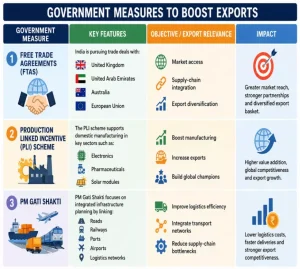
- Free Trade Agreements (FTAs): India’s expanding network of Free Trade Agreements is improving market access and supporting export diversification across regions.
- India and New Zealand signed a fast-tracked FTA in April 2026 to boost trade, investment, and mobility; it awaits ratification before coming into force
- Digital Economy and AI Services: Expansion of the digital economy, AI-enabled services, and knowledge-based industries is creating new opportunities in high-value service exports.
- Green and Sustainable Exports: Increasing global demand for renewable energy equipment, green technologies, and sustainable products is opening new export avenues for India.
- Global Supply Chain Diversification: The global “China Plus One” strategy is encouraging multinational companies to diversify supply chains, creating opportunities for India to emerge as an alternative manufacturing hub.
Challenges
- Emerging Concern: The rise of Artificial Intelligence could reduce India’s traditional comparative advantage in IT-enabled services by automating routine software and outsourcing work.
- High Logistics Cost: India’s logistics expenditure remains around 13–14% of GDP, which is significantly higher than major export competitors such as China, reducing overall export competitiveness.
- Poor Multimodal Transport Integration: Freight movement in India remains heavily dependent on road transport, while inadequate integration of railways, waterways, and ports increases transportation inefficiencies.
- For example, India’s freight movement is heavily skewed towards roads, which account for nearly 71% of cargo transport, while railways handle only about 18% and Inland Water Transport contributes a minimal 2%.
- By comparison, countries such as China make greater use of railways for moving bulk goods, which helps reduce logistics costs and improves export competitiveness.
- Port Inefficiencies: Delays in cargo handling, customs clearance, and port congestion increase turnaround time and raise transaction costs for exporters.
- High Inland Transportation Cost: Elevated inland freight and transportation costs increase the final price of Indian goods, reducing their competitiveness in international markets.
- MSME Credit Gap and Formalization Stress: MSMEs, despite being central to India’s exports, face a large credit shortfall that restricts scaling, technology adoption, and compliance with global quality standards.
- The MSME credit gap is currently estimated at around ₹30 lakh crore, while export credit for Indian MSMEs often carries interest rates 2–4% higher than those faced by their global competitors.
- Quality and Standards Issues: Indian exporters often face difficulties in meeting advanced international technical and quality standards due to inadequate testing and certification infrastructure.
- NTBs and Quality Compliance Challenges: Indian exporters face rising non-tariff barriers, especially strict Sanitary and Phytosanitary (SPS) measures norms in the US and EU, which often restrict market access for agri-products.
- Under the Harmonized System code HS04, which constitutes dairy products as well as eggs and honey, India faced 344 shipment rejections in the United States and Australia between 2010 and 2024.
- Dependence on Imported Inputs: Several sectors remain dependent on imported inputs such as electronic components, semiconductors, and crude oil, limiting domestic value addition and increasing supply-chain vulnerability.
UPSC Online Courses
Government of India’s Export Response Amid the West Asia Crisis to Boost Exports
- RELIEF Scheme for Exporters: The Centre launched the ₹497 crore RELIEF scheme — Resilience & Logistics Intervention for Export Facilitation — to support exporters affected by freight escalation, higher insurance premiums and war-related export risks in the Gulf–West Asia maritime corridor.
- Insurance and Risk Cover: Exporters are being supported through ECGC-linked risk coverage, especially for war-related risks and higher insurance costs. ECGC notes that freight rates on key routes rose nearly 90–100%, with MSME exporters facing the sharpest pressure.
- MSME Exporter Protection: The government has specifically targeted MSME exporters, as they have limited working-capital buffers and are more vulnerable to delayed payments, higher freight costs and insurance premium increases.
- Export Obligation Relief: The government has provided deadline flexibility and extensions for export obligations, reducing compliance pressure on exporters whose shipments are delayed due to regional conflict and shipping disruptions.
- Monitoring Through Inter-Ministerial Mechanism: The government has reviewed the crisis through an Inter-Ministerial Group of Ministers, focusing on energy supplies, essential commodities and supply-chain stability amid West Asia tensions.
- Trade Deficit and Import Management: To manage pressure on the rupee and the trade deficit, the government has also taken import-side measures such as raising duties on precious metals amid West Asia-linked volatility.
Way Forward
- Upgrading Digital and Technological Skills : To maintain its global competitiveness in the services sector, India must focus on:
- upgrading digital and technological skills,
- moving toward high-value innovation and advanced services,
- investing in AI-enabled industries and research,
- promoting innovation-driven service exports instead of relying primarily on low-cost outsourcing.
- Strengthen Export Promotion Mission: The Centre should fast-track the Export Promotion Mission as a single, outcome-based framework for export support. It has an approved outlay of ₹25,060 crore for FY 2025–26 to FY 2030–31, aimed at improving export competitiveness, especially for MSMEs, first-time exporters and labour-intensive sectors.
- Expand Affordable Export Credit: The government should improve access to low-cost and collateral-free trade finance, especially for MSMEs.
-
- The expanded Credit Guarantee Scheme for Exporters is expected to provide up to ₹20,000 crore in additional credit support, helping exporters manage liquidity and enter new markets.
- Reduce Logistics Cost Through PM Gati Shakti: The Centre should deepen the use of PM Gati Shakti and the National Logistics Policy to improve multimodal connectivity, reduce supply-chain bottlenecks and lower export transaction costs.
- Government sources note that these measures directly benefit MSME exporters by improving logistics efficiency.
- Support Manufacturing Through PLI Schemes: India should continue strengthening Production Linked Incentive schemes in export-oriented sectors.
- The PLI schemes have an outlay of ₹1.97 lakh crore across 14 key sectors, intended to promote large-scale manufacturing and enhance exports.
- Promote Districts as Export Hubs and E-Commerce Exports: The government should scale up Districts as Export Hubs and E-Commerce Export Hubs to bring MSMEs, artisans and local producers into global markets.
- E-Commerce Export Hubs aim to reduce logistics time and cost, simplify regulatory processes, support faster clearance and ease returns management.
- Improve Quality Standards and Global Branding: The Centre should strengthen India’s quality ecosystem through Quality Control Orders, testing infrastructure and BIS-aligned standards.
- Government data shows QCOs expanded from 14 orders covering 106 products in 2014 to 156 orders covering 672 products over the last decade, supporting the global reputation of Made in India products.
Conclusion
- India’s recent export growth demonstrates resilience and successful diversification efforts amid global uncertainty.
- However, sustaining long-term export growth requires structural reforms that improve cost efficiency, scale, product quality, and technological competitiveness.
- If India can combine diversification with stronger manufacturing and innovation capabilities, it can emerge as a major global trade contender.
Click to Know UPSC Coaching Centres in India
Export Strategy of Other Countries
- China: Manufacturing Scale and Value-Chain Upgradation
China’s export strategy focuses on large-scale manufacturing, industrial subsidies, technology acquisition, and movement into high-value sectors such as EVs, electronics, machinery, robotics and semiconductors. Its Made in China 2025 policy aimed to raise China’s competitiveness and global market share in advanced manufacturing.
- Vietnam: FTA-Led Market Access: Vietnam has used Free Trade Agreements, low-cost manufacturing, and export-oriented FDI to become a major hub for electronics, textiles, footwear and consumer goods.
- Its export roadmap stresses market diversification, expansion of Vietnamese goods in traditional markets and entry into new potential markets.
- Germany: Quality, Branding and Mittelstand Support: Germany’s export success is based on high-quality engineering, strong SME exporters known as Mittelstand, vocational skills, and active export promotion.
- The German government supports exporters through foreign trade fairs, market information, advisory services through chambers of commerce, and export credit guarantees known as Hermes Cover.
- South Korea: Strategic Sector Specialisation: South Korea focuses on globally competitive sectors such as semiconductors, automobiles, shipbuilding, batteries and electronics. Its trade ministry highlights cooperation and competitiveness in areas like AI, robotics, biotech, semiconductors, shipbuilding and energy security, showing a sector-specific export strategy.
- Japan: Technology and Brand Reliability: Japan’s export model is built around precision manufacturing, high R&D, product reliability and strong global brands.
- It focuses on sectors such as automobiles, machinery, electronics, robotics and high-end components, where quality and long-term trust help sustain export competitiveness.
- United States: Innovation-Driven Exports: The US export strategy relies on technology leadership, intellectual property, high-value services, defence exports, aerospace, software, pharmaceuticals and advanced manufacturing.
- Its competitiveness comes from strong universities, deep capital markets, R&D spending and global dominance in digital platforms.
- Singapore: Trade Hub and Logistics Excellence: Singapore has built its export competitiveness through world-class ports, efficient customs, low trade barriers, high-quality logistics and integration with global supply chains.
- Its strategy is not based on a large domestic market, but on becoming a re-export, finance, shipping and services hub.
- Bangladesh: Labour-Intensive Export Focus: Bangladesh has focused heavily on garments and textiles, using low labour costs, large-scale factory clusters and preferential market access.
- Its export strategy shows how sectoral concentration can generate rapid export growth, though it also creates dependence on a narrow export basket.
- Malaysia and Thailand: Global Value Chain Integration: These countries have used FDI, industrial parks, electronics clusters, automotive supply chains and ASEAN trade integration to enter global production networks. Their model shows the importance of linking domestic firms with multinational corporations.
|
 18 May 2026