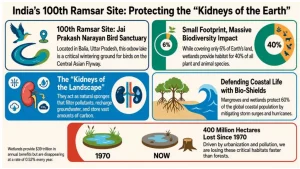
On World Environment Day 2026, India designated Jai Prakash Narayan Bird Sanctuary (Surha Tal) in Uttar Pradesh, as its 100th Ramsar Site.
About Surha Taal (Jai Prakash Narain Bird Sanctuary)
- Location: Located in Ballia district, Uttar Pradesh, in the middle Ganga basin.
- Wetland Type: A natural perennial oxbow lake formed from an abandoned meander of the Ganga River and fed by three freshwater channels.
- Functions as an important source of irrigation and groundwater recharge.
UPSC Coaching Classes
Oxbow Lake
- Formation: An oxbow lake is a crescent- or horseshoe-shaped water body formed when a river cuts off one of its meanders (loops) from the main channel.
- Characteristics: It is a detached water body that was once part of the river and may be permanent or seasonal depending on water supply.
- Ecological Importance: Functions as a valuable wetland ecosystem, supporting biodiversity, fisheries, groundwater recharge, and migratory birds.
|
- Formation: Created in 1991 by consolidating lands of 45 villages covering 3,432.93 hectares.
- Renamed Jai Prakash Narain Bird Sanctuary in 2002.
- Ecological Features: Characterised by floodplains, marshes, seasonally inundated areas, and agricultural wetlands.
- Serves as a key wintering habitat for migratory birds along the Central Asian Flyway (CAF).
What are Wetlands?
- Wetlands are areas where water is the primary factor controlling the environment and associated plant and animal life.
- Ramsar Convention Definition: Defined as areas of marsh, fen, peatland, or water (natural/artificial, permanent/temporary, fresh/brackish/saline), including marine waters up to 6 metres depth at low tide.
- Indian Definition: Under the Wetlands (Conservation and Management) Rules, 2017, wetlands exclude river channels, paddy fields, drinking-water tanks, aquaculture ponds, salt pans, and irrigation structures.
Ramsar Convention on Wetlands
- Origin: Adopted in 1971 at Ramsar, Iran and came into force in 1975; the first global treaty focused on a specific ecosystem.
- Three Pillars:
- Conservation of wetlands of international importance.
- Wise use of all wetlands.
- International cooperation on shared wetlands and migratory species.
- India and Ramsar: India joined the Convention in 1982, initially designating Chilika Lake and Keoladeo National Park.
 World Wetlands Day: Observed annually on 2 February to promote wetland conservation.
Significance of Wetlands
- Biodiversity Hotspots: Occupy only ~6% of Earth’s land area but support nearly 40% of all plant and animal species.
- Natural Flood Control: Act as natural sponges, absorbing excess rainfall and reducing flood risks.
- Water Purification: Known as the “Kidneys of the Landscape” because they filter pollutants and improve water quality.
- Climate Regulation: Function as important carbon sinks, storing carbon in soils and vegetation.
- Coastal Protection: Protect nearly 60% of the global population living near coastlines by buffering storm surges, cyclones, and tsunamis.
Click to Know UPSC OnlyIAS Coaching Centres
 6 Jun 2026