The Union Cabinet approved the Small Hydro Power Development Scheme (2026–31) to boost clean, decentralised energy and strengthen energy security in India.
Best Online Coaching for UPSC
About Small Hydro Power Development Scheme
- The scheme promotes small hydropower projects (1–25 MW) to enhance renewable energy capacity, especially in remote and hilly regions.
- Nodal Ministry: It is implemented by the Ministry of New and Renewable Energy, which oversees small hydropower development in India.
- Key Objectives
- To expand clean and reliable energy capacity
- To promote decentralised power generation in remote areas
- To support regional development and energy access
- Targets: The scheme aims to add ~1,500 MW capacity with a total outlay of ₹2,584.60 crore.
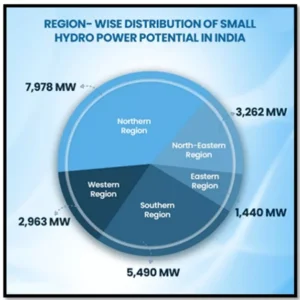
- India’s Potential for SHP: India has an estimated 21,133 MW potential across 7,000+ sites, with only about 5,171 MW harnessed (~24.5%).
- Northern Region (≈38%): Himachal Pradesh, Uttarakhand
- North-East (≈15%): Arunachal Pradesh dominates
Southern Region (≈26%): Karnataka leads
- This reflects a large untapped capacity, especially in hilly and remote areas.
- Implementation Mechanism
- Differential Financial Assistance: The scheme provides graded central financial support
- North-Eastern & Border districts: ₹3.6 crore/MW or 30% of project cost (max ₹30 crore/project)
- Other regions: ₹2.4 crore/MW or 20% of project cost (max ₹20 crore/project)
- Project Pipeline Development (DPR Support): A dedicated ₹30 crore allocation is provided to prepare Detailed Project Reports (DPRs) for at least 200 projects, ensuring a ready pipeline of bankable SHP projects.
- Leveraging Private Investment: The scheme is designed to crowd-in ~₹15,000 crore of private investment by reducing upfront risks and improving project feasibility through government support.
- Promotion of Indigenous Manufacturing: Encourages use of domestically manufactured turbines, equipment, and machinery, aligning with Atmanirbhar Bharat and strengthening supply chains.
- Employment Generation Focus: Expected to generate ~51 lakh person-days of employment, especially in construction, operation, and maintenance in rural and remote areas.
About Small Hydro Power Plants (SHP)
- Small Hydro Power plants generate electricity using natural water flow without large dams, typically with capacity up to 25 MW.
- Examples:
- Himachal Pradesh: Baspa-II Hydro Project (Baspa River)
- Uttarakhand: Maneri Bhali Project (Stage I & II) (Bhagirathi River)
- Karnataka: Shivanasamudra Hydro Plant (Kaveri River)
- Key Features
- Run-of-the-River Technology: Most SHP projects use natural river flow, minimising ecological disruption.
- Low Environmental Impact: They require limited land and cause minimal displacement, ensuring sustainability.
- Decentralised Generation: Plants are located near consumption centres, reducing transmission losses.
- Long Operational Life: SHP plants have high durability and low operating costs, making them economically viable.
- Significance of Small Hydro Power Plant
- Energy Security and Grid Stability: SHP provides reliable, round-the-clock power, unlike intermittent renewables like solar and wind.
- Rural and Regional Development: Improves electricity access in remote areas, supporting livelihoods and infrastructure.
- Environmentally Sustainable Energy: Generates power without emissions or fuel use, contributing to climate goals.
- Employment and Economic Growth: Creates jobs during construction and operation, promoting local economies.
Click to Know UPSC Offline Courses
Conclusion
Small hydropower offers a sustainable, decentralised energy solution that strengthens energy security, supports inclusive growth, and advances India’s clean energy transition.