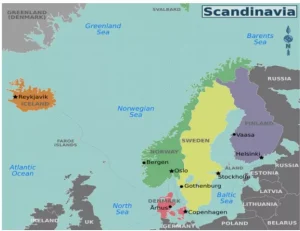
Recently, the 3rd India–Nordic Summit was held in Oslo, Norway with participation of India and leaders of Denmark, Norway, Finland, Iceland and Sweden.
- This Summit builds upon the previous two Summits held in Copenhagen in 2022 and Stockholm in 2018.
- The 4th India-Nordic Summit will be hosted by Finland.
- India’s PM attendance at the summit also marks the first visit by an Indian prime minister to Norway in 43 years, since Indira Gandhi in 1983.
- Referring to shared cultural connections, the Prime Minister noted that the word “Sambandh,” meaning relations, is common in Indian and Nordic languages, and expressed hope that this would reflect in deeper and more meaningful ties going forward.
Best Online Coaching for UPSC
Key Highlights of Summit
- Green Technology & Innovation Strategic Partnership: Leaders agreed to elevate India–Nordic ties into a “Trusted Green Technology and Innovation Strategic Partnership” in response to geopolitical uncertainty, economic transformation, and technological shifts.
- It will complement India’s similar partnerships with Denmark and Norway, drive cooperation in the blue economy and digital infrastructure, and open new avenues for collaboration in climate action, energy security and water management.
- Support for UN Reforms: The leaders emphasized strengthening multilateralism and reforming the United Nations Security Council (UNSC) to make it more representative, inclusive, and reflective of current geopolitical realities.
- Nordic Support for India in UNSC & NSG: Nordic countries reiterated support for India’s permanent membership in a reformed UNSC and welcomed India’s application to the Nuclear Suppliers Group (NSG).
- Commitment to WTO-Based Trade System: The Summit underlined the importance of the World Trade Organization (WTO) and supported a fair, transparent, inclusive, and rules-based multilateral trading system.
- India-EFTA TEPA & India-EU FTA: Leaders welcomed the implementation of the India-EFTA Trade and Economic Partnership Agreement (TEPA) and the conclusion of the India-EU Free Trade Agreement (FTA).
- EFTA countries aim to invest USD 100 billion in India and create 1 million direct jobs.
- Strengthening Connectivity: The leaders stressed improving connectivity between the Nordic region and the Indo-Pacific, including through the India-Middle East-Europe Economic Corridor (IMEC).
- Maritime Security Cooperation: Leaders agreed to deepen cooperation in maritime security, support a free and open Indo-Pacific, and address challenges like piracy, smuggling, IUU fishing, and maritime pollution.
- Cooperation will be strengthened under initiatives like MAHASAGAR (Mutual and Holistic Advancement for Security and Growth Across Regions) and the Indo-Pacific Oceans Initiative (IPOI).
- Climate Action & Sustainable Development: Leaders reaffirmed commitment to tackling climate change, biodiversity loss, and pollution under the Paris Agreement, UNFCCC, and Sustainable Development Goals (SDGs).
- Nordic countries appreciated India’s renewable energy commitments and emphasized climate finance, technology transfer, and capacity building for clean energy transitions.
- Cooperation in Green Technologies: Leaders agreed to accelerate cooperation in green hydrogen, carbon capture, low-emission technologies, and critical minerals.
- LeadIT 2.0 Expansion: The leaders welcomed expansion of LeadIT 2.0 (Leadership Group for Industry Transition) with Iceland joining the initiative.
- Promotion of Blue Economy: India and Nordic countries agreed to cooperate in developing a sustainable blue economy, including low-carbon shipping, shipbuilding, and ship recycling.
- Support for Hong Kong Convention: The leaders supported cooperation under the Hong Kong Convention for the Safe and Environmentally Sound Recycling of Ships.
- AI & Digitalization: Leaders emphasized inclusive and democratized access to Artificial Intelligence (AI), trusted computing infrastructure, and human-centric AI applications.
- The summit supported development of inclusive, transparent, rights-based, and safe AI governance frameworks and welcomed India’s hosting of the AI Impact Summit 2026 in New Delhi.
- Science and Technology: Leaders encouraged joint cooperation in STEM research, start-up ecosystems, innovation hubs, and deployment of 5G and 6G technologies.
- The summit welcomed the agreement between the Indian Space Research Organisation and the Norwegian Space Agency and supported a Swedish payload in India’s Venus Orbiter Mission.
- Arctic Cooperation: Leaders acknowledged growing links between the Arctic and the Indo-Pacific and supported collaboration in polar research, climate studies, and environmental protection.
- India’s Role in Arctic Council: Nordic leaders appreciated India’s constructive participation as an Observer in the Arctic Council.
- Defence Industrial Cooperation: Leaders highlighted increasing momentum in defence cooperation, including defence manufacturing, technology transfer, and investment opportunities in India’s Defence Industrial Corridors with 100% FDI provisions.
Challenges
- Geographical Distance and Connectivity Constraints: Large geographical separation and limited direct transport connectivity increase logistics costs and reduce business and people-to-people exchanges between India and Nordic countries.
- Limited Trade Volume and Economic Engagement: Despite growing cooperation, overall trade and investment levels between India and Nordic nations remain relatively modest compared to India’s engagement with larger European economies.
- Regulatory and Market Access Barriers: Differences in regulations, taxation systems, labor laws, and quality standards create hurdles for businesses and investors on both sides.
- Slow Progress in India–EU Free Trade Agreement: Delays in concluding the India–EU FTA indirectly affect India’s economic engagement with Nordic countries, especially in technology transfer, digital trade, and market access.
- Differences on Climate and Sustainability Standards: Nordic countries maintain very high environmental, labor, and sustainability standards, creating compliance challenges for some Indian industries and exporters.
- Limited Public and Strategic Awareness: India–Nordic relations still face low public visibility, limited academic engagement, and inadequate business awareness regarding mutual opportunities.
- Competition from Other Global Powers: Nordic countries maintain strong ties with major powers such as the United States, China, and leading EU economies, making India compete for greater strategic attention and investment flows.
Significance of 3rd India-Nordic Summit
- Need for Deeper India–Nordic Partnership: Amid global geopolitical flux, rapid economic transformation, and accelerating technological change, India and the Nordic countries agreed to deepen cooperation based on shared interests, shared democratic values, and collaboration in addressing global challenges.
- Pragmatic and Trust-Based Relations: India shares no historical baggage or major disputes with Nordic nations. Their partnership rests on a common commitment to democracy, multilateralism, and a rules-based international order, making the relationship largely pragmatic rather than ideological.
- Institutionalization of Strategic Ties: The summit reflects the growing institutionalization of partnerships between India and some of the world’s most innovation-driven and technologically advanced democracies during a period of deep global uncertainty.
- Strategic Diversification in a Fragmented World: In an era marked by global fragmentation, supply-chain disruptions, and intensifying great-power rivalries, India is expanding its strategic options through low-friction and practical partnerships capable of delivering economic and technological gains.
- Evolution of Indian Foreign Policy: The summit highlights India’s shift from a largely reactive foreign policy to one that is increasingly selective, interest-driven, and strategically diversified.
- Expansion of Multi-Alignment Strategy: India’s engagement with Nordic nations demonstrates that its multi-alignment strategy now goes beyond balancing major powers and increasingly focuses on building issue-based coalitions in areas such as technology, green growth, innovation, and resilient supply chains.
- Collective Engagement with the Nordic Region: By bringing together all five Nordic countries—Denmark, Finland, Iceland, Norway, and Sweden—India can engage the entire Nordic sub-region collectively rather than through isolated bilateral mechanisms.
UPSC Online Courses
India’s Engagement in Arctic
- India’s Connection with the Arctic: India does not share any land or maritime border with Arctic nations, yet it has maintained a long-standing engagement with the Arctic region.
- Svalbard Treaty, 1920: India signed the Svalbard Treaty in February 1920. Under this treaty, Norway has sovereignty over Svalbard, while signatory nations receive rights related to fishing, hunting, mining, commercial activities, and property ownership, including mineral rights.
- Benefits for India: The treaty has enabled India to undertake scientific research activities in the Arctic region.
- First Indian Arctic Expedition (2007): In 2007, India launched its first scientific expedition to study the Arctic region.
- Establishment of Himadri Research Station (2008): In 2008, India established its Arctic research station named Himadri.
- Deployment of IndARC Observatory (2014): In 2014, India deployed IndARC, its first underwater moored observatory, in Kongsfjorden at a depth of around 180–192 metres.
- Purpose of IndARC: IndARC studies the Arctic region’s climate system, ice melt patterns, and their impact on the Indian monsoon.
- India’s Strategic Interest in the Arctic: Beyond scientific research, India has increasingly sought to expand its strategic and economic footprint in the Arctic region.
- Importance of Arctic Resources: The Arctic is rich in natural gas, hydrocarbons, and critical mineral resources, making it strategically and economically important for India.
Arctic Council
- The Arctic Council is an intergovernmental forum which was established in 1996 to promote cooperation, coordination, and interaction among Arctic states and protect Indigenous communities and inhabitants.
- In 2013, India was granted observer status in the Arctic Council, which allowed the country to participate in Arctic policy discussions.
|
- Nordic Strengths in Critical Sectors: Nordic economies possess high levels of technological sophistication, political stability, and regulatory credibility, along with expertise in sectors crucial for India’s transformation, including green technologies, digitalization, advanced manufacturing, Artificial Intelligence (AI), circular economy models, and maritime innovation.
- Support for India’s Green Transition: Indian policymakers increasingly recognize that achieving a green economy transition requires access to trusted capital, advanced technologies, and strong innovation ecosystems.
- In this context, Nordic pension funds and technology partnerships hold significant strategic value.
- Arctic Cooperation and Strategic Relevance: As geopolitical competition intensifies over Arctic shipping routes, energy resources, and critical minerals, India’s role as an observer in the Arctic Council gains importance.
- Cooperation with Nordic nations offers both technical expertise and influence in shaping emerging Arctic governance structures.
- Europe and the Nordic Region in India’s Strategic Vision: Amid uncertainties in the policies of the United States and China, Europe is emerging as a major source of technology, investment capital, and regulatory influence in India’s strategic thinking.
- Within this framework, Nordic nations are viewed as key partners in achieving India’s Viksit Bharat vision.
Benefits from Nordic Countries for India
- Norway – Deep-Sea Mining and Maritime Expertise: Norway possesses advanced expertise in offshore engineering, deep-sea mining, shipping, and ocean resource management. This can support India’s ambitions in critical mineral exploration and the blue economy.
- Denmark – Critical Minerals and Green Shipping: Denmark offers indirect access to rare earth and critical mineral resources through its ties with Greenland.
- Denmark is also a global leader in wind energy, green ports, and sustainable maritime technologies.
- Sweden – Innovation, Defence and Advanced Manufacturing: Sweden is known for cutting-edge innovation in AI, 5G/6G, defence technologies, smart mobility, automation, and sustainable industrial systems. Swedish firms can support India’s digital and manufacturing transformation.
- Finland – Telecom, Cybersecurity and Education: Finland is a leader in telecommunications, semiconductors, cybersecurity, quantum technology, and digital governance.
- Finland’s world-renowned education and skilling models also provide valuable lessons for India.
- Iceland – Geothermal and Climate Resilience Expertise: Iceland has globally recognized expertise in geothermal energy, volcanic studies, and climate adaptation. India can use this knowledge for sustainable energy generation in Himalayan and tectonically active regions.
- Nordic Model – Sustainable Development and Governance: Nordic nations collectively offer best practices in welfare governance, gender equality, urban planning, circular economy, clean technology, and climate-resilient development, aligning with India’s sustainable growth objectives.
What India Has to Offer to Nordic Countries?
- Massive Consumer Market: India provides one of the world’s largest and fastest-growing consumer markets, creating major opportunities for Nordic companies in green technology, healthcare, telecom, mobility, and renewable energy sectors.
- Skilled Human Capital and IT Strength: India offers a vast pool of engineers, IT professionals, startup talent, and research manpower, supporting Nordic innovation ecosystems and addressing skill shortages in Europe.
- Manufacturing and Supply Chain Diversification: India’s initiatives such as “Make in India” and Production-Linked Incentive (PLI) schemes make it an attractive alternative manufacturing and supply-chain hub amid global overdependence on China.
- Strategic Indo-Pacific Partner: India is viewed as a stable and trusted democratic partner in the Indo-Pacific region. Its strategic autonomy and growing geopolitical role make it important for Nordic countries seeking diversified partnerships in Asia.
- Green Energy Transition Opportunities: India’s ambitious renewable energy targets, green hydrogen mission, electric mobility push, and climate initiatives create significant investment and technology collaboration opportunities for Nordic firms.
- Research, Innovation and Startup Collaboration: India’s rapidly expanding startup ecosystem, digital public infrastructure, and research institutions provide opportunities for joint innovation in AI, fintech, biotech, semiconductors, health-tech, and smart infrastructure.
Click to Explore UPSC Offline Coaching
Areas of Cooperation: India- Nordic
- Bilateral Trade: Bilateral trade between India and the Nordic region has reached nearly $19 billion, while more than 700 Nordic firms already operate in India.
- The implementation of the India-EFTA Trade and Economic Partnership Agreement in 2025 has further expanded the scope for investment and technology flows, particularly from Norway and Iceland.
- Green Technology and Clean Energy Cooperation: India and the Nordic countries have elevated their ties to a “Green Technology and Innovation Strategic Partnership,” focusing on renewable energy, green hydrogen, carbon capture, sustainable urban solutions, and energy transition initiatives.
- Digital Technology, AI and 6G Research: India and Nordic nations are cooperating in advanced digital infrastructure, including AI, 5G/6G technologies, cybersecurity, telecom innovation, and trusted digital systems. Joint STEM research and startup collaboration are also being promoted.
- Blue Economy and Maritime Cooperation: The partnership includes collaboration in sustainable shipping, fisheries, offshore renewable energy, maritime infrastructure, ocean governance, and Indo-Pacific maritime cooperation.
- Arctic and Polar Research: India, as an observer in the Arctic Council, is expanding cooperation with Nordic countries in polar research, climate science, environmental monitoring, and Arctic governance.
- Defence and Security Cooperation: India and Nordic countries are deepening cooperation in defence manufacturing, defence technology, cybersecurity, maritime security, and industrial partnerships, including opportunities under India’s defence corridors and FDI framework.
- Space Cooperation and Innovation: Cooperation has expanded in peaceful uses of outer space through partnerships involving Indian Space Research Organisation and Nordic space agencies, including satellite payloads, space research, and private-sector innovation.
- Education, Research and Mobility: India and Nordic nations are promoting academic exchanges, joint research in STEM fields, innovation ecosystems, student mobility, and collaboration among startups and incubators.
Conclusion
- The India-Nordic Summit reveals the deeper priorities shaping Indian foreign policy: economic statecraft, technological self-strengthening, diversification of partnerships and engagement with emerging strategic domains.
- It is indicative that contemporary diplomacy is no longer only about managing crises or balancing power; it is equally about building resilience in technology, energy and supply chains.
Click to Know UPSC OnlyIAS Coaching Centres
Nordic Countries vis – i – vis Scandinavian Countries
| Basis |
Nordic Countries |
Scandinavian Countries |
| Meaning |
Broader regional grouping of Northern European countries |
Narrower cultural-geographical grouping |
| Countries Included |
Denmark, Finland, Iceland, Norway, Sweden |
Denmark, Norway, Sweden |
| Language Group |
Includes North Germanic and Finno-Ugric languages |
Mainly North Germanic (Scandinavian) languages |
| Geographical Scope |
Covers entire Nordic region including North Atlantic islands |
Primarily the Scandinavian Peninsula and Denmark |
| Political Cooperation |
Cooperate through the Nordic Council |
No exclusive Scandinavian political institution |
| Associated Territories |
Includes Greenland, Faroe Islands, and Åland Islands |
Usually does not include these territories |
| Usage |
Used in political, economic, and regional cooperation contexts |
Used mainly in cultural, linguistic, and historical contexts |
| Key Features |
Strong welfare states and high living standards; advanced green technology and sustainability practices; high levels of innovation and digital development; strong democratic governance and gender equality |
Known mainly for shared Scandinavian cultural and linguistic heritage |