Recently, the Union Health Minister launched the nationwide campaign “10 Years of PMSMA – A Decade of Care” in New Delhi to celebrate ten years of the Pradhan Mantri Surakshit Matritva Abhiyan (PMSMA).
UPSC Online Courses
To mark a decade of care on June 9, 2026, the government is rolling out major national activities:
- Ayushman Arogya Shivirs: Special health camps are providing quality checkups across 1.8 lakh (180,000) Ayushman Aarogya Mandirs nationwide.
 Commemorative Coin & Stamp: The government will release a special 75 rupees commemorative coin and a five rupees postal stamp to mark the 10th anniversary.
- Special Hospital Sessions: Special healthcare drives are being held today at all District Hospitals and First Referral Units (FRUs) to re-engage women who dropped out of regular checkups.
About PMSMA & Extended PMSMA: (UPSC CSE Prelims 2024)
Launched in 2016 by the Ministry of Health and Family Welfare, PMSMA aims to provide free and quality antenatal care to pregnant women across India.
- The Core PMSMA Scheme:
- The 9th of the Month Rule: Conducted on the 9th day of every month across designated government health facilities, the program provides fixed-day, assured, and completely free Antenatal Care (ANC) to pregnant women in their second and third trimesters.
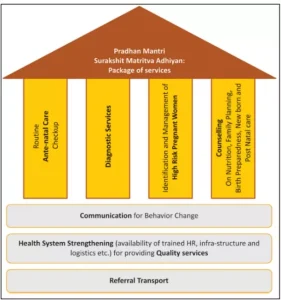
- The Care Package: It uses a single-window system to deliver a bundle of services: clinical examinations by specialists, crucial laboratory tests (blood and urine), ultrasound scans (ultrasonography), free medicines, and specific counseling for birth preparedness.
 Public-Private Partnership: Private obstetricians, gynecologists, and radiologists voluntarily commit 12 days a year to treat patients at government facilities, with top contributors recognized via the ‘IPledgeFor9’ Achievers Awards.
- Objectives: The PMSMA aligns with the broader goals of the Reproductive, Maternal, Newborn, Child, and Adolescent Health plus Nutrition (RMNCAH+N) strategy under the National Health Mission (NHM).
- Ensuring that every pregnant woman receives at least one check-up by a physician/specialist during the second or third trimester.
- Improve the quality of care during antenatal visits.
- Identifying and managing high-risk pregnancies (HRP) at an early stage.
- Appropriate birth planning and complication readiness for each pregnant woman.
- Ensuring appropriate management of women with malnutrition.
- Special focus on adolescent and early pregnancies.
- Key Features:
- Monthly antenatal checkups on the 9th of every month at public health facilities.
 Services provided by OBGY specialists, radiologists, physicians, with private sector support.
- Minimum package for every woman: essential investigations (including 2nd trimester ultrasound) and medicines (IFA, calcium).
- Single window system for all ANC services and investigations.
- Special focus on:
- Unregistered or missed ANC women
- Dropouts
- High-risk pregnancies
 Distribution of Mother and Child Protection Cards and safe motherhood booklets.
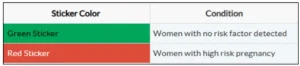
- High-Risk Tracking via Color Stickers: To intercept emergencies early, doctors screen for 25 distinct high-risk factors (such as severe anemia, gestational diabetes, or pregnancy-induced hypertension).
- Healthcare workers paste corresponding color-coded stickers onto the patient’s Mother and Child Protection (MCP) card:
| Sticker Color |
Clinical Classification |
| 🟢 Green Sticker |
Normal pregnancy with no risk factors detected. |
| 🔴 Red Sticker |
High-Risk Pregnancy (HRP) requires strict monitoring. |
| 🔵 Blue Sticker |
Pregnancy complicated by hypertension (high blood pressure). |
| 🟡 Yellow Sticker |
Pregnancy co-existing with other diseases like hypothyroidism or malaria. |
- Extended PMSMA (Launched 2022):
- Dedicated Follow-Up Tracking: Introduced to protect high-risk cases between the monthly sessions, it guarantees additional, specialized ANC visits and continuous tracking for every red-sticker patient until safe delivery.
- Financial Incentives: Provides ₹100 per visit to the beneficiary to offset travel expenses for up to three extra follow-up visits. ASHA workers receive ₹100 per visit for tracking and an additional ₹500 upon ensuring a healthy outcome for both mother and child 45 days post-delivery.
- Digital Alerts: Sends automated SMS reminders to both the patient and their local ASHA worker regarding upcoming clinic dates.
- Key features of E-PMSMA are:
- Name-based line listing of HRPs.
- Provision of additional PMSMA Session (Max 4 times in a month).
- Individual tracking of HRP up to a healthy outcome (till 45th day after delivery).
- SMS alert to beneficiary as well as to the ASHA for registration of HRP & follow-up visits.
Current Coverage & Achievements
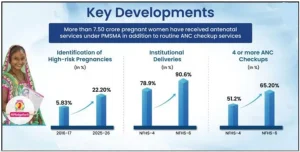
- Massive Beneficiary Base: Over its 10-year journey, the scheme has successfully provided free, comprehensive antenatal services to more than 7.50 crore (75 million) pregnant women across the country, in addition to routine ANC checkups.
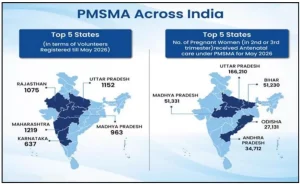 Wider Institutional Footprint: Quality antenatal care services under the scheme are now deeply decentralized and actively delivered through a vast network, including 1.8 lakh Ayushman Aarogya Mandirs across India.
 -
- Special sessions are systematically held at all District Hospitals, Sub-District Hospitals, and designated First Referral Units (FRUs).
- Early High-Risk Detection: Millions of high-risk pregnancies (HRPs) have been successfully identified through screening for 25 risk factors, allowing healthcare providers to line-list and link vulnerable mothers to specialized care before onset of labor.
- Successful Public-Private Mobilization: Thousands of private sector obstetricians, gynecologists, and radiologists have signed up to volunteer, bridging crucial specialist gaps in underserved rural government health centers.
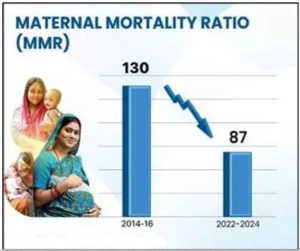
- Direct Impact on National Indicators: By transforming random checkups into a predictable, structured care package, the scheme has acted as a primary driver behind India’s 43-point reduction in the Maternal Mortality Ratio (MMR), which fell from 130 per lakh live births (2014–16) to 87 per lakh live births (2022–24).
UPSC Coaching Classes
Why Maternal Health Matters & What is MMR?
- A Nation’s Foundation: Ensuring a safe pregnancy and healthy childbirth is fundamental to public health.
 Unmanaged gestational complications place severe stress on rural health structures and endanger lives.
- Maternal Mortality Ratio (MMR): This is the official statistical measure representing the number of maternal deaths per 1 lakh (100,000) live births due to pregnancy-related or childbirth causes.
- The Baseline Challenge: In the 2014–16 baseline period, India recorded a high MMR of 130 deaths per lakh live births. This drove national urgency to establish structured medical care to meet the UN Sustainable Development Goal (SDG) target of reducing global MMR to under 70 by 2030.
- Documented Progress: Between the 2014–16 baseline and the recent 2022–24 reporting period, India achieved a 43-point reduction in MMR, successfully bringing the ratio down from 130 to 87.
Working with Other Health Schemes
PMSMA is integrated into the broader Reproductive, Maternal, Newborn, Child and Adolescent Health (RMNCH+A) strategy:
- Janani Suraksha Yojana (JSY): A safe motherhood intervention providing cash incentives to encourage institutional deliveries, benefiting over 11.96 crore women. (UPSC CSE Prelims 2012)
- Janani Shishu Suraksha Karyakram (JSSK): Entitles pregnant women and sick infants to 100% free drugs, diagnostics, diet, and transport to drop financial out-of-pocket expenses to zero. It has supported over 18.05 crore beneficiaries.
- SUMAN Initiative: The Surakshit Matritva Aashwasan scheme guarantees zero-tolerance for service denial, providing assured quality care across a network of over 99,290 public facilities.
- LaQshya & PMMVY: The LaQshya initiative improves the quality of care in labor rooms and maternity operation theatres, while the Pradhan Mantri Matru Vandana Yojana (PMMVY) provides direct cash transfers for partial wage compensation and nutrition.
Key Challenges in Implementation
- Regional Inequalities in Maternal Health: States such as Assam, Madhya Pradesh, and Uttar Pradesh continue to report higher maternal mortality due to geographical barriers, poverty, and weaker healthcare infrastructure.
- Shortage of Medical Specialists: Many rural Primary Health Centres (PHCs) and Community Health Centres (CHCs) lack sufficient obstetricians, pediatricians, and anesthesiologists needed for emergency maternal care.
- Unexpected Pregnancy Complications: Some women initially categorized as low-risk pregnancies later develop sudden complications, showing the limitations of monthly checkup-based monitoring.
- Last-Mile Transport Problems: Delays in transporting pregnant women from remote or tribal areas to higher healthcare centers remain a major cause of preventable maternal deaths.
- Uneven Awareness and Follow-Up: In some regions, lack of awareness, poor nutrition, social barriers, and irregular follow-up visits reduce the effectiveness of the scheme.
Way Forward
- Continuous Digital Monitoring: Shift from only monthly checkups to real-time digital tracking of high-risk pregnancies through mobile applications and cloud-based health records.
- Better Specialist Distribution: Strengthen First Referral Units (FRUs) and rural hospitals by improving deployment of trained gynecologists, pediatricians, and anesthesiologists.
- Dynamic Risk Screening: Train Auxiliary Nurse Midwives (ANMs) and ASHA workers to conduct more frequent community-level screening so rapidly developing complications are detected early.
- Improved Emergency Transport: Integrate ambulance systems with GPS-based tracking and village-level ASHA networks to reduce delays during emergencies.
- Greater Community Awareness: Expand awareness campaigns on nutrition, institutional delivery, regular antenatal care, and danger signs during pregnancy, especially in vulnerable regions.
Click to Know UPSC Coaching Centres in India
Conclusion
The Pradhan Mantri Surakshit Matritva Abhiyan (PMSMA) has significantly improved maternal healthcare through regular risk screening and institutional care. Strengthening digital monitoring, specialist availability, and rural healthcare access is essential for achieving safe and universal motherhood across India.
 10 Jun 2026