Nepal Foreign Minister Shishir Khanal during his India visit emphasised resolving the India–Nepal boundary dispute through diplomatic dialogue and existing bilateral mechanisms.
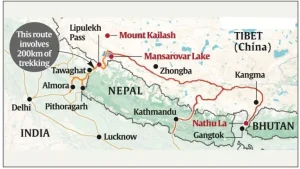
- The remarks come amid renewed discussion over the Kalapani–Lipulekh–Limpiyadhura border dispute and Nepal’s evolving political landscape.
| Area |
Issue |
| Kalapani |
India administers the region; Nepal claims it as part of its territory |
| Lipulekh Pass |
Nepal objects to India-China trade and Kailash Mansarovar route through this area |
| Limpiyadhura |
Nepal claims it as the source of the Kali River and part of its territory |
Best Online Coaching for UPSC
Key Outcomes of Visit
- Digital Payment Integration: India and Nepal launched the Peer-to-Peer (P2P) linkage between India’s UPI and Nepal’s NPI to enable faster and smoother cross-border personal remittances.
- Digital Technology Cooperation: Digital India Bhashini and Kathmandu University signed an MoU to develop a “Voice First” language translation platform for digital inclusion.
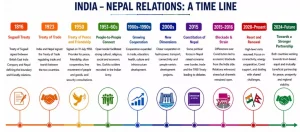
Various Facets of India- Nepal Relation
- Economic: Nepal exports Hydroelectric power, resin, agricultural produce, yarn, pashmina shawls, hide and skins, handicrafts items, silver and gold jewellery and other items to India.
- While Nepal imports petroleum products, Chemical fertilizers, salt, sugar, rice, vehicles, copper, cotton and other items from India.
- People to People Ties: About 80 lakh Nepalese citizens live and work in India, and around 6 lakh Indians live in Nepal.
- Remittance: The bilateral remittance flow is estimated at about US$ 3 billion (Nepal to India) and $ 1 billion (India to Nepal).
- Historical and Cultural Linkages: India and Nepal share centuries-old civilisational ties based on common religion, culture and traditions, reflected through pilgrimage links such as Pashupatinath–Kashi and the open movement of people across the border.
- Migration and Labour Relations: Around 80 lakh Nepalese citizens live and work in India, while around 6 lakh Indians reside in Nepal, supported by the unique open-border arrangement under the 1950 India–Nepal Treaty of Peace and Friendship.
- Tourism Cooperation: India is a major source of tourists for Nepal, with Indians contributing nearly 30% of foreign tourist arrivals, especially due to religious tourism linked to sites like Pashupatinath Temple and Lumbini.
- Energy Cooperation: India and Nepal are expanding cooperation in hydropower and electricity trade, with India importing electricity from Nepal and supporting Nepal’s potential as a regional energy hub.
- Strategic and Security Cooperation: The shared 1,800 km open border creates strong security cooperation but also requires coordination on issues such as smuggling, illegal activities and border management.
- Connectivity and Infrastructure Cooperation: India has supported Nepal through projects such as cross-border railway links, integrated check posts, petroleum pipelines and road connectivity to improve regional integration.
- Defence Cooperation: India and Nepal share long-standing military ties, including the tradition of awarding honorary ranks to each other’s army chiefs and recruitment of Nepalese citizens into the Gorkha regiments of the Indian Army.
Challenge
- Strategic and Geopolitical Challenges:
- India–China Competition: Nepal’s location between India and China has created a geopolitical balancing challenge for Kathmandu.
- China Factor: Nepal has increased engagement with China through infrastructure and connectivity projects, sometimes using the China factor in its relations with India.
- Growing External Influence: The increasing involvement of the US and other powers has added complexity to Nepal’s strategic environment.
- Boundary Dispute and Territorial Claims: The India–Nepal boundary was defined through the Treaty of Sugauli (1816), with India inheriting British-administered territories after independence; however, disputes remain over Kalapani and Susta despite 98% boundary demarcation.
- In 2019, Nepal released a new political map claiming Kalapani, Limpiyadhura, Lipulekh and Susta as its territory, creating diplomatic tensions with India.
- Concerns over 1950 Peace and Friendship Treaty: The 1950 Treaty provides free movement and employment rights to Nepalese citizens in India, but is increasingly viewed in Nepal as an unequal agreement requiring revision.
- Since the mid-1990s, both countries have discussed updating the treaty through bilateral mechanisms, but no major revision has been completed.
- Security Concerns: The porous and lightly monitored India–Nepal border is exploited by insurgent and terrorist groups to facilitate movement of weapons, trained cadres and counterfeit currency.
- Such cross-border activities, particularly involving groups operating in India’s Northeast, create serious internal security challenges for India and require greater coordination between both countries.
Reasons Behind Nepal’s Growing Proximity with China
- Perception of Indian Policy Approach: Nepal has often perceived India’s approach as intrusive or unequal due to issues related to river treaties, border disputes, trade disruptions, inundation concerns and border force behaviour.
- Open Border Concerns: Although the open border promotes people-to-people ties, it has also created concerns in Nepal regarding security, migration and perceived economic imbalance.
- Economic Dependence on India: Nepal’s heavy dependence on India for trade and transit has limited its economic diversification, while competition from cheaper Indian goods has affected Nepalese industries.
- Delay in Indian Projects: Slow implementation of some India-backed projects in Nepal, such as the Mahakali Treaty-related projects, has increased dissatisfaction compared to China’s faster infrastructure execution.
- Attraction of Chinese Investments: Nepal sees Chinese connectivity projects, including rail links, as opportunities to boost tourism, trade and infrastructure development, such as bringing more visitors to Lumbini.
- Political and Ideological Factors: Nepal’s communist parties have traditionally favoured closer ties with China and criticised Indian influence, while sections of other political groups have also supported greater engagement with Beijing.
UPSC Online Coaching
Way Forward
- Diplomatic Resolution: India and Nepal should continue dialogue through established mechanisms such as Foreign Secretary-level talks and boundary working groups to find a mutually acceptable solution.
- Evidence-Based Approach: The boundary issue should be resolved using historical documents, treaty records, and modern surveying technology rather than political narratives.
- Preserve Special Relationship: Both countries must ensure that boundary differences do not overshadow broader cooperation in trade, security, and people-to-people relations.
- Confidence Building Measures: India and Nepal should strengthen cross-border cooperation, trade connectivity, and joint development projects to enhance mutual trust.
- Avoid Nationalistic Escalation: Territorial disputes should not become tools for domestic political mobilisation, as they can damage long-term bilateral relations.
- Strengthening Institutional Mechanisms: India and Nepal should improve existing bilateral institutions for regular consultations, ensuring that disputes are addressed early through structured dialogue rather than political escalation.
- Connectivity and Energy Cooperation: Both countries should expand cross-border infrastructure, hydropower projects, and transport networks to deepen economic interdependence and create shared benefits.
- Respect for Sovereignty and Mutual Sensitivity: India and Nepal should respect each other’s security concerns and sovereign interests while avoiding actions that create mistrust and strain the traditionally close relationship.
Click to Know UPSC Offline Courses
India–Nepal Treaty of Peace and Friendship (1950)
- Signed on 31 July 1950, the treaty provides the foundation of modern India–Nepal relations by promoting peace, friendship, and cooperation.
- It allows free movement of people and goods, provides for mutual security consultation, and facilitates close economic and social ties between the two countries.
- Significance: The treaty reflects the deep historical relationship between India and Nepal but has also become a subject of debate in Nepal, where some groups argue that certain provisions should be revised to ensure greater equality and sovereignty.
Changing Political Dynamics in Nepal
Emerging Trends
Nepal’s new generation of leadership is focusing more on:
- Development
- Economic growth
- Governance reforms
- Reducing corruption and political instability
Changing India–Nepal Equation
Nepal increasingly seeks:
- Equal treatment in relations with India.
- A relationship based on mutual respect rather than traditional dependency.
This reflects Nepal’s desire for a more balanced foreign policy involving multiple partners. |
 10 Jun 2026