US Section 301 Tariffs on India: Forced Labour Concerns and Trade Implications

8 Jun 2026

US Section 301 Tariffs on India: Forced Labour Concerns and Trade Implications

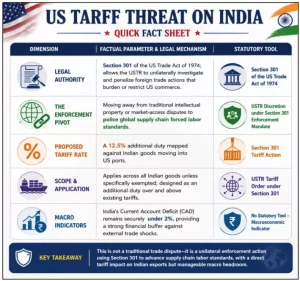
The US Trade Representative (USTR) proposed an additional 12.5% tariff on India under Section 301 over forced-labor concerns. 

The US has launched two Section 301 investigations against India:

  • One for not restricting imports of products allegedly produced through forced labour.
  • Another related to excess capacity.

Excess capacity refers to a situation where a business produces below its maximum possible output — the gap between a company’s full production capacity and its actual production and sales.
UPSC Coaching Classes

About US Section 301

US Section 301

  • Refers: Enacted under the US Trade Act of 1974, Section 301 grants the United States Trade Representative (USTR) broad authority to investigate and unilaterally respond to foreign regulatory practices deemed unjust, discriminatory, or burdensome to US commerce.
  • The Judicial Shift: Following a US Supreme Court ruling (February 2026) that struck down broad emergency tariffs under the International Emergency Economic Powers Act (IEEPA), the US administration has increasingly turned to Section 301 as a primary trade enforcement mechanism.
  • Targeting Global Supply Chains: Traditionally used to resolve direct market-access friction or Intellectual Property Rights (IPR) violations, recent Section 301 actions represent a modern pivot toward enforcing cross-border labor compliance and supply chain due diligence.

Core Mechanics of the US Section 301 Actions

  • The Enforcement Trigger: The USTR initiated this round of Section 301 tariffs after declaring that India and 53 other nations lack explicit, sweeping legal bans on importing goods produced via forced labor.
  • A Congressional Constraint: The US administration is using Section 301 because the US Congress is unlikely to pass broad reciprocal tariff laws due to constitutional and political limits.
  • Parallel Trade Talks: At the same time, India and the US are trying to finalize a major bilateral trade agreement, even as these punitive tariff proposals are being discussed.

Key Structural Challenges

  • Export Vulnerability: If the 12.5% tariff surcharge goes into effect, it will directly hit the pricing and competitive edge of India’s core, labor-intensive export sectors in Western markets.
  • Inward-Looking Corporate Mindset: A persistent internal bottleneck is that Indian banks and large corporations remain too content with a large domestic market, showing hesitation in taking services like UPI international.

Way Forward

  • Leveraging Strong Macro Buffers: India should comfortably utilize its robust foreign exchange reserves and a stable Current Account Deficit (CAD) of under 2% to ensure completely unrestricted capital and outbound investment flows.
  • Pushing Corporate Diversification: The government must push corporate India to step out of its comfort zone and actively capture global market shares in competitive international sectors like engineering, jewelry, education, and financial services.
  • Securing Structural Carve-Outs: During USTR Jamieson Greer’s upcoming visit to New Delhi, Indian negotiators must tie the conclusion of the mid-July interim trade deal to explicit relief or exemptions from unilateral Section 301 tariff surcharges.
  • Transitioning to Global Quality Standards: Domestic export hubs must aggressively upgrade their supply chain tracking frameworks to seamlessly meet Western labor compliance checks, neutralizing unilateral pretexts for tariff weapons.

Click to Know UPSC OnlyIAS Coaching Centres

Section 301 vs. WTO Dispute Settlement
Dimension Section 301 of US Trade Act, 1974 WTO Dispute Settlement Mechanism
Nature Domestic US trade enforcement law. Multilateral trade dispute settlement system under WTO.
Authority Administered by the United States Trade Representative. Administered through WTO’s Dispute Settlement Body.
Who initiates action? The US can initiate investigations unilaterally. A WTO member country files a complaint against another member.
Legal basis US national law: Trade Act of 1974. WTO agreements such as GATT, GATS, TRIPS, SCM Agreement, etc.
Decision-making USTR investigates and decides whether a foreign act is unfair, unreasonable, discriminatory, or burdensome to US commerce. Independent WTO panels and Appellate Body/appeal arbitration assess whether WTO rules were violated.
Remedy US may impose tariffs, duties, import restrictions, or other retaliatory measures. WTO authorises retaliation only after adjudication and non-compliance by the losing party.
Approach Unilateral: One country acts based on its domestic law. Multilateral/rule-based: Decisions are based on agreed international trade rules.
Speed Relatively faster and more politically flexible. Slower due to consultations, panel proceedings, appeals, and compliance stages.
Risk Can trigger trade tensions and accusations of protectionism. More legitimate internationally, but currently weakened by the Appellate Body crisis.
Example US proposal of additional tariff action against India under Section 301 over forced-labour import-ban concerns.  India or another country may challenge trade restrictions at the WTO if they violate WTO obligations.

Check Out UPSC CSE Books

Visit PW Store

online store 1

US Section 301 Tariffs on India: Forced Labour Concerns and Trade Implications

Explore UPSC Foundation Course

Need help preparing for UPSC or State PSCs?

Connect with our experts to get free counselling & start preparing

Aiming for UPSC?

Download Our App

      
Quick Revise Now !
AVAILABLE FOR DOWNLOAD SOON
UDAAN PRELIMS WALLAH
Comprehensive coverage with a concise format
Integration of PYQ within the booklet
Designed as per recent trends of Prelims questions
हिंदी में भी उपलब्ध
Quick Revise Now !
UDAAN PRELIMS WALLAH
Comprehensive coverage with a concise format
Integration of PYQ within the booklet
Designed as per recent trends of Prelims questions
हिंदी में भी उपलब्ध

<div class="new-fform">


    </div>

    Subscribe our Newsletter
    Sign up now for our exclusive newsletter and be the first to know about our latest Initiatives, Quality Content, and much more.
    *Promise! We won't spam you.
    Yes! I want to Subscribe.