The National Family Health Survey-6 (NFHS-6, 2023-24) underscores a paradigm shift in India’s family planning landscape.
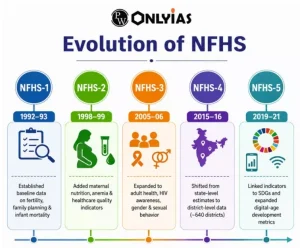
- With the Total Fertility Rate stabilizing at 2.0, the focus is evolving from demographic targets to enhancing women’s reproductive agency and autonomy.”
UPSC Online Coaching
Key Findings of the NFHS-6 Report

- Total Fertility Rate (TFR): India’s TFR has stabilized at 2.0, which is below the standard replacement level of 2.1.
- Contraceptive Prevalence Rate (CPR): Overall CPR increased marginally from 66.7% (NFHS-5) to 69.1%.
- The Gender Skew: Female sterilization remains the heavily dominant method at 36.5% nationally (rising to 38.1% in rural areas), while male sterilization sits at a negligible 0.5%.
- Reversible Method Deficit: Reliance on modern, spacing-oriented scientific options (pills, IUDs, condoms) dropped from 56.4% to 52.7%. Concurrently, unscientific traditional tracking methods spiked sharply from 10.3% to 16.4%.
| Feature |
Total Modern Methods |
Reversible Methods |
| Definition |
- All scientifically recognized contraceptives, including permanent and temporary methods
|
- Only temporary methods that allow fertility to be regained after discontinuation
|
| Includes Permanent Methods? |
- Yes (female sterilization, male sterilization)
|
|
| Includes Temporary Spacing Methods? |
- Yes (pills, IUDs, condoms, injectables, implants)
|
|
| Purpose in NFHS Reporting |
- Measures overall uptake of modern contraception
|
- Measures method-mix, reproductive choice, and spacing autonomy
|
| Policy Implication |
- Shows coverage of scientific contraception
|
- Shows autonomy, choice, and gender equity in family planning
|
| Example (NFHS-6) |
- Female sterilization 36.5%, male sterilization 0.5%, plus reversible methods
|
- Pills, IUDs, condoms, Antara injectables, Chhaya pills (excluding sterilization)
|
Key Terms
- Total Fertility Rate (TFR) represents the average number of children a woman is expected to have during her reproductive years, generally considered to be from 15 to 49 years, if the existing age-specific fertility pattern continues.
- Replacement Level Fertility refers to the fertility level at which one generation replaces itself with the next. It is generally taken as around 2.1 children per woman, as it accounts for mortality, sex ratio at birth, and the possibility that not all children will survive to reproductive age.
- If fertility remains below this level for a prolonged period, population growth may slow and eventually decline, unless factors such as migration or population momentum offset the fall.
- Contraceptive Prevalence Rate (CPR) refers to the percentage of women, or their partners, who are using any method of contraception at a given point in time.
- It is usually measured for a defined population group, such as married or in-union women in the reproductive age group of 15–49 years.
|
Challenges that need to be Addressed
- Early Marriage & Extended Fertility Windows: Nationally, 20.1% of women aged 20–24 were married before 18 (peaking at 23.3% in rural areas).
- Early unions expand a woman’s lifetime pregnancy window while restricting her negotiating power within the household.
- Adolescent Healthcare Emergencies: Due to low contraceptive literacy and social pressure, 6.7% of girls aged 15–19 were already mothers or pregnant at the time of the survey (7.9% in rural India).
- Target-Driven Public Infrastructure: Underfunded rural primary healthcare systems frequently rely on high-volume, cheap permanent sterilization camps.
- This trend places a severe physical burden on women while introducing high surgical risks.
- A Lack of True Autonomy: The transition away from permanent sterilization has caused a regression into informal, traditional tracking methods rather than an upgrade to modern, reversible scientific alternatives.
Global Initiatives & Actions
- FP2030 (Family Planning 2030): A global partnership working to ensure that rights-based family planning systems prioritize individual choice and expand women’s access to a diverse basket of modern contraceptives.
- International Conference on Population and Development (ICPD): A foundational UN-led movement that shifted the global paradigm from top-down numerical population control to individual reproductive rights and maternal safety.
- SDG 3.7 & 5.6: The United Nations Sustainable Development Goals mandate universal access to sexual and reproductive healthcare services and guarantee full reproductive rights by 2030.
|
Actions Taken by India
- Mission Parivar Vikas (MPV): Originally deployed in high-focus, high-fertility districts, this initiative aims to improve access to contraceptives and spacing options through localized community health workers.
- Expanded Contraceptive Basket: The government has progressively added new spacing methods to the public health system, including subcutaneous injectable contraceptives (Antara program) and non-hormonal weekly pills (Chhaya).
- Prohibition of Child Marriage Act: This legal framework is enforced to penalize child marriages, alongside schemes like Sukanya Samriddhi Yojana designed to financially incentivize families to keep girls in school.
Click to Know UPSC Coaching Centres in India
Way Forward
- Prioritize Secondary Education: Keeping girls in rural schools automatically delays child marriage and builds the socioeconomic baseline necessary for strong reproductive negotiating power.
- Pivot Systemic Goals from Compliance to Choice: Shift public healthcare metrics away from permanent operations toward a steady, non-coercive supply of temporary, reversible scientific methods at the village level.
- De-stigmatize Male Contraception: Actively dismantle the patriarchal myths surrounding non-scalpel vasectomies to shift the physical burden of family planning into a shared responsibility between partners.