Philanthropy as Risk Capital in Asia: Social Innovation and Development

21 May 2026

Philanthropy as Risk Capital in Asia: Social Innovation and Development

A report titled “Philanthropy as Risk Capital in Asia: Bridging Innovation to Impact”, released at the Philanthropy Asia Summit, highlighted the growing role of philanthropy in funding high-risk social innovations across Asia.
  • The report was prepared by the Centre for Asian Philanthropy and Society (CAPS) and commissioned by the Philanthropy Asia Alliance (PAA).

Best Online Coaching for UPSC 

Key Findings of Report

  • Basis of the Study: The findings were based on 10 case studies and 37 interviews with philanthropists, social enterprise founders, fund managers, and programme leaders.
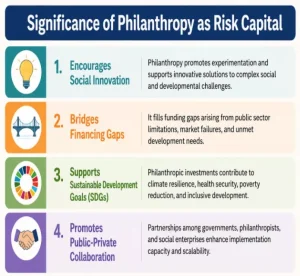
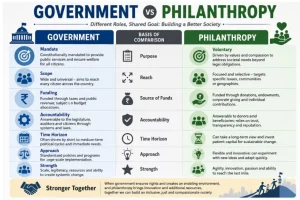
  • Filling Gaps Left by Governments and Markets: The study stated that philanthropy is increasingly filling spaces where governments are unwilling or unable to take risks and where commercial investors do not yet see profitable returns.
  • PhilanthropyPhilanthropy as “Risk Capital” in Asia: Philanthropy is termed “risk capital” in Asia  because it funds innovative and high-risk social projects that governments and private investors are often unwilling to support initially.
  • Asia’s Climate Financing Gap: The report highlighted that Asia faces a $200 billion annual climate adaptation financing gap.
  • Expanding Social Impact: Philanthropic initiatives across Asia have reportedly impacted over 210 million people across 13 Asian economies in sectors such as:
    • Climate adaptation
    • Healthcare
    • Housing
    • Waste management
    • Water access
    • Digital inclusion
  • Importance of Government Alignment: The report observed that philanthropic projects achieve greater legitimacy and scale when aligned with government priorities and public programmes.
  • Rise of Innovative Financing Models: Asian philanthropists are moving beyond traditional donations and grants towards:
    • Concessional debt
    • Equity financing
    • PhilanthropyBlended finance models
    • Social impact investing
  • Important Examples Highlighted in the Report:
    • Indonesia: Dengue Control Programme
      • Tahija Foundation funded research using Wolbachia bacteria to reduce dengue transmission.
      • The programme reduced dengue transmission by about 77% and was integrated into Indonesia’s national health strategy.
    • India: Digital Inclusion Initiative
      • Tata Trusts supported Haqdarshak under the Digital India initiative.
      • The initiative aimed to improve access to welfare schemes and promote digital inclusion for vulnerable communities.
    • China: Waste Management Innovation
      • Vanke Foundation supported social enterprise INSPRO under China’s zero-waste city initiative.
      • The initiative promoted waste management innovation and expanded operations through government partnerships.

What is Philanthropy?

  • The word philanthropy literally means ‘love of mankind’. 
  • Philanthropy refers to the voluntary donation of money, resources, time, or expertise by individuals or organisations to promote social welfare and address public challenges such as poverty, education, healthcare, and environmental protection.
  • Modern philanthropy increasingly focuses on:
    • Long-term social impact
    • Innovation and experimentation
    • Capacity building and institutional support
    • Public-private collaboration for sustainable development
  • Examples of Philanthropy
    • Tata Trusts supporting digital inclusion initiatives in India.
    • Bill & Melinda Gates Foundation funding healthcare and vaccination programmes globally.
    • Azim Premji Foundation working in education and teacher development in India.

Views on Philanthropy

Perspective Thinker/Tradition Core Idea of Philanthropy
Indian Perspective Arthashastra Chanakya suggested that rulers should allocate one-sixth of revenue for public welfare and social development.
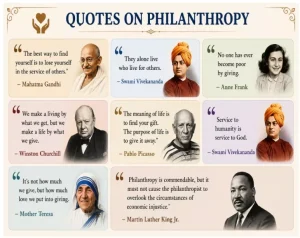
Swami Vivekananda – Daridra Narayana Serving the poor is equivalent to serving God.
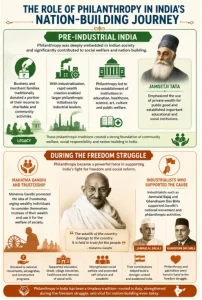
Mahatma Gandhi – Trusteeship Theory Wealthy individuals should act as trustees of societal wealth for the welfare of society.
Hinduism Emphasizes daana (charitable giving) and dakshina (alms/offering).
Islam Promotes zakaat (obligatory charity) and sadaqaat (voluntary charity).
Buddhism Encourages bhiksha (alms-giving) as a moral and spiritual duty.
Sikhism Promotes langar (community kitchen) and service to humanity.
Western Perspective Virtue Ethics Generosity, compassion, and benevolence are considered important moral virtues.
Immanuel Kant – Kantian Ethics Helping others is viewed as a moral duty and ethical obligation.
John Rawls – Justice as Fairness Society should prioritize the welfare of the most disadvantaged sections.
Utilitarianism Philanthropy should maximize happiness and well-being for the greatest number of people.
Libertarianism Voluntary philanthropy is considered morally superior to state-provided welfare assistance.

Philanthropy in India

  • India has a long-standing tradition of philanthropy rooted in values such as Dana (charitable giving) and Seva (selfless service).
  • In recent years, philanthropy has also expanded through Corporate Social Responsibility (CSR) initiatives and institutional social investments.

Philanthropy

Key Legal and Institutional Frameworks

  • Indian Trusts Act, 1882
    • Governs private trusts in India.
    • Defines roles and responsibilities of trustees.
    • Widely used for charitable and philanthropic activities.
  • Societies Registration Act, 1860
    • Provides legal status to non-profit societies involved in education, culture, research, and welfare.
    • Enables registration of NGOs and voluntary organizations.
  • Companies Act, 2013: Section 8 Companies: Allows creation of non-profit companies for charitable purposes.
    • Corporate Social Responsibility (CSR) under Section 135:
    • Mandates eligible companies to spend 2% of average net profits on social development activities.
    • Institutionalized corporate philanthropy in India.
  • Income Tax Act, 1961
    • Provides tax exemptions for charitable organizations.
    • Section 12A/12AB: Tax exemption for registered charitable institutions.
    • Section 80G: Tax deduction for donors contributing to eligible charities.

UPSC Online Classes

Need For Philanthropy

  • Filling Governance Gaps: Governments often face financial, administrative, or political constraints. Philanthropy helps support sectors like education, healthcare, nutrition, disaster relief, and rural development where public delivery may be inadequate.
  • Supporting High-Risk Innovation: Private investors usually avoid projects with low or uncertain profits. Philanthropic funding acts as “risk capital” by supporting experimental solutions in climate action, public health, sanitation, digital inclusion, and social entrepreneurship.
  • Reducing Social and Economic Inequality: Large disparities in income, education, and access to opportunities persist in many societies. Philanthropy can help marginalized communities through scholarships, livelihood programs, skill development, and social justice initiatives.
  • Strengthening Civil Society: Non-governmental organizations, community groups, and grassroots movements often depend on philanthropic support. This strengthens democratic participation and citizen engagement.
  • Providing Rapid Humanitarian Response: During disasters, pandemics, conflicts, or emergencies, philanthropic organizations can mobilize funds and resources quickly, sometimes faster than formal state mechanisms.
  • Encouraging Inclusive Development: Philanthropy promotes welfare beyond economic growth by investing in human dignity, cultural preservation, gender equality, disability rights, and environmental sustainability.
  • Complementing Corporate Social Responsibility (CSR): In countries like India, philanthropy complements CSR and welfare schemes by mobilizing private wealth for public good.
  • Promoting Long-Term Social Change: Unlike short-term political cycles, philanthropy can invest patiently in structural reforms such as education reform, public policy research, scientific research, and institution building.

Challenges Associated with Philanthropy

  • Regulatory Barriers: Complex regulations and compliance frameworks often restrict innovative financing models.
    • PhilanthropyIn India, regulations under the Foreign Contribution Regulation Act have affected the functioning and foreign funding access of several NGOs.
  • Corporate Dilemma: Businesses are primarily expected to maximize profits for shareholders, and excessive philanthropic spending may be viewed as conflicting with shareholder interests and asset utilization.
  • Limited Awareness: There is inadequate understanding of blended finance and impact investment mechanisms.
    • Many small social enterprises in Southeast Asia struggle to access blended finance due to limited financial literacy and investor awareness, as highlighted in regional development studies.
  • Lack of Transparency: Some philanthropic initiatives lack transparent governance and disclosure systems.
    • Concerns have been raised globally regarding limited disclosure practices of large private foundations managing significant philanthropic capital.
  • Weak Public Accountability: Limited public oversight may reduce accountability in fund utilisation and programme implementation.
    • Several charity organisations across Asian countries have faced criticism for insufficient public reporting on project outcomes and expenditure.
  • Absence of Independent Evaluation: Many philanthropic projects lack robust monitoring and independent evaluation mechanisms.
    • Climate adaptation projects funded through philanthropic grants in developing regions often face challenges in impact assessment and long-term evaluation.
  • Risk of Policy Influence: Large philanthropic actors may disproportionately influence policy priorities without democratic accountability.
    • Global debates around the influence of major philanthropic foundations in shaping education and public health policies illustrate this concern.
  • Uneven Regional Access: Philanthropic funding is often concentrated in urban or high-visibility sectors, leaving remote areas underserved.
    • In parts of South Asia, rural communities receive significantly lower philanthropic investments compared to metropolitan regions.
  • Dependence on Donor Priorities: Development programmes may become excessively dependent on donor interests and funding patterns.
    • Some NGOs alter programme priorities to align with donor preferences rather than local community needs.

Way Forward

  • Strengthen Regulatory Clarity: Develop transparent and enabling regulations for impact investing and blended finance.
  • Promote Public-Philanthropic Partnerships: Encourage collaboration among governments, NGOs, philanthropists, and social enterprises.
  • Enhance Accountability: Ensure transparency, ethical governance, and outcome-based evaluation in philanthropic initiatives.
  • Support Innovation Ecosystems: Provide institutional support for early-stage social innovations addressing climate, health, and inclusion challenges.
  • Leverage Technology and Data: Use AI, digital platforms, and evidence-based monitoring to improve efficiency and social impact.
  • Encourage Grassroots Participation: Promote community-based philanthropy and local participation in development initiatives.
  • Build Capacity of Social Enterprises: Provide training, mentorship, and financial support to strengthen social enterprises and non-profit organisations.
  • Increase Awareness of Impact Investing: Conduct awareness programmes and financial literacy initiatives to expand understanding of impact investing and blended finance models.

Click to Know UPSC Offline Courses

Conclusion

  • Philanthropy as risk capital is emerging as a critical force in addressing Asia’s developmental and climate challenges. 
  • By supporting high-risk social innovations and complementing state efforts, philanthropy can accelerate inclusive and sustainable development. 
  • However, long-term impact requires transparent governance, regulatory support, and strong alignment with public welfare objectives.

Check Out UPSC CSE Books

Visit PW Store

online store 1

Philanthropy as Risk Capital in Asia: Social Innovation and Development

Explore UPSC Foundation Course

Need help preparing for UPSC or State PSCs?

Connect with our experts to get free counselling & start preparing

Aiming for UPSC?

Download Our App

      
Quick Revise Now !
AVAILABLE FOR DOWNLOAD SOON
UDAAN PRELIMS WALLAH
Comprehensive coverage with a concise format
Integration of PYQ within the booklet
Designed as per recent trends of Prelims questions
हिंदी में भी उपलब्ध
Quick Revise Now !
UDAAN PRELIMS WALLAH
Comprehensive coverage with a concise format
Integration of PYQ within the booklet
Designed as per recent trends of Prelims questions
हिंदी में भी उपलब्ध

<div class="new-fform">


    </div>

    Subscribe our Newsletter
    Sign up now for our exclusive newsletter and be the first to know about our latest Initiatives, Quality Content, and much more.
    *Promise! We won't spam you.
    Yes! I want to Subscribe.