A recent study by AIIMS New Delhi has found that increased screen time among children below one year is associated with a higher risk of autism-related symptoms by age three.
- The study focuses on device addiction and psychological and behavioural impacts, not just exposure.
Best Online Coaching for UPSC
Key Findings of Study
- Study Sample and Methodology: AIIMS study was conducted on 250 children aged between three and six years, including 150 children with autism and 100 children with normal development milestones.
What is Autism?
- Autism is a neurodevelopmental condition affecting communication and social interaction.
- Early childhood is crucial for cognitive and social development.
- Signs of Autism include lack of eye contact, delayed speech and loss of previously learned skills.
- Global Incidence: According to the US Centers for Disease Control and Prevention (CDC), about 1 in 31 children is now diagnosed with autism.
- The World Health Organisation places the global estimate at around 1 in 100.
|
- Increased Risk of Autism-like Symptoms: According to the researchers children are highly susceptible to develop a likelihood of autism-like signs by age 3.
- Medical Recommendation on Screen Exposure: Doctors recommend no screen exposure for children under 18 months, and ideally no screens before age 3.
- Correlation, Not Causation: The study found a strong correlation between the screen exposure at early age and autism but did not establish it to be the cause of autism.
About Screen Time in Children
- Screen time refers to the duration children spend using digital devices such as smartphones, televisions, tablets, and computers.
Scientific Basis: How Screen Time Affects Brain Development?
| Aspect |
Key Points |
| Early Brain Plasticity (0–3 years) |
- The first three years of life are marked by rapid brain growth, during which neural connections are formed at a very high rate, making this period crucial for development.
- The brain exhibits high plasticity, meaning it is highly sensitive to environmental inputs and experiences.
- Real-life interactions such as talking, playing, and eye contact help in strengthening neural pathways essential for cognitive and emotional growth.
- Excessive screen time reduces these interactions, which may hinder proper brain development and learning
|
| Attention |
- Exposure to fast-paced and highly stimulating screen content conditions the brain to expect constant engagement, thereby reducing the child’s ability to focus on slower, real-life activities.
|
| Language Development |
- Language acquisition in early childhood depends on active listening and two-way communication with caregivers.
- Passive screen viewing limits verbal interaction, which can lead to delayed speech and weaker language skills.
|
| Social Interaction |
- Human interaction is essential for developing social skills such as eye contact, emotional understanding, and bonding.
- Excessive screen use replaces these interactions, potentially leading to difficulties in social communication and relationships.
|
| Melatonin (Sleep Hormone) |
- Screen exposure, especially at night, emits blue light that suppresses melatonin production, disrupting sleep patterns and negatively affecting brain development.
|
| Dopamine (Reward System) |
- Digital media provides instant gratification, leading to repeated dopamine release in the brain.
- This may result in addiction-like behavior and a growing preference for screens over real-world activities, affecting motivation and emotional regulation.
|
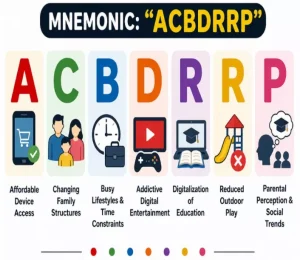
Why is there a rise in screentime for kids in today’s lifestyle?
- Affordable Device Access: Easy access to affordable smartphones and tablets has increased early exposure to screens among children.
- For Example: Toddlers watch cartoons on YouTube during meals as smartphones are readily available at home.
- Changing Family Structures: Rise of nuclear families and working parents has reduced supervision time, making screens act as digital babysitters.
- For Example: A child is left with a mobile phone for engagement while both parents are at work.
- Busy Lifestyles & Time Constraints: Time constraints in modern lifestyles push parents toward convenient engagement tools like screens.
- For Example: Parents give a tablet to calm a child during travel or while managing household chores.
Addictive Digital Entertainment: Growth of algorithm-driven digital platforms has increased screen dependency among children.
-
- For Example: Autoplay content on Netflix keeps children engaged continuously for long hours.
- Digitalization of Education: Online learning has normalized prolonged screen exposure among children.
- For Example: A child attends online classes and then continues using the same device for gaming or watching videos.
- Reduced Outdoor Play: Urbanization and lack of safe play spaces have shifted children toward indoor digital activities.
- For Example: Children spend evenings playing mobile games instead of going to playgrounds.
- Parental Perception & Social Trends: Screens are increasingly perceived as educational tools, leading to higher usage among children.
- Parents encourage educational videos, which gradually extend into prolonged entertainment viewing.
UPSC Online Coaching
Challenges
- Cognitive Development Distortion: The excessive and early exposure to digital screens is increasingly impairing children’s cognitive development by reducing attention span, weakening memory retention, and limiting critical thinking abilities due to passive content consumption.
- Deterioration of Physical Health: Prolonged sedentary screen engagement is contributing to a rise in childhood obesity, poor posture, early vision problems, and sleep disorders, thereby affecting long-term physical well-being.
- Emotional and Behavioral Instability: Overdependence on digital devices is leading to increased irritability, reduced emotional regulation, and higher susceptibility to anxiety and depression among children.
- Erosion of Social Skills: Excessive screen time is replacing real-world interactions, resulting in weakened interpersonal communication skills, reduced empathy, and difficulty in forming meaningful social relationships.
- Academic Disruption: Unregulated digital exposure, especially through gaming and social media, is diverting attention from studies, lowering academic performance, and fostering a culture of instant gratification over disciplined learning.
- Exposure to Inappropriate Content: Children are increasingly vulnerable to harmful, violent, or age-inappropriate content online, which can negatively influence behavior, values, and psychological development.
- Addiction and Dopamine Dependency: The algorithm-driven design of digital platforms fosters addictive usage patterns, creating dependency loops that affect self-control and increase screen reliance from an early age.
- Family Interaction Decline: Increased individual screen engagement within households is reducing quality family time, weakening parent-child bonding and communication.
- Digital Divide and Inequality: While some children face overexposure, others lack access to constructive digital tools, creating a paradoxical divide in digital literacy and balanced usage.
- Long-Term Societal Implications: The normalization of high screen dependency in childhood risks creating a generation with diminished physical activity, lower resilience, and compromised real-world problem-solving abilities.
Government Measures To Tackle Screen Time
- State-led regulatory initiatives: The government, particularly at the state level, has begun formulating targeted digital detox policies aimed at regulating children’s screen exposure through age-based restrictions and time limits.
- Example: Karnataka’s proposed Digital Detox Policy (2026) suggests limiting recreational screen time to one hour and restricting social media access for minors.
- Integration of digital well-being in education: Efforts are being made to incorporate digital literacy and responsible technology usage into school curricula to inculcate disciplined screen habits among children.
- Example: NCERT and CBSE initiatives on cyber safety modules and digital citizenship education under NEP 2020.
- Promotion of structured school interventions: Educational institutions are being encouraged to adopt mechanisms such as tech-free periods and increased offline engagement to reduce screen dependency.
- Example: State-level guidelines in Karnataka and Kerala promoting “no gadget hours” and enhanced sports activities in schools.
- Public health advisory framework: Government-supported health bodies are issuing age-specific screen time norms to prevent cognitive and physical harm among children.
- Indian Academy of Pediatrics (IAP) guidelines recommending no screen exposure for children below 2 years and limited usage for older children.
- Mental health support mechanisms: The government is strengthening mental health responses to digital addiction through institutional collaboration and counselling services.
- Example: NIMHANS-led research on behavioural addiction and integration with Tele-MANAS mental health helpline.
- Encouragement of offline engagement ecosystems: Policy efforts are focusing on promoting physical activities and recreational alternatives to reduce sedentary digital lifestyles.
- Example: Khelo India Programme encouraging sports participation among children and youth.
- Focus on preventive rather than punitive approach: The government strategy emphasizes behavioural change through awareness and institutional support rather than strict enforcement.
- Example: CBSE advisories during and post-COVID recommending balanced screen use for students.
International Best Practices on Screen Time Regulation
- Strict Gaming Time Regulations in China: The government enforces legally binding limits on online gaming for minors, restricting playtime to specific hours to curb digital addiction.
- Holistic Digital Wellbeing Framework in Australia: National policies promote balanced screen use through parental guidance tools, school interventions, and public awareness campaigns.
- Child Online Safety Laws in the United Kingdom: Regulatory frameworks emphasize age-appropriate design, privacy protection, and limits on addictive features targeting children.
- Pediatric Screen-Time Guidelines Globally: Organizations like the World Health Organization recommend minimal or no screen exposure for very young children and structured limits for older age groups.
- Integration of Digital Literacy in School Curriculum: Many developed countries embed digital citizenship education to foster responsible and mindful technology use among children.
|
Click to Know UPSC OnlyIAS Coaching Centres
Way Forward
- Age-Appropriate Screen Guidelines Enforcement: Adopt and strictly implement evidence-based guidelines such as those by the Indian Academy of Pediatrics and World Health Organization, ensuring zero screen exposure below 2 years and regulated usage thereafter.
- Parental Awareness and Behavioural Training: Launch large-scale awareness campaigns to educate parents about the developmental risks of excessive screen time and promote mindful parenting practices, including co-viewing and setting consistent screen limits.
- Strengthening Early Childhood Care Systems: Integrate screen-time counselling into Anganwadi services and pediatric healthcare visits under programmes like Integrated Child Development Services, ensuring early intervention at the community level.
- Design Regulation of Digital Platforms: Encourage regulation of algorithm-driven platforms (like YouTube or Netflix) to include child-safe modes, disable autoplay by default, and reduce addictive design features targeting young users.
- Promoting Outdoor and Experiential Learning: Strengthen initiatives such as Khelo India to ensure access to safe play spaces, sports infrastructure, and community-based recreational activities that reduce dependence on screens.
- School-Level Digital Discipline Framework: Institutionalize “no-gadget hours”, digital detox periods, and experiential learning modules in schools in line with National Education Policy 2020 to build balanced digital habits among children.
- Research, Monitoring and Policy Integration: Encourage continuous research by institutions like All India Institute of Medical Sciences to track long-term impacts, and integrate findings into national child health and education policies for adaptive governance.