Over the last decade, sustained economic reforms, digital transformation, and improvements in public service delivery have significantly enhanced the living standards, aspirations, and economic role of India’s growing middle class.
India’s Growing Middle-Class Population
- India’s GDP per capita increased by 53% between 2011 and 2019.
- The Indian middle class expanded at an annual rate of 6.3% between 1995 and 2021.
- Currently, the middle class constitutes about 31% of India’s population
UPSC Online Classes
Who is the Middle Class?
- What defines “middle class” varies across countries, shaped by factors like purchasing power, education levels, social services, perceptions of wealth.
- The World Bank classifies economies annually, based on Gross National Income (GNI) per capita, the value of primary incomes for all sectors.
- The updated country income classifications in US dollars for FY26 are-
- Low income: ≤ $1,135
- Lower-middle income: $1,136 – $4,495
- Upper-middle income: $4,496 – $13,935
- High income: > $13,935
These classifications provide a broad framework to situate income groups, including the middle segment, within the global economy.
Key Distinctive Features of India’s Middle Class
- Aspirational Rather than Affluent: Much of India’s middle class is focused on upward mobility, whereas middle classes in developed countries are largely focused on maintaining living standards.
- Higher Spending on Human Capital: Indian households devote a significant share of income to education, coaching, skill development, and healthcare to secure future opportunities.
- Limited Welfare Cushion: Unlike Europe and many OECD countries, Indian middle-class families often face a “missing middle” problem—too affluent for subsidies but not wealthy enough to absorb major economic shocks comfortably.
- Family-Centric Financial Model: Inter-generational support remains strong, with middle-class households often supporting children’s education and elderly parents simultaneously.
- Engine of Future Growth: According to the World Economic Forum, India’s middle class is expected to become one of the largest sources of global consumption growth, unlike developed economies where middle-class consumption is relatively saturated.
How is India’s Middle Class Different from the Middle Class in Developed Nations?
| Dimension |
India’s Middle Class |
Developed Nations’ Middle Class |
| Income Security |
More vulnerable to economic shocks, medical expenses, and job losses. |
Higher income security due to stronger welfare systems and social safety nets. |
| Social Security |
Relies heavily on personal savings and family support. |
Greater dependence on state-provided pensions, healthcare, and unemployment benefits. |
| Consumption Pattern |
A larger share of income is spent on essentials like housing, education, healthcare, and food. |
Higher discretionary spending on leisure, travel, and lifestyle services. |
| Healthcare Costs |
Significant out-of-pocket expenditure despite expanding insurance coverage. |
Universal or heavily subsidized healthcare reduces financial burden. |
| Education Spending |
Families invest heavily in private education and coaching for upward mobility. |
Quality public education systems reduce private spending requirements. |
| Employment Structure |
Large share employed in informal or semi-formal sectors with limited job security. |
Predominantly formal employment with contractual protections and benefits. |
| Asset Ownership |
Homeownership is considered a primary indicator of financial security and social status. |
Greater acceptance of rental housing and diversified financial asset ownership. |
| Savings Behaviour |
High propensity to save due to uncertainty and limited social protection. |
Greater reliance on institutional social security systems, leading to relatively lower precautionary savings. |
| Demographic Profile |
Younger, expanding, and aspirational population. |
Aging middle class with slower population growth. |
| Economic Role |
Primarily an emerging growth driver with rising consumption potential. |
A mature consumer class sustaining already developed economies. |
Why is the Middle Class Important?
- Engine of Consumption and Growth: Drives consumer demand, savings, investments, and entrepreneurship, thereby stimulating economic growth and job creation.
- Human Capital Formation: Invests significantly in education, healthcare, housing, and skills, enhancing productivity and long-term development.
- Fiscal and Governance Support: Contributes substantially to tax revenues and demands better governance, accountability, and public service delivery.
- Social Stability and Inclusion: Helps reduce inequalities, strengthens social cohesion and trust, and promotes inclusive and sustainable growth.
- Expands the Consumer Market: A growing middle class increases purchasing power, encouraging industrial growth, innovation, and service-sector expansion.
- The WEF opines that by 2036, India’s middle class (and affluent consumers) will account for 93% of all spending. This would be a rise from 80% in 2026. Additionally, by 2035, 20%+ of key generations (baby boomers, Gen X, millennials, Gen Z) will spend $45 or more daily.
- Supports Urbanisation and Modernisation: Drives demand for better infrastructure, housing, transportation, and digital services, accelerating urban development.
- Promotes Democratic Values: A strong middle class often advocates for transparency, rule of law, institutional reforms, and participatory governance.
- Catalyst for Economic Resilience: Stable middle-class incomes help sustain domestic demand during economic downturns, reducing dependence on external markets.
UPSC Online Coaching
Government Initiatives to Boost Middle Class in Various Sectors
- Finance:
- Simplified taxation: In July 2024, the Government announced a comprehensive review of the Income Tax Act, 1961. This was completed in record time and the Income Tax Act, 2025 came into effect in April, 2026.
 In 2014, individuals with income of up to 2.5 lakhs attracted zero tax. Now, individuals earning up to ₹12 lakh annually (₹12.75 lakh for salaried persons with standard deduction) pay zero tax under the new tax regime (introduced in 2023). This has increased their savings, disposable income, and overall financial choices.
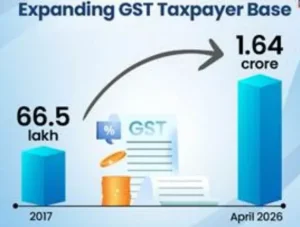
 - The Goods and Services Tax (GST): Introduced in 2017, the middle class specifically, has delivered several tangible benefits by simplifying taxes and lowering everyday costs.
- The GST taxpayer base grew from 66.5 lakh in 2017 to 1.64 crore by April 2026.
- Unified Pension Scheme (UPS): Effective since April 2025, UPS strengthens retirement security for central government employees in India- a significant segment of middle class.It combines employee and Government contributions under a contributory structure and offers assured, inflation-linked pension benefits after retirement. UPS guarantees a minimum pension of ₹10,000 per month after retirement (with at least 10 years of service).
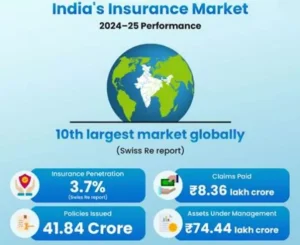 Insurance: From a middle-class perspective, the Insurance Regulatory and Development Authority of India (IRDAI) is committed to the vision of “Insurance for All by 2047”.
- It aims to ensure that every citizen has adequate life, health, property insurance; every enterprise has access to suitable risk protection.
- Expanding Urban Growth and Connectivity:
- Pradhan Mantri Awas Yojana- Urban (PMAY-U) for Housing- Launched in 2015, it has transformed the lives of crores by providing them with secure housing. PMAY-U 2.0 scheme builds upon the strong foundation. It was launched under ‘Housing for All’ Mission (w.e.f. September 2024).
- Out of a total 125.31 lakh sanctioned houses, 98.1 lakh are completed/delivered to beneficiaries across the country (May 2026).
- SWAMIH (Special Window for Affordable and Mid-Income Housing) fund: It is specifically designed for the middle class and lower-middle-class, aimed at completing stalled residential projects.
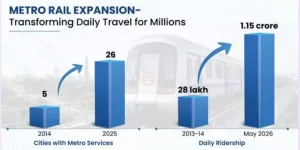
- Metro Rail Expansion- India now has the world’s third-largest metro network, transforming daily travel for millions. Metro expansion has accelerated from 0.68 km per month before 2014 to nearly 6 km today. Over the last 12 years, nearly ₹3.7 lakh crore has been invested in expanding metro connectivity across the country.
-
- Airports expansion: Air travel in India has become more accessible and convenient for middle-class families. The number of operational airports increased from 74 in 2014 to 165 in 2026.
- Strengthened Education, Entrepreneurship & Skill Development
- IIT Expansion-There were 16 Indian Institutes of Technology (IITs) in India in 2014. With the addition of 7 new IITs in the subsequent years, the total number rose to 23 (2025).
- Influx of Foreign Universities in India- Leading global universities like Deakin University and University of Wollongong have opened campuses in GIFT City, Gujarat, while University of Southampton has set up in Gurugram.
- Skill India: Key schemes include Pradhan Mantri Kaushal Vikas Yojana (PMKVY), Jan Shikshan Sansthan (JSS), Pradhan Mantri National Apprenticeship Promotion Scheme (NAPS)and Craftsmen Training Scheme (CTS).
- Seamless Digital Governance for Greater Convenience:
- DigiLocker– Launched in 2015, DigiLocker aims at ‘Digital Empowerment’ of citizens by providing access to authentic digital documents to citizen’s digital document wallet.
- UMANG App- Launched in 2017, UMANG, the Unified Mobile Application for New age Governance, was designed to advance mobile governance in India. It provides a single window mobile and web platform to access services from central, state and local government bodies.
Challenges Before India’s Middle Class
- Income Inequality: Despite strong GDP growth, the gains of development remain concentrated among higher-income groups, limiting broad-based prosperity and upward mobility.
- Employment Concerns: Rising educational attainment and aspirations are often not matched by the availability of quality and secure employment opportunities, necessitating greater focus on skill-linked job creation.
- Rising Cost of Living: Escalating costs of housing, healthcare, education, and urban services are eroding disposable incomes and reducing the savings potential of middle-class households.
- Housing Affordability Crisis: Rapid increases in property prices and rents, particularly in metropolitan cities, have pushed homeownership beyond the reach of many middle-income families.
- Informal Employment and Social Security Gaps: A significant section of the workforce continues to remain outside formal employment, limiting access to pensions, insurance, and other social protection mechanisms.
- Skill Mismatch: The gap between industry requirements and workforce capabilities continues to affect employability, highlighting the need for continuous skilling and reskilling.
- Financial Vulnerability: Rising EMIs, consumption-driven borrowing, and inflationary pressures have increased the financial stress on middle-class families, even when nominal incomes are rising.
- Aspirations vs. Affordability: Growing aspirations for quality education, healthcare, housing, and lifestyle upgrades are often constrained by stagnant real incomes, creating a widening aspiration-achievement gap.
Click to Know UPSC Offline Courses
Way Forward
- Generate Quality Employment: Promote labour-intensive manufacturing, MSMEs, and sunrise sectors such as AI, semiconductors, and green energy to create stable and well-paying jobs.
- Bridge the Skill Gap: Strengthen industry-academia collaboration and expand initiatives like Skill India to align workforce capabilities with evolving market demands.
- Enhance Social Security: Expand coverage of pensions, health insurance, and unemployment support, particularly for informal and gig workers.
- Improve Housing Affordability: Accelerate affordable housing schemes such as PMAY and promote rental housing models to ease the burden of rising urban property prices.
- Control Cost of Living: Ensure affordable access to quality healthcare, education, and public transport through greater public investment and regulatory reforms.
- Strengthen the Urban Ecosystem: Invest in mass transit, water supply, waste management, and digital infrastructure to improve quality of life in rapidly growing cities.
- Boost Financial Security: Encourage financial literacy, diversified savings, and long-term investment instruments to protect households from inflation and economic shocks.
- Support Entrepreneurship: Expand access to credit, startup funding, and ease of doing business reforms to enable middle-class wealth creation and job generation.
- Promote Inclusive Growth: Focus on reducing regional and income disparities by fostering growth in Tier-II and Tier-III cities, as highlighted by the World Economic Forum’s projection of emerging “consumer cities.”
- Leverage Digital Governance: Deepen the use of Digital Public Infrastructure (JAM, DigiLocker, UMANG) to improve service delivery, reduce transaction costs, and enhance ease of living.
 5 Jun 2026