India reaffirmed its commitment to ecological restoration, climate action, and sustainable development on the occasion of World Environment Day 2026 (June 5), celebrated in Baku, Azerbaijan.
Best Online Coaching for UPSC
About World Environment Day
- The Beginning: World Environment Day was established by the United Nations Environment Programme (UNEP) during the 1972 Stockholm Conference on the Human Environment.
- It marked the birth of modern global climate diplomacy and is celebrated every year on June 5.
- Host Country for 2026: The Republic of Azerbaijan is hosting the global commemoration of World Environment Day 2026 in Baku, driving international focus toward immediate action on modern ecological catastrophes.
- This follows Azerbaijan’s critical role in hosting the UN Climate Change Conference (COP29) here in Baku.
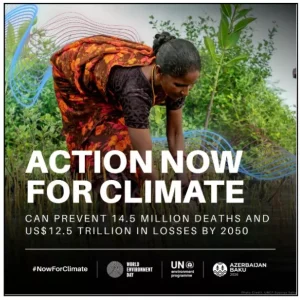
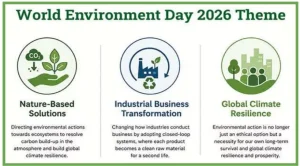 The 2026 Focus: The official theme is “Inspired by Nature. For Climate. For Our Future.” paired with the global campaign message #NowForClimate.
Major Global Environmental Hazards & Emerging Threats
Recent scientific data reveals interconnected planet-wide crises that directly threaten ecosystems, global economies, and human health:
- Weakening of Ocean Currents (AMOC): The Atlantic Meridional Overturning Circulation (AMOC) is a massive network of ocean currents.
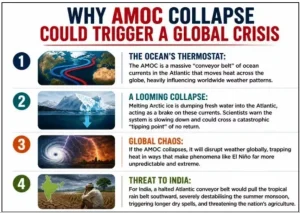 It acts like a giant conveyor belt, moving warm surface water from the tropics north where it cools, becomes denser, and sinks several kilometers into the deep ocean to drift back south as a cold current, balancing global temperatures.
- The Threat: Huge amounts of melting fresh water from Arctic ice are mixing into the ocean, lowering salinity and stalling this engine.
- According to the Intergovernmental Panel on Climate Change (IPCC Sixth Assessment Report), there is high confidence that the system will weaken over the twenty-first century.
- New research warns that the AMOC may slow by up to 59% by 2100, dangerously approaching a “climate tipping point” where it could irreversibly collapse into a sluggish state.
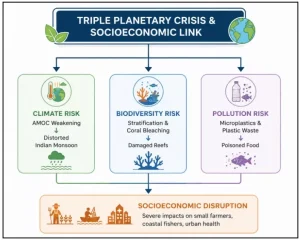 Socioeconomic Impact: A disrupted AMOC will trigger extreme sea-level rise in North America and alter global weather systems.
- This shift is projected to heavily impact the Indian Monsoon, creating severe risks for farming, food security, and water supplies, directly disrupting rural livelihoods for hundreds of millions of people who depend on summer rains.
- Rising Ocean Heat and Stratification: The Earth’s oceans absorbed record levels of heat over the 2024–2025 period, taking in an additional 23 zettajoule of energy.
- This intense warming causes ocean stratification—the natural separation of water into horizontal layers by density, where warmer, nutrient-poor surface water sits on top of heavier, colder, nutrient-rich deep water.
- The Damage: High temperatures make it harder for these layers to mix. As a result, oceans absorb less carbon dioxide from the atmosphere, and vital oxygen cannot circulate properly, threatening marine biodiversity.
- The Weather Connection: This thermal stress causes marine heatwaves (MHWs)—where surface temperatures rise 3 to 4 degrees Celsius above average for at least five days.
- It results in bleaching coral reefs, disrupting global fisheries, and fueling more frequent and intense storms like hurricanes and cyclones in the Arabian Sea and the Bay of Bengal.
- The Melting Arctic Sea Ice Illusion: A study titled ‘Minimal Arctic Sea Ice Loss in the Last 20 Years, Consistent With Internal Climate Variability’ revealed that the pace of Arctic sea ice loss has temporarily slowed due to natural climate shifts.
- The Core Issue: This is not a recovery. The region has already lost over 10,000 cubic kilometres of sea ice since the 1980s.
- Human-driven greenhouse gas emissions continue to climb, and this temporary 5-to-10-year slowdown will likely be followed by faster, accelerated melting.
- Long-term ice loss will exacerbate global warming, drive sea levels higher, and trigger greenhouse gas releases via permafrost thaw.
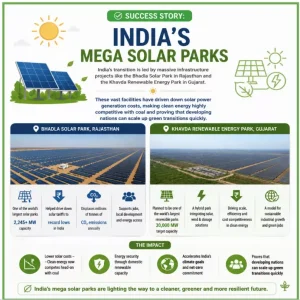
- The Clean Energy Puzzle: The world added a record-breaking 582 gigawatts of renewable energy capacity in 2024 (a 15% annual increase), bringing total global capacity to over 4,442 gigawatts, according to the International Renewable Energy Agency (IRENA).
- Clean sources now produce around 30% of global electricity.
- The Structural Flaw: While this growth aligns with the COP28 (Dubai) historic mandate to triple global renewable energy capacity by 2030, clean energy has not yet begun to fully replace fossil fuels at a global scale.
- Negotiations at COP30 in Belém, Brazil faced heavy geopolitical gridlock, with nations failing to secure a consensus text outlining a legally binding timeline to explicitly “phase out” fossil fuels, settling instead on standard text emphasizing clean energy expansion to handle rising electricity demands.
India’s Environmental Vision and Actions
India is addressing the 2026 theme by linking ancient ecological traditions with large-scale domestic policies and updated climate goals.
- Philosophical Foundation:
- Living in Harmony: India’s approach views nature as a shared heritage to protect, rather than an economic resource to exploit.
 Cultural Roots: Classical Indian traditions, like those found in the ancient text Thirukkural, teach compassion for all living creatures and the sustainable use of natural resources.
- Comprehensive Ecosystem Restoration:
- Wildlife Protection: Moving past isolated reserves, India applies scientific management and habitat restoration to protect crucial species like the Great Indian Bustard, Snow Leopard, Sloth Bear, and Cheetah.
- Ecosystem-Level Protection: Beyond flagship animals, restoration efforts focus on critical ecological shields like wetlands (e.g., Chilika Lake), which serve as vital regional carbon sinks, and mangroves, which act as natural barriers against powerful cyclones and shoreline erosion.
- ‘Ek Ped Maa Ke Naam’ Campaign: This popular tree-planting movement relies on citizen participation (Jan Bhagidari). Backed by these sustained afforestation efforts, reports from the Ministry of Environment, Forest and Climate Change (MoEFCC) show India adds nearly 119,000 hectares of forest cover annually.
- Mission LiFE and Circular Economy Practices: India’s Mission LiFE (Lifestyle for Environment) translates national climate goals into individual behavioral shifts, aiming to reshape the economy through specific focus areas:
- Sustainable Agriculture: Promoting organic and regenerative farming to protect soil fertility and conserve water.
- Plastic Waste Management: Enforcing strict single-use plastic bans alongside Extended Producer Responsibility (EPR) frameworks to hold manufacturers accountable for packaging waste.
- Behavioral Shifts: Nudging citizens toward individual actions like eco-friendly commuting, water-saving measures, and minimizing food waste to directly drive economic green jobs.
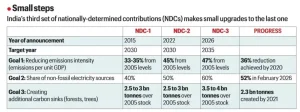
- India’s Climate Commitments for 2035: In accordance with the Paris Agreement timeline re-emphasized at recent summits, India has updated its Nationally-Determined Contributions (NDCs) for the 2035 cycle, scaling up its targets independently:
International Initiatives and Global Cooperation
Global climate platforms are building practical cooperation frameworks to address the planetary crisis, despite high-stakes diplomatic friction:
- The New Collective Quantified Goal (NCQG): Formally established during the grueling negotiations at COP29 in Baku, the NCQG serves as the modern foundational pillar for global climate finance.
- It sets an ambitious overarching target to scale up climate funding to developing nations to at least $1.3 trillion per year by 2035 from all public and private sources.
- Of this, developed nations agreed to lead the mobilization of at least $300 billion annually by 2035.
International Institute for Sustainable Development (IISD)+ 2
- The “Baku-Belém Roadmap to 1.3T”: This institutional mechanism was designed to span the transition between the Azerbaijan and Brazil presidencies, creating a clear operational path to aggressively unlock public, private, and highly concessional grant-based funding streams.
- The Tropical Forest Forever Facility (TFFF): Officially launched at the landmark COP30 Summit in Belém, Brazil (widely termed the ‘Amazon Forest COP’), this vehicle directly addresses the financial drivers of deforestation by making standing, living tropical forests more economically valuable than cleared land.
- The Framework: The facility targets a $125 billion fund backed by sovereign contributions and private capital, placing resources into a secure portfolio and utilizing net annual returns to pay developing tropical nations directly for maintaining forest canopy integrity.
- Socioeconomic Safeguards: Crucially, COP30 mandates that at least 20% of TFFF capital payouts go directly to Indigenous Peoples and Local Communities (IPLCs) who act as direct frontline guardians of the biomes.
- Unlocking Global Carbon Markets: After a decade of technical and diplomatic deadlock, COP29 finalized the international framework for Article 6 (specifically Article 6.4) of the Paris Agreement. This milestone fully operationalizes unified UN carbon markets, paving the way to safely channel an estimated $1 trillion per year by 2050 into highly verified green projects across the Global South.
UPSC Online Coaching
The Climate Finance Challenge
Securing predictable, low-cost capital remains the most difficult challenge in turning climate policy into reality.
- The Funding Gap and Geopolitical Discontent: While COP29 successfully codified the $300 billion developed-nation pledge, the summit concluded amid immense friction.
- Developing economies, including India, Nigeria, and Bolivia, aggressively protested the target, labeling the $300 billion core figure as deeply inadequate compared to the actual trillions needed to cover clean technology transitions, adaptation, and severe loss and damage.
- According to domestic fiscal assessments, India alone requires approximately $2.5 trillion by 2030 to execute its baseline green targets, and a staggering $10.1 trillion by 2070 to secure its complete net-zero emissions trajectory.
- Decarbonizing heavy-emission industrial blocks like steel, cement, transport, and thermal power requires immense up-front financing because green alternatives (such as Green Hydrogen) are not yet commercially viable at mass scale.
- Structural Obstacles:
- The Taxonomy Gap: India lacks a finalized Climate Finance Taxonomy—the official, standardized rulebook that legally defines what qualifies as a valid “green investment“.
- Without this, international investors remain cautious due to potential greenwashing risks.
- Local Fiscal Weakness: While major climate adaptation policies are designed centrally, execution falls on state and local governments.
- These entities often lack the fiscal capacity and direct lines to tap international climate funds.
Way Forward
To turn environmental targets into measurable, fair progress, the global community and domestic planners should prioritize five steps:
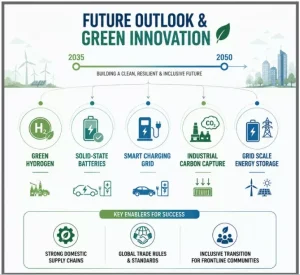
- Finalize the Green Taxonomy: Establish a clear, transparent Climate Finance Taxonomy to unlock global capital pools and remove greenwashing risks.
- Deploy Blended Finance: Use public and multilateral funds as a financial buffer to absorb early losses, lowering risks for private developers and drawing corporate investments into offshore wind, grid-scale energy storage, and green hydrogen projects.
- Enhance Central Bank Regulations: The Reserve Bank of India (RBI) should introduce mandatory climate stress-testing for commercial banking networks, expand Priority Sector Lending (PSL) allocations for green ventures, and increase capital requirements for carbon-intensive investments.
- Create a Dedicated Sub-National Facility: Set up a coordinated financing channel uniting the central government, NABARD, and international financial institutions to route adaptation funding directly to state and local bodies.
- Remove Intellectual Property Barriers: Developed countries should share patents and industrial expertise for green steel, carbon capture, and smart grid systems.
- This helps developing countries skip pollution-heavy stages of development.
Click to Know UPSC Coaching Centres in India
Conclusion
World Environment Day 2026 stressed that environmental protection is vital for sustainable growth. From COP29 to COP30, global climate policy is becoming more nature-centric. India shows that clean energy, green finance, innovation, and climate-resilient lifestyles can support both development and planetary health.
 5 Jun 2026