At the 11th Quad Foreign Ministers’ meeting, the Indian External Affairs Minister and his counterparts launched initiatives on energy security, as well as on maritime surveillance and domain awareness to aid in emergency operations and humanitarian responses at sea.
- The summit focused on building regional resilience against market shocks caused by global conflicts and promoting a free and open Indo-Pacific.
- The meeting produced four key outcome documents– the Quad Foreign Ministers’ Joint Statement, a Fact Sheet on Quad Initiatives, the Quad Statement on Indo-Pacific Energy Security, and the Quad Critical Minerals Initiative Framework.
- Key Pillars & Pillars of Cooperation: The summit marked a significant transition for the Quad, moving from a consultative diplomatic platform toward action-oriented, tangible public goods delivery.
Best Online Coaching for UPSC
Major Outcomes of the Quad Foreign Minister Meeting, 2026
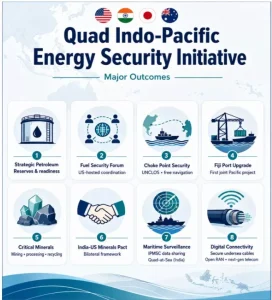
- The Quad Initiative on Indo-Pacific Energy Security: Designed to shield economically vulnerable and small island economies from volatile global commodity shocks in crude oil, liquefied natural gas, and critical downstream agricultural sectors like chemical fertilizers, this new multilateral framework concentrates on three core pillars:
- Strategic Petroleum Systems: Leveraging collective techno-economic expertise to assist regional partner nations in establishing, expanding, and fortifying their own Strategic Petroleum Reserves (SPRs) to withstand severe global supply disruptions.
- Quad Fuel Security Forum: Institutionalizing high-level policy coordination through a specialized body slated to be hosted by the United States Department of Energy (DoE) later this year. This forum will design and execute regional energy resilience frameworks and joint Emergency Response Exercises (EREs).
- Choke Point Security: Reaffirming an unwavering commitment to the Freedom of Navigation (FoN) and unhindered maritime commerce under the statutory guidelines of the United Nations Convention on the Law of the Sea (UNCLOS).
 The grouping explicitly opposes illegal transit restrictions or the unilateral imposition of maritime tolls in highly vital global corridors such as the Strait of Hormuz.
- Quad Ports of the Future Partnership (The Fiji Port Project):
- First Joint Infrastructure Asset: The alliance announced its first collaborative, physical pilot project to expand, deepen, and modernize Fiji’s port infrastructure, directly addressing the insufficient maritime handling capacity and supply-chain bottlenecks plaguing Pacific Island Countries (PICs).
- Strategic Counter-Weight: Because Fiji was among the first Pacific nations to sign a formal Memorandum of Understanding (MoU) with Beijing under the Belt and Road Initiative (BRI), this partnership presents a transparent, financially sustainable, and non-coercive alternative for regional infrastructure development.
- The Critical Minerals Initiative Framework:
- Supply Chain De-risking: Fully activating a comprehensive multilateral framework to channel and coordinate public-private capital across the mining, value-added processing, and industrial recycling sectors.
- This is specifically aimed at reducing extreme, vulnerable single-source dependencies on the People’s Republic of China, which currently commands an estimated 85% global monopoly on processing capacity for rare earth elements.
- Expansion of Maritime Domain Awareness (MDA):
- Launch of the IPMSC: To supplement the operational capabilities of the existing Indo-Pacific Partnership for Maritime Domain Awareness (IPMDA), the foreign ministers formally launched the Indo-Pacific Maritime Surveillance Collaboration (IPMSC).
- Real-Time Data Sharing: Operating initially within the Indian Ocean Region (IOR), the IPMSC will pool unclassified commercial maritime data and leverage India’s state-of-the-art Information Fusion Centre–Indian Ocean Region (IFC-IOR) located in Gurugram to track “dark vessels” and eliminate maritime blind spots.
- Interoperability: India announced that it will host the second edition of the “Quad-at-Sea” Ship Observer Mission to structurally boost joint coast guard capacity, tactical familiarity, and enforce maritime law against Illegal, Unreported, and Unregulated (IUU) fishing and transnational maritime crimes.
- Digital and Telecommunications Infrastructure:
- Undersea Cable Resilience: Pledging collaborative state capital to ensure all Pacific Island Forum (PIF) member countries are securely and redundantly connected via resilient undersea fiber-optic cable networks to prevent communication blackouts.
- Next-Gen Telecom Standards: Advancing strict standard-setting cooperation for Open Radio Access Network (Open RAN) architectures, while simultaneously launching joint technical collaborations to spearhead global Sixth-Generation (6G) telecommunication standards.
About Quad Foreign Ministers’ Meeting (QFMM)
- Refers: The Quad Foreign Ministers’ Meeting (QFMM) serves as the “Sherpa and Architect” of the Quad framework.
- Frequency: The track operates on a rolling schedule, meeting at least once or twice a year (frequently on the sidelines of the United Nations General Assembly or via hosted standalone ministerials in member capitals).
- Origin and Structural Evolution: The implementation of a dedicated ministerial track was a calculated step taken to institutionalize the dialogue:
-
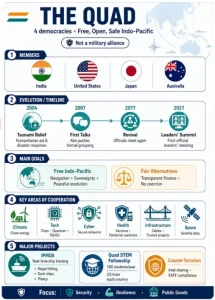
- 2007 (The Working-Level Start): When the Quad was first conceptualized by Japanese Prime Minister Shinzo Abe, the grouping met on the margins of the ASEAN Regional Forum in Manila, Philippines.
- September 2019 (The Official Birth of the QFMM): Following the formal revival of the group as “Quad 2.0” in late 2017, the framework was officially elevated to the ministerial level for the first time on September 26, 2019, in New York.
- This marked the formal launch of the QFMM.
- 2021 (The Catalyst for Leaders’ Summits): The operational success and institutional habits built through the regular 2019–2020 Foreign Ministers’ tracks directly enabled the grouping’s promotion to the executive level—the Heads of State (Leaders’ Summit)—in March 2021.
PWOnlyIAS Extra Edge:
Key Terms & Concepts Related to the Initiative
- Quad: A strategic grouping of India, the US, Japan, and Australia aimed at promoting a free, open, and inclusive Indo-Pacific.
- Strategic Petroleum Systems: Emergency oil storage and fuel-management mechanisms used during supply disruptions or crises.
- Critical Minerals: Minerals such as lithium, cobalt, nickel, graphite, and rare earth elements essential for EV batteries, semiconductors, renewable energy, and defence technologies.
- Indo-Pacific Maritime Surveillance Collaboration (IPMSC): A Quad initiative for sharing maritime data to improve Maritime Domain Awareness (MDA) and monitor activities at sea.
- Quad-at-Sea Ship Observer Mission: A joint maritime cooperation exercise aimed at improving coordination and interoperability among Quad coast guards and navies.
- Open Radio Access Network (Open RAN): A telecom framework that allows equipment and software from different companies to work together, reducing dependence on a few major vendors.
- Pacific Islands Forum (PIF): A regional grouping of Pacific Island countries focused on political, economic, and security cooperation.
- United Nations Convention on the Law of the Sea (UNCLOS): An international legal framework governing maritime rights, navigation, and ocean resources.
- Maritime Chokepoints: Narrow sea routes such as the Strait of Hormuz and Malacca Strait through which a large share of global trade and energy supplies passes.
- Net Security Provider: A country that contributes to regional stability through security cooperation, maritime safety, disaster relief, and humanitarian assistance.
|
Strategic Significance of the Meeting
- From Dialogue to Action: Reflects the Quad’s evolution from a consultative platform into an action-oriented provider of public goods, seen in initiatives like the Fiji port project.
- Strengthening Economic & Supply-Chain Security: Promotes diversified supply chains in energy and critical minerals, reducing dependence on any single country and limiting risks from export restrictions or supply-chain weaponisation.
- Reinforcing Maritime Stability: Enhances India’s role as a Net Security Provider through mechanisms like IPMSC, while supporting a rules-based maritime order in the Indo-Pacific.
- Reducing Vulnerability to External Shocks: Helps developing and island nations tackle economic stress caused by commodity price volatility and disruptions at key maritime chokepoints.
Key Challenges that need to be Tackled
- Uncertain Summit Schedule: The absence of a fixed date and venue for the next Quad Leaders’ Summit may slow the pace of cooperation.
- Trade-Related Differences: Strategic unity could face pressure due to economic disagreements and protectionist tariff policies among member countries.
- Chinese Opposition: China continues to criticize the Quad as an exclusive grouping that promotes bloc politics and confrontation.
- Infrastructure Funding Gap: Providing timely and transparent infrastructure financing to Pacific nations remains difficult amid growing regional needs.
Way Forward
- Regularize Quad Summits: Establish a fixed and recurring schedule for Quad Leaders’ Summits to ensure continuity in cooperation.
- Strengthen Operational Coordination: Use initiatives like the Counterterrorism Tabletop Exercise and Quad-at-Sea mission to improve joint maritime coordination and response mechanisms.
- Promote Inclusive Regional Partnerships: Work closely with ASEAN and the Pacific Islands Forum to ensure that Quad initiatives remain transparent, inclusive, and non-coercive.
Click to Know UPSC Coaching Centres in India
Conclusion
The New Delhi Ministerial Summit marks the Quad’s transition into a more action-oriented grouping, linking maritime security with energy, infrastructure, and technology cooperation to strengthen a free, open, and resilient Indo-Pacific.
 27 May 2026