Subject: GS 02: Polity and Governance
Context: The Tamil Nadu Assembly has unanimously passed a resolution opposing Karnataka’s proposed Mekedatu Dam Project on the Cauvery River, citing violation of existing water-sharing arrangements.
Best Online Coaching for UPSC
About Mekedatu Project
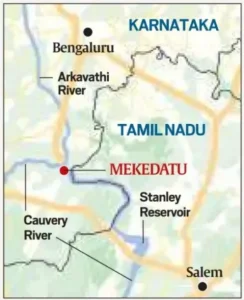
- Location: Proposed across the Cauvery River at Mekedatu Gorge in Ramanagara district of Karnataka.
- Situated downstream of the confluence of the Arkavathi and Cauvery rivers.
- Purpose: Intended as a balancing reservoir for storing water for:
- Drinking water supply to Bengaluru and nearby areas.
- Hydropower generation.
- Capacity: Proposed storage capacity of around 67 TMC (Thousand Million Cubic Feet) of water.
- Karnataka’s Argument: Claims the project will utilize Karnataka’s allocated share of Cauvery water and improve water management without affecting Tamil Nadu’s share.
- Tamil Nadu’s Objection: Tamil Nadu contends that no new project in the Cauvery basin should proceed without:
- Consent of co-basin States.
- Approval of the Union Government.
- Clearance from the Cauvery management framework.
- Reasons for Tamil Nadu’s Opposition: Fears reduction in downstream water flow to Tamil Nadu.
- Argues that the Cauvery basin is already a water-deficit basin and water has been fully allocated by tribunal and court orders.
Cauvery Water Dispute
- Interstate River Dispute: Dispute over sharing of Cauvery River waters among Karnataka, Tamil Nadu, Kerala, and Puducherry.
- Origin of Dispute: Rooted in agreements of 1892 and 1924 between the Madras Presidency and the Princely State of Mysore.
- Cauvery Water Disputes Tribunal (CWDT): Constituted in 1990 under the Inter-State River Water Disputes Act, 1956.
- Delivered final award in 2007 after 17 years of deliberations.
- Supreme Court Verdict (2018): Modified the Tribunal Award and increased Karnataka’s share and reduced Tamil Nadu’s allocation accordingly.
- Cauvery Water Management Authority (CWMA): Established in 2018 to implement the SC judgment and monitor water releases among basin states.
- Key Cause of Conflict:
- Upstream Karnataka seeks water storage for irrigation and drinking water.
- Downstream Tamil Nadu depends heavily on Cauvery for delta agriculture.
- Water-Deficit Basin: Both the Tribunal and Supreme Court recognised Cauvery as a water-stressed/deficit basin, making equitable sharing crucial.
Click to Explore UPSC Offline Coaching
Constitutional & Legal Framework for Inter-State River Water Disputes:
- Article 262: Empowers Parliament to adjudicate disputes relating to inter-State rivers and river valleys; allows exclusion of Supreme Court jurisdiction in such matters.
- Entry 17, State List (List II):Water is primarily a State subject (water supply, irrigation, canals, drainage, etc.).
- Entry 56, Union List (List I): Parliament can regulate and develop inter-State rivers and river valleys in the public interest.
- Inter-State River Water Disputes Act, 1956: Provides for the establishment of Tribunals to adjudicate inter-State river water disputes.
- River Boards Act, 1956: Enables the Centre to establish River Boards for inter-State river basin management and development.
|
 22 Jun 2026