Industrial Accidents in India: Causes, Safety Failures & Lessons from Recent Boiler Explosion

17 Apr 2026

Industrial Accidents in India: Causes, Safety Failures & Lessons from Recent Boiler Explosion

At least 10 workers have died and have been injured after a major industrial accident caused by a boiler  explosion at a Vedanta power plant in Chhattisgarh.
  • According to preliminary findings, the incident was triggered by the bursting of a pipeline carrying hot water, leading to severe burn injuries among workers present at the site.

Best Online Coaching for UPSC

About Industrial Accident

Industrial Accidents in India

  • Industrial accidents refer to unplanned events in industrial settings (factories, power plants, chemical units) that result in injury, loss of life, environmental damage, or property loss. 
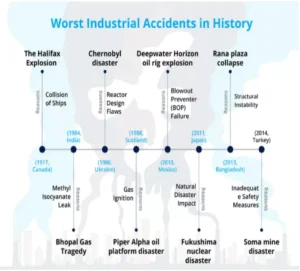
    • For Example: Bhopal Gas Tragedy 1984
  • They are often linked to hazardous processes, unsafe working conditions, and regulatory failures. Major incidents such as the Bhopal Gas Tragedy highlight their catastrophic potential.

Reasons Behind Industrial Accidents (Current Disaster)

  • Weak Inspection & Regulatory Oversight: Neither the national boiler inspection regime nor the regulatory framework heighten oversight in these phases. 
    • Certification is valid for up to a year even though boiler conditions vary on a daily basis. 
  • Perverse Incentive Structure: The current structure also penalises downtime instead of unsafe operations and rewarding maintenance shutdowns. 
  • Inadequate Focus on Continuous Monitoring: Events such as those at Sakti are also evidence that the framework’s focus on fabrication standards rather than continuous instrumentation and auditing is not working. 
  • Ease of Doing Business vs Safety: The Centre’s focus on ‘ease of doing business’ has favoured self-certification and scheduled third-party audits in place of surprise government inspections. 
  • Regulatory Uncertainty: The Boiler Accident Inquiry Rules were notified in 2025; whether they will address these structural gaps remains to be seen.
  • Stress on Ageing Infrastructure: The expansion of India’s industrial capacity is pushing ageing infrastructure harder, more plants are operating closer to their limits, and flaws in their management are being exposed to more media coverage and political attention.
  • Vulnerability of Contract Labour: Contract labour is the most exposed. A growing share of workers are migrants hired via subcontractors, who trade blame with the operator after a disaster. 
  • Lack of Safety Awareness: The safety signage and manuals are often unavailable in workers’ native languages.
    • Investigators have reported workers in the Pune industrial belt since 2021 and following explosions in Sangareddy in 2024 and 2025 being unaware of the names and properties of the chemicals in their workplace.
  • Gaps in Labour Liability Framework: The new OSHW Code 2020 also does not clearly hold the principal employer criminally liable for safety lapses in contractors’ operations but qualifies it on the employer’s negligence. 

Major Industrial Disasters in India

  • Bhopal Gas Tragedy (1984): Leak of methyl isocyanate gas from Union Carbide plant; world’s worst industrial disaster with massive loss of life and long-term health impacts.
  • Chasnala Mining Disaster: Flooding of a coal mine in Dhanbad led to the death of over 350 miners.
  • Visakhapatnam Gas Leak(2020): Styrene gas leak from LG Polymers plant causing deaths and widespread illness.
  • Neyveli Thermal Power Plant Explosion:Boiler explosion at NLC plant in Tamil Nadu resulting in fatalities and injuries.
  • Sivakasi Fireworks Factory Explosions: Frequent explosions in fireworks units due to unsafe handling of explosive materials.

Framework on Industrial & Chemical Safety

International 

  • International Labour Organization Conventions
    • Convention 155: Establishes national policies on occupational safety and health.
    • Convention 174: Focuses on prevention, preparedness, and response to major industrial accidents.
  • United Nations Environment Programme (UNEP): Promotes chemical safety, risk reduction, and disaster preparedness through global guidelines and capacity-building initiatives.
  • OECD Chemical Accident Programme: Encourages adoption of best practices in chemical risk management, safety protocols, and accident prevention strategies among industries.
  • Sendai Framework for Disaster Risk Reduction: Emphasises disaster risk reduction, resilience building, and minimising losses from industrial and technological hazards.

UPSC Online Courses

Occupational Safety, Health and Working Conditions Code 2020

  • It clearly defines the duties and responsibilities of both employers and employees to ensure workplace safety.
  • It lays down sector-specific safety standards for different industries.
  • It focuses on the overall well-being of workers, including health, working conditions, working hours, and leave provisions.
  • It recognises and protects the rights of contract workers.
  • It promotes gender equality by allowing women to work in all types of establishments and roles.

India

  • Factories act, 1948:  It provides safety provisions for hazardous processes.
  • Plantations labour act, 1951:  It focuses on the safety and welfare of workers in plantations.
  • Mines Act, 1952:  It provides guidelines for safety and health in mines, including regulations for mining operations and worker welfare.
  • Environment Protection Act 1986: This Act provides a comprehensive legal framework for the protection and improvement of the environment and control of industrial pollution.
  • Public Liability Insurance Act (PLIA): This Act mandates industries dealing with hazardous substances to take insurance so that immediate relief can be provided to accident victims.
  • National Policy on Safety, Health and Environment at Workplace (2009): Promotes a preventive safety culture and ensures safe and healthy working conditions.
  • Directorate General Factory Advice Service & Labour Institutes (DGFASLI):  Provides technical guidance, training, and support for industrial safety and health.
  • National Disaster Management Authority (NDMA) Guidelines: It  issues frameworks and guidelines for chemical disaster management and preparedness.

Way Forward

  • Strengthen Inspection Mechanisms: Move beyond periodic checks by introducing surprise inspections and real-time monitoring through IoT sensors. 
    • For instance, continuous pressure and temperature sensors in boilers can alert authorities instantly, preventing accidents like the Sakti boiler explosion.
  • Shift to Continuous Safety Auditing: Replace annual certification with dynamic, risk-based audits. Industries handling hazardous chemicals can adopt real-time dashboards to track safety parameters, similar to advanced refineries where deviations trigger automatic shutdowns.
  • Fix Accountability Clearly: Establish clear liability of principal employers in contractor-based operations. 
  • Promote Safety Culture: Encourage industries to prioritise safety over production by incentivising preventive maintenance shutdowns. 
    • Companies that proactively halt operations for safety checks should be rewarded rather than penalised for downtime.
  • Technology Integration: Leverage AI, predictive maintenance, and digital twins to detect risks early.
    • For instance, thermal power plants can use predictive analytics to identify equipment fatigue before failure, reducing the likelihood of explosions.

Click to Explore UPSC Offline Coaching

Aspect Industrial Disaster Chemical Disaster
Definition Accidents arising from industrial operations such as machinery failure, explosions, or structural collapse Disasters caused by the release, leakage, or explosion of hazardous chemicals
Nature of Hazard Mechanical, electrical, thermal Toxic, corrosive, flammable, reactive substances
Causes Boiler explosions, equipment failure, human error, poor maintenance Gas leaks, chemical spills, improper storage/handling, process failure
Scope May be confined to factory premises or immediate surroundings Often spreads beyond factory, affecting air, water, and large populations
Impact on Health Injuries, burns, fatalities Poisoning, respiratory illness, long-term health effects, deaths
Environmental Impact Limited to physical damage and localized pollution Severe contamination of air, water, and soil
Examples Boiler explosion in Chhattisgarh Bhopal Gas Tragedy
Response Mechanism Firefighting, rescue, structural safety measures Evacuation, decontamination, medical emergency response
Regulatory Focus Factory safety norms, equipment standards Chemical handling rules, hazardous waste management, environmental laws
Predictability Relatively predictable with maintenance and inspection Less predictable due to chemical reactions and leak dynamics

Check Out UPSC CSE Books

Visit PW Store


online store 1

Explore SRIJAN Prelims Crash Course

Need help preparing for UPSC or State PSCs?

Connect with our experts to get free counselling & start preparing

Aiming for UPSC?

Download Our App

      
Quick Revise Now !
AVAILABLE FOR DOWNLOAD SOON
UDAAN PRELIMS WALLAH
Comprehensive coverage with a concise format
Integration of PYQ within the booklet
Designed as per recent trends of Prelims questions
हिंदी में भी उपलब्ध
Quick Revise Now !
UDAAN PRELIMS WALLAH
Comprehensive coverage with a concise format
Integration of PYQ within the booklet
Designed as per recent trends of Prelims questions
हिंदी में भी उपलब्ध

<div class="new-fform">


    </div>

    Subscribe our Newsletter
    Sign up now for our exclusive newsletter and be the first to know about our latest Initiatives, Quality Content, and much more.
    *Promise! We won't spam you.
    Yes! I want to Subscribe.