Subject: GS 3: Security
Context: According to the 2026 Annual Report of the Narcotics Control Bureau (NCB), Myanmar has replaced Afghanistan as the world’s largest source of illicit opium following the Taliban’s 2022 ban on poppy cultivation.
- The report highlights that the consequences are increasingly visible along India’s eastern borders, particularly through Manipur, Mizoram and Nagaland, while drone-based narcotics trafficking from Pakistan has also emerged as a significant security challenge.
Best Online Coaching for UPSC
The Narcotics Control Bureau (NCB)
- It was established on 17th March 1986 by the Government of India to lead the national effort against drug trafficking and abuse.
 Operating under the supervision of the Central Government, NCB coordinates enforcement actions across states and various agencies under the Narcotic Drugs and Psychotropic Substances (NDPS) Act, 1985 and related laws. Operating under the supervision of the Central Government, NCB coordinates enforcement actions across states and various agencies under the Narcotic Drugs and Psychotropic Substances (NDPS) Act, 1985 and related laws. - It also ensures India’s compliance with international conventions, supports global cooperation to combat drug trafficking, and works with other ministries to address issues related to drug abuse.
- NCB-specific Expansion:
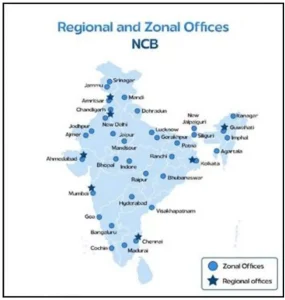
- Regional Offices: Increased from 3 to 7 (e.g., Amritsar, Guwahati, Chennai, Ahmedabad)
- Zonal Offices: Expanded from 13 to 30, including new ones at Gorakhpur, Siliguri, Agartala, Itanagar, and Raipur.
- Staff Strength: Added 536 posts raising sanctioned strength to 1,496.
- Narco-Canine Pool: Nar-K9 units deployed in 10 zonal offices for enhanced detection.
|
Drivers Behind Myanmar’s Emergence as the Global Opium Hub
- Taliban’s Opium Ban: The Taliban’s ban on opium poppy cultivation in April 2022 led to an estimated 93% decline in Afghanistan’s opium production, creating a global supply vacuum.
- Expansion of Poppy Cultivation: Myanmar’s illicit poppy cultivation expanded by nearly 56% between 2021 and 2023, reaching approximately 45,200 hectares.
- Political Instability: The 2021 military coup and the subsequent civil conflict weakened state control, allowing illicit drug production and trafficking networks to flourish.
- Ethnic Armed Organisations: Drug production is concentrated in Shan State, where several ethnic armed groups finance their activities through narcotics trafficking.
- Golden Triangle Resurgence: The Golden Triangle has re-emerged as one of the world’s largest centres for the production of opium, heroin and synthetic drugs, particularly methamphetamine (Yaba).
Production & Trafficking Profile
- Global Production:
- Myanmar: Myanmar is currently the world’s largest source of illicit opium, replacing Afghanistan after the Taliban’s ban.
- Afghanistan: Although production has declined sharply, the Golden Crescent continues to remain an important trafficking corridor because of large pre-ban opium stockpiles.
- Major Illicit Production Regions:
- Golden Triangle: Myanmar, Laos and Thailand
- Golden Crescent: Afghanistan, Pakistan and Iran
 India’s Position:
-
- Legal Opium Producer: India is among the few countries authorised to cultivate opium poppy legally for medicinal and scientific purposes under the Single Convention on Narcotic Drugs, 1961.
- Licensed Cultivation: Legal cultivation is undertaken under licence in Madhya Pradesh, Rajasthan and Uttar Pradesh.
- Transit Country: Owing to its strategic location between the Golden Triangle and the Golden Crescent, India has emerged as a major transit and destination country for illicit narcotics.
Implications for India’s Internal Security
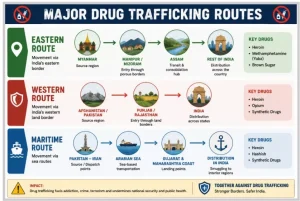
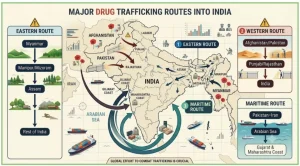
- Eastern Border Corridor: The Manipur corridor, connected through National Highway-102, has become the principal land route for trafficking heroin and methamphetamine into India.
- Mizoram Route: Drugs also enter through Champhai (Mizoram) before moving towards Assam and the Indian hinterland.
- Porous Border: Unfenced borders, difficult terrain and cross-border ethnic linkages facilitate illegal movement of narcotics.
- Free Movement Regime (FMR): The movement of border communities under the FMR has been increasingly exploited by trafficking networks.
- Drone-based Smuggling: Cross-border narcotics trafficking through Unmanned Aerial Vehicles (UAVs) has increased significantly along the Punjab border.
- Maritime Trafficking: Drug syndicates increasingly use fishing vessels and small coastal boats to transport narcotics through the Gujarat and Maharashtra coastlines.
- National Security Threat: Drug trafficking fuels organised crime, terror financing, money laundering, cross-border insurgency, and drug addiction, posing a multidimensional internal security challenge.
Click to Explore UPSC Offline Coaching
| PWOnlyIAS Extra Edge:
Key Regions, Routes & Concepts:
- Golden Triangle:
- Location: Tri-junction of Myanmar, Laos and Thailand.
- Significance: One of the world’s largest centres for the production of opium, heroin, and methamphetamine (Yaba).
- Golden Crescent:
- Location: Afghanistan, Pakistan and Iran.
- Significance: Traditionally the world’s largest opium-producing region and an important global trafficking corridor.
- Yaba:
- Composition: A synthetic drug containing methamphetamine and caffeine.
- Origin: Widely manufactured in the Golden Triangle.
- Amphetamine-Type Stimulants (ATS):
- Definition: Synthetic psychoactive substances that stimulate the central nervous system.
- Examples: Methamphetamine, Amphetamine, and MDMA (Ecstasy).
- Free Movement Regime (FMR):
- Purpose: Allows recognised border tribes to cross the India–Myanmar border without a visa for specified purposes.
- Current Status: Under review owing to growing national security concerns.
|
 27 Jun 2026