Recently, the Stockholm International Peace Research Institute (SIPRI) released its 2026 fact sheet titled Developments and Trends in Multilateral Peace Operations, 2025.
Key Highlights of the Report
It warns that global peacekeeping is facing a major crisis due to a “perfect storm” of funding shortages and intense political fights between powerful countries.
- Declining Deployment Strengths: By the end of 2025, the number of international peacekeepers fell to around 79,000 (78,633).
- This represents a massive 49% decline since 2016 and the lowest level in 25 years.
- Shrinking Mission Footprint: The total number of active peace missions dropped to 58 across 34 countries.
- This is the first time since 2016 that active operations have fallen below 60.
- High Geographical Concentration: Peacekeepers are not distributed evenly.
- Nearly three-fourths (75%) of all global personnel are deployed in just five conflict zones — South Sudan, Central African Republic, Somalia, Democratic Republic of the Congo, and Lebanon.
UPSC Coaching Classes
Historical & Operational Background
- Genesis: UN Peacekeeping began in 1948 with the United Nations Truce Supervision Organization (UNTSO) to monitor ceasefires in the Middle East.
- The Three Core Principles: All operations must strictly follow three basic rules:
- Consent of the main parties involved in the conflict,
- Strict neutrality (Impartiality), and
- Non-use of force except in self-defence and defence of the mission’s goals
- Deployment Framework: The UN has no standing military of its own.
- Peacekeeping operations are authorized and controlled exclusively by the UN Security Council (UNSC), relying entirely on voluntary troops and police sent by member countries.
PWOnlyIAS Extra Edge:
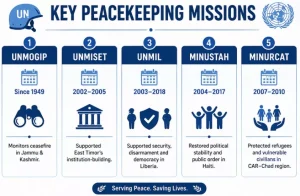
Key Historical and Active Peacekeeping Missions
- UNMOGIP (UN Military Observer Group in India and Pakistan): Started in 1949 to supervise the ceasefire in Jammu and Kashmir; remains one of the oldest active UN missions.
- UNMISET (UN Mission of Support in East Timor): Operated from 2002 to 2005 to help build government institutions after independence.
- UNMIL (UN Mission in Liberia): Operated from 2003 to 2018 to maintain security, help soldiers disarm, and assist democratic transitions.
- MINUSTAH (UN Stabilization Mission in Haiti): Operated from 2004 to 2017 to restore political stability and public order.
- MINURCAT (UN Mission in the Central African Republic and Chad): Operated from 2007 to 2010 to protect refugees and vulnerable civilians.
India’s Relevance & Contribution
- Historical Legacy: India has been one of the largest cumulative troop contributors to UN Peacekeeping operations since their very beginning, having participated in more than 50 missions worldwide.
- High Operational Stakes: India currently has thousands of “Blue Helmets” deployed in major global flashpoints highlighted by the SIPRI report, including UNMISS (South Sudan) and UNIFIL (Lebanon).
- Champion of Gender Parity: India pioneered the deployment of the first all-female police unit in Liberia in 2007.
- Recently, the UN honored Indian peacekeeper Major Abhilasha Barak with the prestigious UN Military Gender Advocate of the Year Award, highlighting India’s leading role in women, peace, and security initiatives.
- Voices of the Global South: As noted by SIPRI, India stands at the forefront of the developing nations that bear the maximum physical risk of these missions, making India a key advocate for structural reforms and fairer decision-making powers at the UNSC.
|
Key Challenges Faced by Peacekeeping Operations
- Funding Shortfall: Wealthy donor countries like the USA failed to pay their promised shares.
- This caused a massive $2 billion shortfall in the UN’s $5.6 billion peacekeeping budget for 2024–25, forcing deep cuts to troop numbers.
- Geopolitical Gridlock: Hardline demands and veto threats from permanent members (P5) in the UN Security Council have made it very difficult to renew mission mandates.
- For example, U.S. pressure pushed to end the UN Interim Force in Lebanon (UNIFIL), forcing a compromise where the UNSC renewed the mission for a final time only until December 2026.
- Defunding of Regional Missions: Western groups are moving money away due to changing political priorities.
- For instance, the European Union has redirected its European Peace Facility (EPF) funding away from long-standing peace operations in Africa to prioritize Ukraine and West Asia.
- Rise of Ad Hoc Interventions: Because the UN is stuck in gridlock, middle powers (like the UAE) are increasingly making bilateral (two-country) military deals.
- These focus on short-term security fixes rather than long-term peace.
- Unequal Burden on the Global South: The report highlights a stark systemic imbalance where all top 10 troop-contributing nations—including India—are developing countries from the Global South, while wealthy Western nations mostly dictate the mandates and hold the financial keys.
Way Forward
- Securing Predictable Funding: Member states must go beyond vocal support and provide steady, guaranteed funding to prevent missions from shutting down.
- Equitable Burden-Sharing: Developed nations need to share the physical risk and send their own soldiers to match the heavy troop commitments of the Global South.
- Stronger Regional Cooperation: The UN must build stronger partnerships with regional organizations (such as the African Union) to effectively handle rapidly changing global security threats.
Click to Know UPSC OnlyIAS Coaching Centres
Conclusion
The steady decline of traditional UN peacekeeping shows that countries are turning away from shared global conflict management. Without steady money, structural reforms, and agreement among powerful nations, the breakdown of global security rules will ultimately leave innocent civilians to suffer the worst impacts of war.
 26 May 2026