Subject: GS 2: Polity & Governance
Context: Recently, the Ministry of Home Affairs has tightened rules for Non-Governmental Organisations (NGOs) using foreign donations.
- The updates fix exact areas of work, expand leadership accountability, and raise fines to track foreign money and stop religious conversions.
IAS coaching
Key Changes
- Strict Rules on Location and Work:
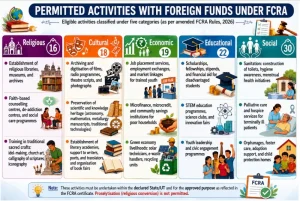
- Exact Choices: NGOs must choose their work from a strict list under five groups: Social, Economic, Educational, Cultural, and Religious.
- Fixed State/UT boundaries: NGOs must state the exact State or Union Territory where they will spend the money. Existing NGOs have one year to submit Form FC-6F to choose their area.
- Fees per State: Instead of one flat fee, NGOs must now pay separate fees for every activity and every State they work in.
 Ban on Religious Conversions (Proselytisation): The biggest changes are in the religious category. Foreign funds are allowed for building places of worship or running community kitchens (langars). However, foreign money is strictly banned from proselytisation (trying to convert people’s religion) in:
-
- Teaching religion, holding meditation retreats, or conducting discourses.
- Studying or documenting religious history and theology.
- Preserving and reviving tribal or local faith practices.
- Spending Limits and Money Rules:
- The ₹10 Lakh Minimum: To renew their license, an NGO must show it actively spent at least ₹10 lakh of foreign money over the last two years.
- The 75% Rule: If an NGO gets money in parts, the government will release the next installment only after 75% of the previous money is spent and verified by a field check.
- Tracking Donors: NGOs must reveal the real, original donor if the money passes through middle-man funds or platforms.
- Who is Accountable?
- More Leaders Tracked: The definition of a “key functionary” now includes trustees, directors, partners, and the head (Karta) of a Hindu Undivided Family.
- Foreign National Ban: NGOs run by foreign citizens (except Persons of Indian Origin) are generally not allowed to get a license unless the government gives special permission.
- Social Media & Books: NGOs must declare all their websites, social media handles, and any books or articles published by their leaders.
- Revised Fines: The government revised the fines for breaking these laws. The minimum fine is now ₹1 lakh.
| Mistake / Violation |
New Fine |
| Using money for unapproved work or states |
- ₹1 lakh or 30% of the misused money (whichever is higher).
|
| Investing in risky assets (speculation) |
- ₹1 lakh or 30% of the money invested (whichever is higher), plus 100% recovery of all profits.
|
| Spending too much on office/admin costs |
- ₹1 lakh or 5% of the extra money spent (whichever is higher), if they cross the allowed 20% limit.
|
About (FCRA) Foreign Contribution (Regulation) Act
- It regulates and prohibits the acceptance and utilisation of foreign contributions by certain associations for any activities detrimental to the national interest.
- The Act also prohibits the receipt of foreign funds by candidates for elections, journalists or newspaper and media broadcast companies, judges and government servants, members of the legislature and political parties or their office-bearers, and organisations of a political nature.
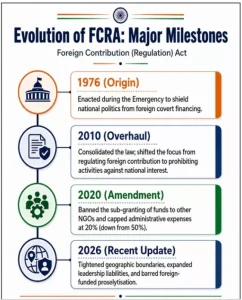
- Origin: The FCRA was enacted during the Emergency in 1976 amid apprehensions that foreign powers were interfering in India’s affairs by pumping money into the country through independent organisations.
- Duration of Approval Granted: FCRA registration is valid for five years.
- NGOs are expected to apply for renewal within six months of the registration expiry date. In case of failure to apply for renewal, the registration is deemed to have expired.
On What Basis is Approval Cancelled?
- Registration can be cancelled if an inquiry finds:
- A false statement in the application.
- NGO is found to have violated any of the terms and conditions of the certificate or renewal.
- If it has not been engaged in any reasonable activity in its chosen field for the benefit of society for two consecutive years.
- If it has become defunct.
- Other reasons for cancellation:
- If in the opinion of the Central Government, it is necessary in the public interest to cancel the certificate.
- When an audit finds irregularities in the finances of an NGO in terms of misutilisation of foreign funds.
- Remedy: All government orders can be challenged in the High Court.
Amendments to the FCRA:
- FCRA Amendment 2010: Enacted to consolidate the law on utilising foreign funds, and to prohibit their use for any activities detrimental to national interest.
- FCRA Amendment 2020: The law was amended again, giving the government tighter control and scrutiny over NGOs’ receipt and utilisation of foreign funds.
- Foreign Contribution (Regulation) (Amendment) Rules, 2022: In July 2022, the Ministry of Home Affairs (MHA) changed FCRA rules, increasing the number of compoundable offenses under the Act from 7 to 12.
- The other key changes were:
- Exemption from intimation to the government for contributions less than Rs 10 lakh, the earlier limit was Rs 1 lakh.
- Increase the time limit for the intimation of the opening of bank accounts.
|
Significance of the New Changes
- Insulating Sovereignty: Shields internal democratic systems from outside financial influence, making sure that cross-border wealth doesn’t reshape regional communities or drive manufactured social campaigns.
- Targeted Fund Trails: Locking functions to unique jurisdictions helps monitoring agencies spot double-dipping or secret shifts of money from simple aid to unapproved campaigns.
- Weeding Out Redundant Units: Setting a firm financial floor filters out inactive shell groups that take up oversight bandwidth and often act as passages for illicit money transfers.
- Personalized Executive Liability: Expanding leadership definitions makes managers directly liable for institutional actions, reducing internal errors and building fiscal discipline.
Need for FCRA:
- National Interest and Security: The law sought to regulate foreign donations to individuals and associations so that they functioned consistently with the values of a sovereign democratic republic.
- In 2015, the Ford Foundation was put under the prior approval category and put on the Home Ministry’s watch list for some time in the interest of national security.
- Regulation of Foreign Funding: The FCRA provides a legal framework for regulating foreign contributions to ensure transparency and accountability in utilising such funds.
- Preventing Money Laundering and Unlawful Activities: The FCRA helps prevent using foreign funds for prohibited or unlawful activities under Indian law.
- For instance, the Enforcement Directorate (ED) froze the bank accounts of NGO Amnesty International (AI) India over alleged charges of money laundering in 2020.
- Ensuring Legitimate Purposes: The act is designed to ensure that foreign contributions are used for legitimate purposes such as social, educational, cultural, and economic activities that benefit the people of India. It establishes mechanisms to verify the authenticity of the organizations receiving foreign funds.
- In 2016, the Ministry of Home Affairs (MHA) cancelled the FCRA licence of the NGO Lawyers’ Collective for allegedly using foreign contributions for political purposes.
|
Challenges that need to be Addressed
- Administrative Gridlock: Forcing separate registration pipelines and fee processing for every single territory creates deep administrative drag that could slow down immediate public support.
- Ambiguous Operational Clauses: Phrases like “ideological content” remain open to interpretation. This lack of definition could lead to local investigators unfairly halting valid studies on human liberties or folk arts.
- Delaying Vital Crisis Relief: Requiring 75% fund drainage and physical verification checks before giving out subsequent tranches could cripple relief efforts during sudden climate catastrophes or healthcare crises.
- Survival Threats to Micro-NGOs: Well-funded cross-border organizations can handle complex compliance routines, but small-scale, localized grassroots networks lack the manpower and may be forced to shut down.
Click to Explore UPSC Offline Coaching
Way Forward
- Objective Rulebooks: The government should release clear, objective definitions for political and ideological thresholds to protect peaceful social workers from unfair targeting.
- Automated Filing Pipelines: To balance security with function, the new reporting rules and Form FC-6F declarations should rely on a swift, automated web dashboard that bypasses bureaucratic delays.
- Proportional Risk Evaluation: Mirroring international Financial Action Task Force (FATF) frameworks, the state should use risk-ranked targeting—focusing heavily on suspicious channels while offering easier compliance paths for historically clean social groups.
- Cultivating Domestic Backing: To reduce dependence on international capital for human development, India could broaden corporate social responsibility (CSR) incentives, shifting the resource base to internal philanthropy.
 24 Jun 2026