National Space Day 2026
Context: India observed its third National Space Day on 23 August 2026, commemorating Chandrayaan-3’s historic lunar landing.
UPSC Online Courses
About National Space Day
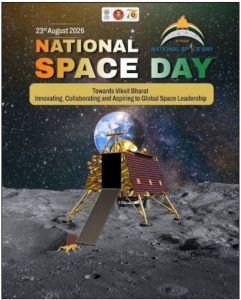
- National Space Day is observed annually on 23 August to commemorate the successful soft landing of Chandrayaan-3’s Vikram Lander and deployment of the Pragyan Rover on the Moon on 23 August 2023.
- The landing occurred near the lunar south-polar region at Shiv Shakti Point.
- Chandrayaan-3 made India the fourth country to successfully soft-land on the Moon, after the former Soviet Union, the United States and China.
- India became the first country to achieve a soft landing in the Moon’s southern high-latitude region.
- Origin: India celebrated the first National Space Day on 23 August 2024.
- 2026 Theme: “Towards Viksit Bharat: Innovating, Collaborating and Aspiring to Global Space Leadership.”
- 2026 Focus Areas
- Innovation: Developing indigenous space technologies, applications and advanced capabilities.
- Collaboration: Strengthening cooperation among ISRO, academia, startups, industry and international partners.
- Global Leadership: Promoting India as a leading and responsible spacefaring nation through peaceful exploration and technological self-reliance.
- Major Events in 2026: The main national programme was organised at the Space Applications Centre (SAC), Ahmedabad, reflecting Gujarat’s historical connection with Vikram Sarabhai.
- Exhibitions showcased ISRO achievements, space technologies and the growing Indian space-startup ecosystem.
- National Space Day inspires scientific temper and STEM participation while showcasing India’s technological capabilities and strengthening its aspirations for global space leadership.
Mangrol ASW-SWC
Context: The Indian Navy received Mangrol, the third indigenous ASW Shallow Water Craft, from Cochin Shipyard Limited on 21 August 2026.
About Mangrol
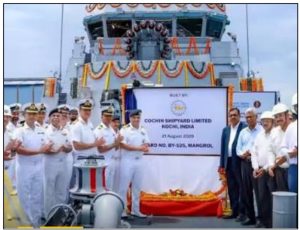
- Mangrol is an Anti-Submarine Warfare Shallow Water Craft (ASW-SWC) designed to detect and counter underwater threats in shallow coastal waters.
- It belongs to the Mahe-class of ASW Shallow Water Crafts being built for the Indian Navy.
- The first and second ships of the Indian Navy’s Mahe-class Anti-Submarine Warfare Shallow Water Craft (ASW-SWC) are INS Mahe and INS Malvan.
- Built By: Mangrol has been constructed by Cochin Shipyard Limited (CSL), Kochi, under a Ministry of Defence contract for eight ASW-SWCs.
- It incorporates more than 80% indigenous content, reflecting increasing domestic capability in naval shipbuilding and defence manufacturing.
- Namesake: The vessel is named after Mangrol, a coastal town and minor port in Junagadh district, Gujarat, known for its fishing harbour.
- The name also revives the legacy of the former INS Mangrol, an Indian Navy minesweeper that remained in service until 2004.
- Key Features
- Anti-Submarine Warfare: Mangrol is equipped with shallow-water sonar, lightweight torpedoes and anti-submarine rockets for detecting and engaging underwater threats.
- Propulsion and Surveillance: Its waterjet propulsion system provides high manoeuvrability in shallow waters, while advanced radars and surveillance systems enhance maritime domain awareness.
- Multiple Operational Roles: Besides ASW, it can undertake underwater surveillance, mine warfare and Low-Intensity Maritime Operations (LIMO) in coastal areas.
Mangrol strengthens India’s coastal anti-submarine capabilities while advancing Aatmanirbhar Bharat through indigenous naval shipbuilding and defence manufacturing.
BHU Uncovers A 70-Year-Old Archaeological Treasure From Rajghat
Context: The Banaras Hindu University (BHU) recently opened 22 boxes excavated from Rajghat, Varanasi, in 1957.
About The Discovery
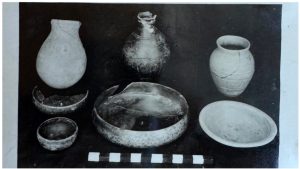
- Archaeological Artifacts: Include sculptures, ancient coins, tools, stamp seals, and objects made of copper, ivory, and bone, as well as pottery believed to be nearly 3,000 years old.
- Inscriptions and Scripts: Several seals bear inscriptions, including in Brahmi script, offering potential insights into ancient governance, trade and economic systems.
- Rare Photographic Records: Around 3,000 glass slides and over 5,000 photographic negatives documenting archaeological sites such as Rajghat, Ajanta, Ellora, Ratnagiri and Manjhi.
Why Is Rajghat Important?
- Ancient Varanasi: Rajghat, near the Ganga–Varuna confluence, was an important settlement of ancient Varanasi, associated with the Kashi Mahajanapada.
- Long Cultural History: Excavations indicate six cultural periods, from around 800 BCE to the medieval period.
- Recent Discovery: A human skeleton recovered from Rajghat and preserved in a sealed box for nearly 70 years was recently opened for study.
- Samples were collected for genetic and bioarchaeological analysis to understand the people who lived in Varanasi around 1,000 years ago.
Typhoon Narra
Context: Typhoon Narra triggered widespread flooding in China’s Guangxi region, forcing around 54,000 people to relocate, while heavy rainfall is expected to continue across southern China.
About Typhoon Narra
- Typhoon Narra, internationally designated 2619 and known as Zitan in China, is the 19th named storm of the 2026 Pacific typhoon season.
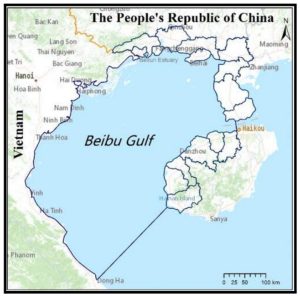
- Origin: Narra developed from a tropical depression in the South China Sea that intensified over the Beibu Gulf on August 21, 2026, becoming a tropical storm.
- Beibu Gulf, also called the Gulf of Tonkin, is a vital body of water in Southeast Asia bordered by southern China (Guangxi, Guangdong, and Hainan) and northern Vietnam.
- Naming: The name Narra, meaning the Philippine national tree (Pterocarpus indicus), was contributed by the Philippines under the regional typhoon-naming system.
- Impacted Region: The typhoon affected Guangxi, Guangdong and Hainan in China, while heavy rainfall also affected parts of northern Vietnam.
UPSC Online Classes
Chlorpheniramine Maleate–Phenylephrine FDCs
Context: The government has restricted all Chlorpheniramine Maleate–Phenylephrine FDCs for children below four years, citing potential health risks and safer alternatives.
About Fixed-Dose Combinations (FDCs)
- A Fixed-Dose Combination (FDC) is a pharmaceutical formulation containing two or more active pharmaceutical ingredients (APIs) in a predetermined fixed ratio within a single dosage form.
- Examples:
-
- Amoxicillin + Clavulanic Acid: Clavulanic acid inhibits bacterial enzymes that can destroy amoxicillin, enhancing its effectiveness.
- Rifampicin + Isoniazid: The combination is widely used in tuberculosis treatment to improve efficacy and reduce the risk of drug resistance.
About Chlorpheniramine–Phenylephrine FDCs
- Chlorpheniramine Maleate–Phenylephrine is an FDC commonly used in medicines for the symptomatic relief of cold and allergy-related symptoms.
- Key Composition:
-
- Chlorpheniramine Maleate: An antihistamine that helps relieve symptoms such as sneezing and runny nose.
- Phenylephrine Hydrochloride: A decongestant that helps reduce nasal congestion.
- Application: The combination is used to provide relief from multiple upper-respiratory symptoms, particularly nasal congestion, runny nose and sneezing.
Rationale for Restricting Chlorpheniramine–Phenylephrine FDCs
- Child Safety & Safer Alternatives: The combination poses potential risks in children below four years, while safer therapeutic alternatives are available for managing their symptoms.
- Regulatory and Public-Health Action: The decision follows recommendations of an Expert Committee and the Drugs Technical Advisory Board (DTAB) and has been issued under Section 26A of the Drugs and Cosmetics Act, 1940, in the interest of public health.
- Labelling Requirement: Manufacturers must prominently display the warning: “Fixed Dose Combination shall not be used in children below four years of age” on labels, package inserts and promotional literature.
Click to Know UPSC Coaching Centres in India
Surge in H1N1 Infection
Context: The Indian Council of Medical Research (ICMR) has calrified that the Influenza A (H1N1) viruses currently circulating in the country belong to the A/Missouri/11/2025 (H1N1) pdm09-like virus strain.
About H1N1 Infection
- H1N1 is a subtype of Influenza A virus that causes seasonal respiratory illness and is commonly known as swine flu.
- H1N1 stands for Hemagglutinin 1, Neuraminidase 1.
- These names refer to two specific types of proteins found on the surface of the virus.
- Caused By: H1N1 infection is caused by the Influenza A(H1N1)pdm09 virus, which has become part of the seasonal influenza spectrum.
- Strains: The currently circulating Indian strain is A/Missouri/11/2025 (H1N1)pdm09-like, classified under clade 6B.1A.5a2a and subclade D.3.1.1.
- Transmission: The infection primarily spreads through respiratory droplets and aerosols from infected individuals and through contaminated hands or surfaces.
- Fatality: Severe H1N1 infection can cause complications such as pneumonia and respiratory distress, particularly among vulnerable groups, although most healthy individuals recover with appropriate care.
- During the 2026 monsoon surge in India, the overall case fatality rate (CFR) for H1N1 (swine flu) has dropped significantly compared to historical outbreak levels (which peaked near 8.5% in 2009–2010).
- Prevention: Annual influenza vaccination, respiratory and hand hygiene, avoiding crowded places when symptomatic, masking when appropriate and maintaining adequate hydration.
- Treatment: Most cases recover with rest, fluids and symptomatic care, while medical consultation is advised when symptoms persist, worsen or become severe; high-risk patients may require specific medical treatment.
- Vaccine Relevance
- Vaccine Match: ICMR stated that circulating H1N1 strains are well matched with vaccine strains recommended for the Northern Hemisphere, reducing concern over vaccine mismatch.
- WHO Role: The WHO annually recommends influenza vaccine strains for the Northern and Southern Hemispheres based on surveillance data from its global laboratory network.
 24 Aug 2026