A pioneering country-wide study (2004–2024) has found that intensifying heatwaves accelerate the formation of harmful surface ozone (O₃), significantly increasing cardiovascular and respiratory mortality risks across India.
UPSC Online Preparation
Key Findings of the Study
- The Double Burden of Heatwaves and Ozone Pollution: The study found that heatwaves significantly accelerate the formation of surface ozone (O₃), causing ozone concentrations to rise to 85–110 μg/m³ across parts of northern India.
- These levels substantially exceed the World Health Organization (WHO) guideline value of 70 μg/m³, indicating heightened health risks during extreme heat events.
- Health Impact: The researchers estimated that exposure to elevated surface ozone levels contributes substantially to seasonal mortality associated with cardiovascular and respiratory diseases.
- During the heatwave days of 2024, approximately 26,500 deaths from Ischaemic Heart Disease (IHD) and Chronic Obstructive Pulmonary Disease (COPD) were linked to ozone exposure.
- The ozone surge associated with heatwave conditions was estimated to have caused nearly 830 additional deaths above normal baseline levels.
- Geographical Hotspot: The Western Himalayan region recorded the most rapid long-term increase in surface ozone concentrations.
- Ozone levels in the region exceeded the WHO guideline value by about 115% in 2024, making it one of the most vulnerable regions in the country.
- Climate Linkages: The most severe heatwave–ozone episodes observed during the study period, including those in 2010, 2016, 2019 and 2024, occurred following strong El Niño events.
- This suggests a close relationship between large-scale climate variability and extreme ozone pollution episodes in India.
About the Study
- Institutional Affiliation & Publication: The study was conducted by researchers from the Indian Institute of Technology (IIT) Kharagpur and Kerala University of Fisheries and Ocean Studies (KUFOS) and was published in the peer-reviewed journal npj Clean Air.
- Scope of the Study: It is the first comprehensive long-term, country-wide assessment of changes in surface ozone (O₃) during heatwave conditions in India, covering the period 2004–2024 and analysing 188 heatwave events.
- Methodology: In the absence of continuous ground-level ozone monitoring across many regions, the study used surface observations, satellite datasets, meteorological reanalysis products, and atmospheric modelling techniques to estimate surface ozone concentrations and their behaviour during heatwaves.
- Data Sources: The analysis integrated 20 years of India Meteorological Department (IMD) temperature records, satellite observations, and global atmospheric datasets to examine the relationship between heatwaves, ozone formation, and associated health risks.
- Significance: The study provides the first national-scale evidence that heatwaves significantly intensify surface ozone pollution, creating a compound heat–ozone hazard with serious implications for public health and climate adaptation policies in India.
About Ozone (O₃)
- Surface Ozone (Ground-Level Ozone) is a secondary air pollutant formed through chemical reactions between Nitrogen Oxides (NOₓ) and Volatile Organic Compounds (VOCs) in the presence of sunlight and high temperatures.
| Nitrogen Oxides (NOx)+Volatile Organic Compounds (VOCs)+Sunlight→Surface Ozone (O3) |
-
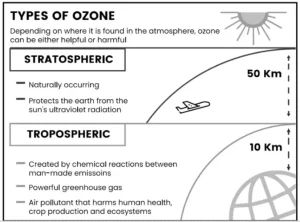
- It is a major component of photochemical smog and is often referred to as “bad ozone.” (UPSC CSE Mains 2022)
- Dual Nature of Ozone:
- Stratospheric Ozone (“Good Ozone”): Stratospheric ozone forms the ozone layer in the upper atmosphere and protects life on Earth by absorbing harmful ultraviolet (UV) radiation from the Sun.
- Tropospheric or Surface Ozone (“Bad Ozone”): Surface ozone is a harmful air pollutant that acts as a short-lived climate pollutant and poses significant risks to human health, agriculture and ecosystems.
PWOnlyIAS Extra Edge: (UPSC CSE Prelims 2011) & (UPSC CSE Prelims 1998)
- The Stratosphere is the second layer of Earth’s atmosphere, extending from about 12 km to 50 km above the surface.
- It contains the ozone layer, which absorbs harmful UV radiation.
- Unlike the troposphere, temperature increases with altitude due to ozone absorption. The air is dry and stable, with almost no clouds or weather disturbances, making it suitable for jet aircraft and weather balloons.
|
- Major Sources of Surface Ozone (O₃): Surface ozone is a secondary pollutant formed when Nitrogen Oxides (NOₓ) and Volatile Organic Compounds (VOCs) react in the presence of sunlight and high temperatures.
- Vehicular emissions are a major source of NOₓ and VOCs, particularly in urban areas.
- Thermal power plants release large quantities of NOₓ during the combustion of fossil fuels.
- Industrial activities, including refineries, cement plants, steel industries, and chemical manufacturing units, emit significant ozone precursors.
- Biomass burning, such as crop residue burning, forest fires, and household fuel combustion, contributes substantially to ozone formation.
- Diesel generators and construction machinery add to NOₓ emissions, especially in urban and peri-urban areas.
- Paints, solvents, adhesives, and petrochemical products release VOCs that facilitate ozone formation.
- Natural vegetation emits biogenic VOCs, which can also contribute to ozone generation under suitable conditions.
- Heatwaves, intense solar radiation, and stagnant atmospheric conditions accelerate ozone formation and accumulation.
- Impacts of Surface Ozone (O₃)
- Human Health Impacts: Surface ozone irritates the respiratory system and reduces lung function.
- Long-term exposure increases the risk of cardiovascular diseases, hospital admissions, and premature mortality.
- Agricultural Impacts: Ozone damages plant tissues and reduces the efficiency of photosynthesis.
- Sensitive crops such as wheat, rice, soybean, cotton, and pulses are particularly vulnerable..
- Ecosystem Impacts: Surface ozone weakens forests and natural vegetation by reducing plant growth and productivity.
- Climate Impacts: Surface ozone is a Short-Lived Climate Pollutant (SLCP) that contributes to global warming.
- It exerts a warming effect by trapping heat in the atmosphere.
- Economic Impacts: Ozone pollution increases healthcare costs and reduces labour productivity.
About Heatwaves
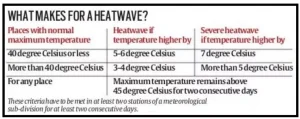
- Definition: According to the India Meteorological Department (IMD), a heatwave is a period of abnormally high temperatures determined using both absolute temperature thresholds and deviations from normal temperature conditions.
- In general, the maximum temperature must reach at least 40°C in plains, 37°C in coastal regions, and 30°C in hilly regions, along with specified departures from normal temperatures, for a heatwave to be declared.
Why Do Heatwaves Increase Ozone Formation?
- Faster Photochemical Reactions: High temperatures accelerate the photochemical reactions between Nitrogen Oxides (NOₓ) and Volatile Organic Compounds (VOCs), resulting in increased formation of surface ozone (O₃).
- Enhanced Solar Radiation: Intense solar radiation during heatwave conditions increases atmospheric photochemical activity, thereby boosting the rate at which ozone is produced.
- Stagnant Atmospheric Conditions: Heatwaves are often associated with stagnant air masses and low wind speeds, which restrict the dispersion of pollutants and allow ozone concentrations to accumulate near the Earth’s surface.
- Reduced Natural Removal of Pollutants: Clear skies, limited cloud cover, and reduced rainfall decrease the natural cleansing of the atmosphere, enabling ozone and its precursor pollutants to persist for longer periods.
- Prolonged Ozone-Forming Conditions: Extended heatwave events sustain high-temperature and high-radiation conditions, leading to prolonged episodes of elevated surface ozone pollution.
Click to Know UPSC Coaching Centres in India
Disaster Management Significance
- Proposed Inclusion as Notified Disasters: The 16th Finance Commission has recommended that heatwaves and lightning strikes be considered for inclusion in the list of notified disasters under India’s disaster management framework.
- Enhanced Access to Disaster Funds: Such inclusion would enable States to make greater use of the State Disaster Response Fund (SDRF) for undertaking preparedness, mitigation, response, and relief measures related to these hazards.
- Strengthened Disaster Preparedness: Access to SDRF resources would support the development of early warning systems, public awareness campaigns, heat action plans, and other preventive interventions.
- Improved Relief and Compensation Mechanisms: Recognition as notified disasters would facilitate more systematic relief assistance, compensation, and support for affected individuals and communities.
- Recognition of Emerging Climate Risks: The recommendation reflects the growing need to address heatwaves and lightning as major climate-induced disasters, given their increasing frequency, intensity, and mortality burden in India.
|
Conclusion
The study underscores the growing link between climate change, heatwaves, and surface ozone pollution in India. Strengthening air-quality monitoring, heat-action plans, and climate-resilient public health systems will be crucial to reducing the risks from heat–ozone extremes.
 16 Jun 2026