Mission Rangeen Machhli 2031
Context: Recently, Vice-President C.P. Radhakrishnan released the Mission Rangeen Machhli 2031 Strategic Action Plan at Agatti, Lakshadweep.
UPSC Online Courses
About Mission Rangeen Machhli 2031
- Mission Rangeen Machhli 2031 is a national strategic action plan to transform India’s ornamental fisheries sector into an organised, sustainable and globally competitive industry.
- Objective: It focuses on breeding, rearing, trade and value addition of ornamental fish while promoting sustainable livelihoods and Blue Economy development.
- Nodal Ministry & Implementation: The mission is implemented by the Department of Fisheries, Ministry of Fisheries, Animal Husbandry & Dairying.
- Location: Agatti Island, Lakshadweep.
- Features
- Standardised Value Chain: It establishes Standard Operating Procedures (SOPs) for broodstock management, captive breeding, hatcheries, disease prevention and safe transportation.
- Biosecurity & Quality: It promotes quarantine, fish-health surveillance and quality assurance to control diseases and meet international standards.
- Traceability & Certification: Traceability mechanisms will verify captive-bred origins, discourage illegal wild collection and facilitate sustainability certification.
- Cluster-Based Development: The mission aligns with Pradhan Mantri Matsya Sampada Yojana (PMMSY) to develop production, processing, logistics and domestic/export market linkages.
- Livelihood & Women Empowerment: It promotes backyard ornamental-fish rearing among coastal communities, youth and women-led Self-Help Groups (SHGs), creating low-investment livelihood opportunities.
- Lakshadweep’s Potential:
- Lakshadweep has an EEZ of nearly 4 lakh sq km, around 17% of India’s EEZ, and approximately 4,200 sq km of lagoon area.
- The islands harbour more than 300 ornamental fish species, providing considerable potential for sustainable mariculture and captive breeding.
Ramon Magsaysay Award 2026
Context: The 2026 Ramon Magsaysay Award was conferred on Tommy Koh, Runa Khan and Bo Kyi for humanitarian service, diplomacy and democratic activism.
About Ramon Magsaysay Award
- The Ramon Magsaysay Award, established in 1957, is widely regarded as “Asia’s Nobel Prize” and recognises individuals and organisations demonstrating exceptional public service and humanitarian commitment.
- It is named after Ramon Magsaysay, the third President of the Philippines, whose legacy emphasised integrity, courage and service to society.
- Organised By: The award is administered by the Ramon Magsaysay Award Foundation (RMAF), an independent non-profit organisation based in Manila, Philippines.
- It was established by the Rockefeller Brothers Fund in cooperation with the Philippine government.
- Key Categories
- Emergent Leadership: Recognises young leaders, generally aged 40 or below, creating transformative social change.
- Government/Public Service: Honours individuals demonstrating integrity and excellence in public administration.
- Community Leadership: Recognises grassroots leaders working for social and economic empowerment.
- Journalism, Literature and Creative Communication Arts: Recognises communication and creative work contributing to public awareness and social progress.
- Since 2009, the Foundation has largely moved away from fixed categories, with Emergent Leadership remaining the principal continuing category.
- 2026 Winners
- Tommy Koh (Singapore): Recognised for promoting international dialogue and the rule of law, including his role in the adoption of the UN Convention on the Law of the Sea.
- Runa Khan (Bangladesh): Honoured for her work among poor and excluded communities through Friendship Bangladesh, focusing on climate resilience, education, women’s empowerment and livelihoods.
- Bo Kyi (Myanmar): Recognised for defending democracy and human rights and documenting political imprisonment through the Assistance Association for Political Prisoners.
- Notable Indian Winners
- Vinoba Bhave (1958): First Indian and first-ever recipient, recognised for community leadership and social reform.
- C.D. Deshmukh (1959): Recognised for distinguished public service.
- Amitabh Chowdhury (1961): Recognised for journalism and creative communication.
- Arvind Kejriwal (2006): Recognised for emergent leadership and public service.
- Ravish Kumar (2019): Recognised for journalism and public-interest communication.
Integrated Fertilizer Management System (iFMS) Enters a New Digital Phase
Context: The Ministry of Chemicals and Fertilizers has introduced new digital dashboards and analytical tools under iFMS to improve transparency, monitor fertilizer availability, and strengthen data-driven management of the fertilizer supply chain.
About Integrated Fertilizer Management System (iFMS)

- Integrated Platform: Connects fertilizer production, imports, movement, stocks, retail sales and subsidy processing on a common digital platform.
- Large-Scale Coverage: Tracks over 14 crore Aadhaar-linked buyers, 2.5 lakh retailers and around 7 crore fertilizer transactions annually.
- Subsidy Management: Supports the administration of nearly ₹2 lakh crore in annual fertilizer subsidy.
Key New Digital Initiatives
- Real-Time Monitoring: Dashboards provide a consolidated view of production, imports, dispatches, stocks, and retail sales.
- Multi-Level Oversight: Enables monitoring at national, State, district, and retailer levels.
- Early-Warning Mechanism: Analytics help detect unusual trends and emerging shortages early.
- Consumption Analytics: Fertilizer purchases can be analyzed by buyer category, landholding, crop, district, and fertilizer type.
- Targeted Governance: Transaction-level data enables better identification of consumption patterns and informed decision-making.
Future Circular Collider (FCC)
Context: CERN Director-General Mark Thomson, during his visit to India, emphasized the need for more mega-science projects and highlighted the Future Circular Collider (FCC) as CERN’s long-term successor to the Large Hadron Collider (LHC).
About the Future Circular Collider (FCC)
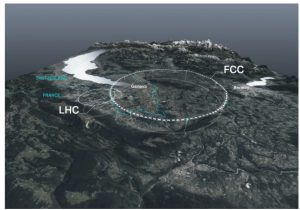
- Next-Generation Collider: A proposed 91-km underground particle accelerator being developed by CERN as the long-term successor to the LHC.
- Higgs Factory: Its first stage, FCC-ee, would collide electrons and positrons to study the Higgs boson and other fundamental particles with unprecedented precision.
- Future Expansion: A later stage could use the same tunnel for a proton–proton collider with collision energies of around 100 TeV, far beyond the LHC.
- Timeline: Expected to become operational around 2045–48, subject to approval; CERN expects a decision by 2028.
- Scientific Purpose: It aims to investigate major unanswered questions, including dark matter, matter–antimatter asymmetry, and physics beyond the Standard Model.
UPSC Online Classes
LHC and High-Luminosity LHC
- Large Hadron Collider (LHC): It is CERN’s 27-km particle accelerator that collides particles at near-light speed to study the fundamental building blocks of matter. It is known for the discovery of the Higgs boson in 2012.
- Current Status: The LHC was shut down on 29 June 2026 for a planned upgrade and is expected to remain offline until 2030.
- High-Luminosity LHC (HL-LHC): It is an upgraded version of the LHC designed to produce about 10 times as many particle collisions (luminosity).
- This will generate far more data, allowing scientists to study known particles more precisely and improve the chances of discovering new physics.
INS Nipun
The Indian Navy commissioned INS Nipun, the second Diving Support Vessel (DSV) of the Nistar-class, at Naval Dockyard, Mumbai.
Click to Know UPSC Coaching Centres in India

About INS Nipun
- Class: Nistar-class Diving Support Vessel — Nipun is the second ship in this class.
- Built by: Hindustan Shipyard Limited (HSL), Visakhapatnam — indigenously designed and constructed.
- Role: A dedicated diving support and submarine rescue vessel, built to support a wide spectrum of diving and underwater operations.
- Significance: Enhance the Western Naval Command’s capabilities for complex underwater operations.
 1 Sep 2026