72nd National Film Awards
Context: The 72nd National Film Awards are being presented at Ekta Nagar, Gujarat, marking the first time the ceremony has moved outside New Delhi.
UPSC Online Courses
About National Film Awards

- The National Film Awards are India’s premier national-level honours for recognising artistic and technical excellence in Indian cinema.
- Origin: The awards were instituted in 1954 and are conferred annually for eligible films and cinematic works.
- Organised By: Ministry of Information and Broadcasting (I&B), Government of India.
- Presented By: The President of India traditionally presents the National Film Awards to the awardees.
- Major Categories: The awards recognise outstanding contributions across Feature Films, Non-Feature Films and Writing on Cinema.
- Films must be CBFC-certified during the award year, carry English subtitles, and feature films must exceed 72 minutes
- It can be awarded to films in any official or regional Indian language, as well as English
- Selection and Jury
- Entries are invited annually for films certified during the preceding calendar year.
- The Ministry constitutes separate juries for Feature Films, Non-Feature Films and Best Writing on Cinema.
- Jury members are distinguished personalities from cinema, allied arts and humanities.
- Key Facts:
- First Best Feature Film: Shyamchi Aai (1953, Marathi), directed by P. K. Atre, won the first President’s Gold Medal.
- First Best Actor: Uttam Kumar won in 1968 for Antony Firingee and Chiriyakhana.
- First Best Actress: Nargis Dutt won in 1968 for Raat Aur Din.
- Most National Film Awards by an individual: Satyajit Ray with 32 awards, including a record 6 Best Director awards.
- Most Best Actress awards: Shabana Azmi with 5 wins.
About 72nd National Film Awards
- The 72nd National Film Awards honour outstanding cinematic achievements for films certified in 2024.
- Venue: The ceremony is being held at Ekta Nagar (formerly Kevadia), Gujarat, marking the first time the prestigious event has moved outside New Delhi.
- Key Winners
-
- Best Feature Film: Article 370
- Best Actress: Yami Gautam — Article 370
- Best Actor: Mammootty — Bramayugam and Kartik Aaryan — Chandu Champion
- Best Direction: Rajkumar Periasamy — Amaran
- Best Popular Film Providing Wholesome Entertainment: Kalki 2898 AD
- Best Debut Director: Randeep Hooda — Swatantrya Veer Savarkar
- Best Non-Feature Film: Bhangaar (Marathi)
- Best Direction (Non-Feature): Aanand L Rai — Statue of Unity – Ekta ka Prateek
- Best Debut Director (Non-Feature): Ravi Raj Murmu — Angen (Santhali)
- Dadasaheb Phalke Award 2024: Anant Nag for his outstanding contribution to Indian cinema.
World Bank–IMF Debt Framework Reforms
Context: The World Bank and the International Monetary Fund (IMF) conducted the first joint review of their Debt Sustainability Framework since 2017 and approved proposed reforms to evaluate the debt of low-income countries.
- The revised framework is expected to become operational in the second half of 2027.
UPSC Online Classes
About Debt Sustainability Framework for Low-Income Countries (LIC-DSF)
- The Debt Sustainability Framework for Low-Income Countries (LIC-DSF) is a framework developed jointly by the IMF and the World Bank to analyze public debt stress and sustainability in countries eligible for concessional financing from either institution.
- Objectives: Support IMF–World Bank policy advice and lending decisions, guide fiscal policies and public debt management in LICs, and balance development financing with debt sustainability.
- Performance: The framework , first introduced in 2005, has worked well to identify debt distress episodes in advance and to help countries make informed borrowing and lending decisions.
Why Reforms Are Needed
- Rising Debt: Low-income countries have seen debt levels rise.
- Changing Financing Sources: Greater reliance on domestic and external borrowing on commercial terms has changed the financing landscape.
- Development Needs: Reforms are needed amid elevated development needs.
- Decline in ODA: A sharp decline in official development assistance (ODA) has created additional challenges.
- Climate Change: Debt sustainability analysis needs to account for long-term development challenges, including climate change.
Key Reforms Proposed In the Joint Review
- Domestic Debt Analysis: Strengthening the analysis of domestic debt to better capture countries’ overall debt vulnerabilities.
- Long-Term Development Risks: Expanding the framework to consider long-term development challenges, including climate change.
- Debt-Carrying Capacity: Refining the assessment of countries’ debt-carrying capacity.
- New Assessment Tools: Introducing new tools to improve debt sustainability analysis.
- Realism Tools and Stress Tests: Strengthening realism tools and stress tests to improve the consistency and accuracy of economic forecasts.
- Realism tools assess whether the assumptions and forecasts used in debt sustainability analysis are realistic and internally consistent.
- Debt Data Transparency: Encouraging countries to improve debt data transparency for more reliable debt assessments.
‘Partners for Multilateralism’ (P4M)
Context: External Affairs Minister S Jaishankar has co-chaired the first-ever ‘Partners for Multilateralism (P4M)’ Summit held on the margins of the high-level 81st session of the UN General Assembly.
About ‘Partners for Multilateralism’ (P4M)
- Partners for Multilateralism (P4M) is a flexible and open diplomatic framework that seeks to strengthen UN-based multilateral cooperation across regions and political traditions.
- Origin: P4M was founded by leaders of the European Union, Brazil, Kenya and Canada and was launched as a diplomatic initiative during the 81st UN General Assembly High-Level Week in September 2026.
- Key Objectives
-
- UN Reform: It seeks to make the UN and other multilateral institutions more representative, legitimate, effective and trusted.
- Collective Action: It aims to promote cooperation on global challenges such as AI, climate change, health security and digital transformation.
- Flexible Cooperation: It intends to provide an open framework for countries to build coalitions across geopolitical and political divides rather than create another exclusive bloc.
- Initial co-sponsors: Australia, Barbados, Brazil, Canada, the European Union, India and Kenya.
- Signatories: Albania, Bosnia and Herzegovina, Croatia, Cyprus, Finland, Guatemala, Ireland, Liechtenstein, Luxembourg, Moldova, Norway, San Marino, Slovakia, Spain, Türkiye and Uruguay.
- Need for P4M: P4M seeks to strengthen rules-based multilateralism at a time of geopolitical tensions and increasing state-based conflicts.
- 2025 saw the highest recorded number of state-based armed conflicts since 1946, in 35 countries, and highest recorded military spending of nearly $3 trillion.
- It emphasises collective action and institutional reform rather than alignment with competing superpower blocs.
- India’s Multilateral Engagement: India is already part of platforms such as the Non-Aligned Movement, BRICS, G20 and G-4, which provide avenues for advancing multilateral cooperation and reform.
UPSC Coaching Classes
Exercise Nomadic Elephant 2026
Context: The 18th edition of Exercise Nomadic Elephant between India and Mongolia has commenced at Pithoragarh, Uttarakhand.
- The previous edition was held in Ulaanbaatar, Mongolia, in May–June 2025.
About the Exercise Nomadic Elephant 2026
- Exercise Nomadic Elephant is an annual, platoon-level joint military exercise conducted alternately in India and Mongolia.
- Participation: Each side is represented by 45 personnel — from the Indian Army and the Mongolian Armed Forces.
- Location: Foreign Training Node, Pithoragarh, Uttarakhand
- Focus: The exercise is conducted under a United Nations mandate, with a focus on Counter-Insurgency Operations in semi-urban and mountainous terrain.
- Other Exercise: Khaan Quest, a multinational peacekeeping exercise organised by Mongolia, with active Indian participation.
Open Market Operations (OMO)
Context: The RBI sold ₹25,000 crore of G-Secs through OMO on September 21, 2026, to absorb surplus banking-system liquidity amid strong foreign-currency inflows.
Key Highlights of RBI’s OMO
- The RBI announced OMO sales worth ₹1 lakh crore in September 2026 to manage prevailing and evolving liquidity conditions.
- The programme comprises ₹50,000 crore on September 17 and ₹25,000 crore each on September 21 and September 28.
- The RBI received bids worth ₹84,982 crore against the notified ₹25,000 crore and accepted the entire ₹25,000 crore.
- The operation withdraws rupee liquidity as participants pay the RBI for the government securities.
About Open Market Operations (OMO)
- Open Market Operations (OMOs) refer to the RBI’s purchase or sale of Government securities (G-Secs) in the open market to manage systemic liquidity and influence monetary conditions.
- Components
- Outright Operations: The outright purchase or sale of G-Secs involves no agreement to reverse the transaction, thereby producing a more durable change in liquidity.
- Temporary Operations: Repo and reverse-repo-type transactions involve temporary and reversible liquidity adjustment through securities transactions with an agreed future reversal.
- Impacts of OMO
- Liquidity and Money Supply: OMO sales absorb liquidity from the banking system, while OMO purchases inject liquidity, thereby influencing banks’ capacity to extend credit.
- Interest Rates and Monetary Conditions: OMO sales can tighten liquidity and exert upward pressure on market interest rates, whereas purchases can ease liquidity and monetary conditions.
- Bond Yields: OMO purchases increase demand for government securities, generally raising bond prices and lowering their yields, while sales can exert the opposite pressure.
Click to Know UPSC Coaching Centres in India
State of Global Water Resources Report 2025
Context: The WMO’s 2025 assessment reports widespread glacier loss for the fourth consecutive year, alongside declining freshwater storage and increasingly erratic water cycles.
About State of Global Water Resources Report
- The State of Global Water Resources Report is a comprehensive, science-based annual assessment of the global hydrological cycle and extreme events.
- Published By: World Meteorological Organization (WMO), the UN’s authoritative body on weather, climate and water.
- Focus Areas: It assesses river discharge, groundwater, evapotranspiration, terrestrial water storage, snow and ice, along with high-impact hydrometeorological events.
- Period of Assessment: Hydrological cycle and extreme events in 2025 and over the past five years.
Key Findings of State of Global Water Resources 2025
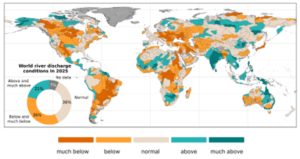
- River Discharge: 2025 was one of the driest years for global river discharge in 35 years, with below-normal flows across 36% of global basin area.
- Declining Terrestrial Water Storage: Terrestrial water storage has shown a persistent negative trend since 2014–16, with increasing areas experiencing below-normal conditions.
- Terrestrial water storage is all the fresh water held on and under land, in groundwater, soil, rivers, reservoirs, snow and ice.
- Groundwater Depletion: Persistent groundwater deficits during 2022–25 were observed across parts of the Americas, Europe, Middle East, India, southern Africa and Australia, indicating multi-year depletion.
- Widespread Glacier Loss: In 2025, glaciers lost 408 ± 132 gigatonnes of mass, equivalent to 1.1 ± 0.4 mm of sea-level rise, marking the fourth consecutive year of net loss across every major glaciated region.
- Water-Related Extremes: Asia and Africa were the regions most affected by extreme hydrometeorological events, while droughts and floods continued to affect several regions repeatedly.
- The region is associated with more than 80% of reported associated deaths over the past five years.
 22 Sep 2026