Books

Mahaparinirvan Diwas 2025 will mark the 69th death anniversary of Dr. B.R. Ambedkar on December 6. The day highlights his fight for equality and the Buddhist concept of “Mahaparinirvan,” meaning ultimate liberation. It is important for UPSC aspirants studying Indian Polity, Modern History, and Ethics.
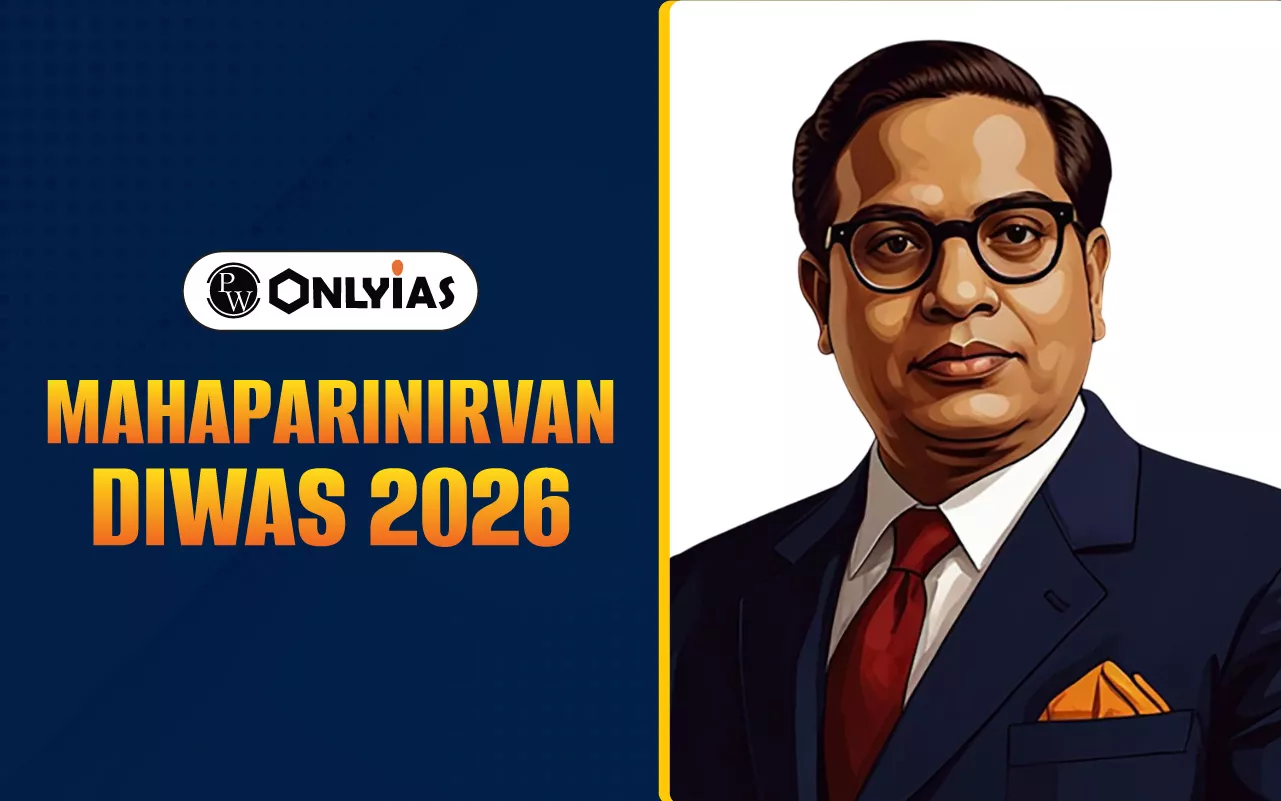
Mahaparinirvan Diwas 2025 will mark the 69th death anniversary of Dr. B.R. Ambedkar, honouring his legacy in social reform, equality, and the drafting of the Constitution of India. For aspirants and students, understanding the meaning and significance of Mahaparinirvan Diwas is important. It provides in-depth context for topics in Indian Polity, Modern History, and Ethics papers for competitive exams, such as the UPSC.
The observance of br ambedkar death anniversary 2025 is a solemn occasion marked by constitutional pledges, prayers, and tributes across the nation. Here is an overview:
| Mahaparinirvan Diwas 2025 Overview | |
| Aspect | Details |
| Day of Celebration | Mahaparinirvan Diwas 2025 |
| Date | December 6, 2025 |
| Day of the Week | Saturday |
| Anniversary | 69th Death Anniversary (1956 – 2025) |
| Personality Honored | Dr. Bhimrao Ramji Ambedkar (Babasaheb) |
| Memorial Site | Chaitya Bhoomi, Dadar, Mumbai |
| Purpose | To honor Dr. Ambedkar’s fight for social justice, equality, and his role as the architect of the Indian Constitution. |
Note for Candidates: Dr. B.R. Ambedkar is often referred to as the Father of the Indian Constitution. He was the first Law Minister of India. Having an understanding of his background and key movements like the Mahad Satyagraha and the Poona Pact is very important for exam preparation.
Mahaparinirvan (also written as Mahaparinirvana) is an important concept in Buddhist philosophy. It refers to the final state of freedom a person enters after death, when they have already achieved Nirvana during their lifetime. In this stage, the cycle of birth, death, and rebirth (samsara) ends completely.
The term comes from Sanskrit:
Together, Mahaparinirvan means “the great final liberation.”
It represents a condition where there is no return to life, no attachment, and no suffering.
Unlike some other international observances, Mahaparinirvan Diwas 2025 theme is not announced with a new, official government theme each year. The observance consistently centres on:
The death anniversary of Dr B.R. Ambedkar is celebrated as Mahaparinirvan Diwas. This day honours his lifelong struggle against social discrimination and his monumental contribution to the legal and social framework of India. The name of the day is very significant:
Mahaparinirvan (or Mahaparinibbana in Pali): This is a Buddhist term that translates to ‘great nirvana’ or ‘ultimate liberation’. It signifies the passing away of someone who has attained Nirvana during their lifetime, leading to freedom from the cycle of birth and death (samsara).
Connection to Dr. Ambedkar: Just a few weeks before his death on December 6, 1956, Dr. Ambedkar converted to Buddhism in Nagpur along with over half a million followers and rejected the caste system of Hinduism. His followers acknowledged him as a great teacher and spiritual leader. His followers commemorate his death with this sacred Buddhist term by dedicating his life to creating an egalitarian society based on Buddhist principles.
Millions of followers and citizens gather at Chaitya Bhoomi in Dadar, Mumbai, the site of his cremation, to pay homage and reaffirm their commitment to his ideals.
The death Anniversary of Dr B.R. Ambedkar is observed on 6 December every year as Mahaparinirvan Diwas. His death anniversary holds deep national and spiritual significance. In 2025, the day marks his 69th death anniversary and serves as a reminder of his lifelong struggle against caste discrimination, social inequality, and oppression.
The day is commemorated with large gatherings at Chaitya Bhoomi in Mumbai, where millions of followers pay tributes to Babasaheb. While paying tribute, the followers reaffirm their commitment to his ideals of justice, liberty, equality, and fraternity. This day is an important point of reflection on the contributions of UPSC to the drafting of the Indian Constitution, its role in shaping democratic institutions of India, and its embrace of Buddhism as a path to social transformation.
Check Out UPSC CSE Books
Visit PW Store
Dr. Bhimrao Ramji Ambedkar (14 April 1891 – 6 December 1956) was one of modern India’s most influential leaders. He is also known as an architect of the Indian Constitution. He was born in Mhow (now in Madhya Pradesh), he belonged to a Scheduled Caste community and faced discrimination from a young age. Despite these challenges, he became one of the most educated Indians of his time, earning doctorates in Economics from Columbia University and the London School of Economics, and also qualifying as a Barrister from Gray’s Inn, London.
Dr. Ambedkar worked throughout his life for social justice, equality, and the upliftment of the oppressed communities. He founded organizations like Bahishkrit Hitkarini Sabha and led historic movements such as the Mahad Satyagraha (1927) for equal access to public water resources. He started several journals such as Mook Nayak, Bahishkrit Bharat, and Equality Janta to raise the voice of the marginalized.
Ambedkar played a key role in the Poona Pact (1932) which increased political representation for the depressed classes. His book Annihilation of Caste (1936) is a strong critique of the caste system. He also wrote the autobiographical note Waiting for a Visa, describing his struggles against social discrimination.
In 1946, Ambedkar became a member of the Constituent Assembly. On 15 August 1947, he became India’s first Law and Justice Minister, and was appointed Chairman of the Drafting Committee. He is widely recognised as the chief architect of the Indian Constitution.
In October 1956, Ambedkar embraced Buddhism along with lakhs of followers, which started a big social and religious movement. He passed away in his sleep on 6 December 1956 in Delhi. In 1990, he was honoured with the Bharat Ratna, India’s highest civilian award.
| Year/Period | Event/Contribution |
| 1891 | Born in Mhow, Central Provinces (now Madhya Pradesh) |
| 1912 | Graduated (Economics & Political Science), Bombay University |
| 1913–1916 | Studied at Columbia University (MA, PhD research) |
| 1920–1923 | Further studies at LSE & Gray’s Inn (M.Sc., D.Sc., Barrister) |
| 1927 | Mahad Satyagraha for access to public water |
| 1932 | Signed Poona Pact with Madan Mohan Malaviya |
| 1936 | Published Annihilation of Caste |
| 1946 | Elected to Constituent Assembly |
| 1947–1951 | India’s first Law & Justice Minister, Chairman of Drafting Committee |
| 1952–1956 | Member of Rajya Sabha |
| 1956 | Converted to Buddhism; passed away on 6 December 1956 |
| 1990 | Awarded Bharat Ratna (posthumous) |
Ready to boost your UPSC 2026 preparation? Join PW’s UPSC online courses today!
Explore UPSC Test Series

Mahaparinirvan Diwas is observed annually on December 6. In 2025, it falls on saturday, December 6, marking the 69th death anniversary of Dr. B.R. Ambedkar.
The term "Mahaparinirvan" is derived from Buddhist philosophy. It means the ultimate state of salvation or liberation after death. The day honors Dr. Ambedkar’s passing, symbolizing his spiritual liberation just weeks after he embraced Buddhism.
Dr. Ambedkar's death anniversary is called Mahaparinirvan Diwas because he had adopted Buddhism, a religion whose core tenets aligned with his lifelong fight for equality. His followers regard him as a Bodhisattva or great teacher, and therefore, use the highly revered Buddhist term "Mahaparinirvan" to mark his demise.
Chaitya Bhoomi in Dadar, Mumbai, is the memorial and cremation ground of Dr. B.R. Ambedkar. It is the central site of reverence where millions of his followers, known as Ambedkarites, gather every year on December 6 to pay their respects and offer tribute.
Aspirants should focus on his role as the Chairman of the Drafting Committee of the Constitution, his contributions to Fundamental Rights (Part III), his economic ideas, and his leadership of the Dalit movement. This information is key for General Studies papers and is crucial for understanding the principles of the Constitution.



Explore SRIJAN Prelims Crash Course


Connect with our experts to get free counselling & start preparing
Books
Udaan (Prelims Wallah)
Prahaar (Mains Wallah)
Q&A Bank (Prelims & Mains)
Budget & Economic Survey
NCERT Wallah
Marks Booster
हिंदी माध्यम विशेष शृंखला
 Current Affairs
Monthly Current Wallah
Subject Wise Current Affairs
Editorial Analysis
Editorial PDFs
News of The Day
Download Our App



Download Our App
<div class="new-fform">
</div>

 GS Foundation
 Optional Course
 Combo Courses
 Degree Program