Books

Deserts in India highlight features of the Thar Desert, the Great Rann of Kutch, and the Cold Desert of Ladakh. Learn about their unique geography, diverse ecosystems, and the importance of desert conservation. These notes aid in quick revision for competitive exams.
Deserts in India include hot, cold, and semi-arid regions with very low rainfall and extreme temperatures. The major deserts are the Thar Desert, the Great Rann of Kutch, and the Cold Desert of Ladakh. Each desert has unique landforms, climate conditions, and plants and animals adapted to dry environments.
Hot deserts like the Thar form due to low rainfall and rain shadow effects, while cold deserts like Ladakh exist because of high altitude and freezing climate. These deserts are important for geography studies and quick revision for competitive exams.
A desert is a region that receives very little rainfall, usually less than 25 cm in a year. The land may have sand, rocks, or cold snow-covered surfaces. Many students ask what is desert—it is not only hot sand; some deserts are very cold too.
Key points about deserts:
Hot deserts, like the Thar, form due to high pressure belts, which cause sinking dry air. The Aravalli Range blocks monsoon winds, preventing rain in western Rajasthan. Cold deserts, like Ladakh, form due to their rain shadow location behind the Himalayas.
Moisture-laden winds cannot reach these high-altitude regions, leading to extreme dryness and cold. This leads to unique desert landforms in India.
The classification of Indian deserts is based on temperature and land type.
Main types:
This classification of Indian deserts helps students understand climate differences.
India hosts several significant desert landforms. These areas vary greatly in climate and features, ranging from hot sandy plains to cold, high-altitude plateaus. We explore the major list of deserts in India and their characteristics below.
| Indian Deserts Names | Type of Desert | Location (State/Region) | Key Features |
| Thar Desert | Hot Desert | Rajasthan, Gujarat, parts of Haryana and Punjab | Largest hot desert of India, sand dunes, very low rainfall, hot summers, supports camel, Indian gazelle, and desert vegetation |
| Marusthali Desert | Hot Desert | Rajasthan | Part of the Thar region, sandy plains, rocky areas, dry climate, historical forts and trade routes |
| Great Rann of Kutch | Salt Desert | Gujarat | Vast salt marsh, white salt crust in dry season, flooded during monsoon, habitat of flamingos and wild ass |
| Cold Desert of Ladakh | Cold Desert | Ladakh (Trans-Himalayan region) | Very low rainfall, freezing temperatures, snow-covered dry land, high altitude, formed due to rain shadow of Himalayas |
| Deccan Plateau (Semi-arid) | Semi-arid Region | Southern India | Rocky terrain, less rainfall, sparse vegetation, water scarcity, not a true desert but shows arid features |
| Other Arid Regions | Arid/Semi-desert | Rajasthan, Gujarat | Includes Barmer-Bikaner belt and smaller dry zones, adds to India’s ecological diversity |
The Thar Desert, also known as the Great Indian Desert, is the largest hot desert of India. It lies in northwest India, covering parts of Rajasthan, Gujarat, Haryana, and Punjab. This desert features extensive sand dunes and a very arid climate. Temperatures can soar high during summers.
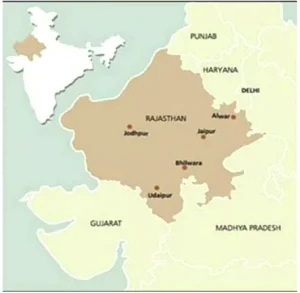
Despite harsh conditions, it supports unique desert flora and fauna, including the Great Indian Bustard and Indian Gazelle. The Thar Desert location and features make it a distinct geographical zone.
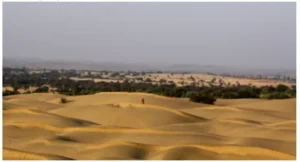
Main features:
Deserts of Rajasthan mostly include the Thar and Marusthali regions.
Situated in Gujarat, the Great Rann of Kutch is a vast salt marsh desert. It ranks among the world’s largest salt deserts, spanning thousands of square kilometers. Seasonal flooding followed by drying creates its unique white salt crust.
This area is home to wildlife such as the Greater Flamingo and Wild Ass. Conservation efforts protect this fragile ecosystem.
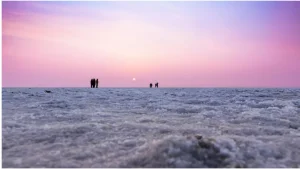
The Great Rann of Kutch is a salt desert found in Gujarat. It becomes white with salt during dry months and fills with water du\ring the monsoon. The deserts of Gujarat mainly include the Great Rann and nearby dry areas.
The Cold Desert of Ladakh is a high-altitude desert located in the Trans-Himalayan region of northern India. It experiences extremely cold temperatures and has barren terrain. This cold desert stands in stark contrast to hot deserts.
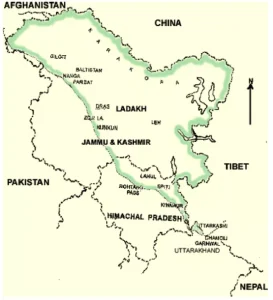
Ladakhi people have adapted their lifestyle to this harsh environment. Its rugged landscapes and cultural heritage attract many visitors. Why Ladakh is called Cold Desert is due to its high elevation and minimal precipitation.
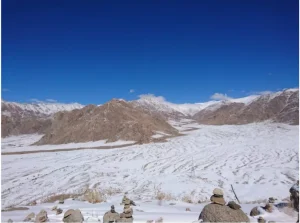
Students often ask why Ladakh is called Cold Desert. This is because:
About Ladakh desert, it lies in the rain shadow area of the Himalayas.
The Marusthali Desert is another name often used for the Thar Desert. It displays vast sand dunes, rocky outcrops, and dry plains. This area holds ancient historical significance, with ruins of old cities and trade routes.
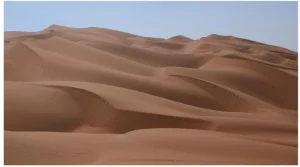
Grand forts and palaces attract tourists, showcasing the region’s rich past. Rapid urbanization and tourism pose challenges to its preservation.
The Deccan Plateau is a semi-arid region in southern India. It has undulating terrain with rocky areas and sparse vegetation. While not a traditional desert, it shares some arid characteristics. This region shows diverse flora and fauna, including the Indian Gazelle and Indian Wolf. Agriculture faces water scarcity challenges here.
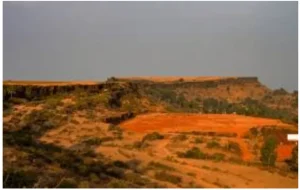
The desert flora and fauna in India are adapted to survive with little water. Plants like cactus, thorny bushes, and date palms store water, while animals such as camel, desert fox, and yak (in cold deserts) thrive in extreme climates.
Smaller desert areas and arid regions exist in India. These include parts of the Barmer-Bikaner Desert in Rajasthan, and arid zones in Gujarat. These less-known deserts of India list adds to the country’s ecological and cultural diversity.
Check Out UPSC CSE Books
Visit PW Store
The Deserts of India map helps students clearly see the location of all major deserts in one view. It shows hot, cold, and salt deserts across different regions, making geography learning easier and exam-friendly.
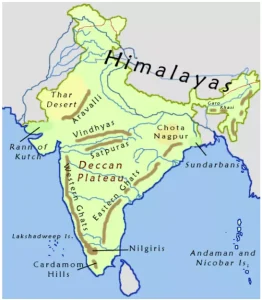
The desert climate in India is very different from other regions due to low rainfall and extreme temperatures. India has both hot deserts, like the Thar Desert, and cold deserts, like the Ladakh Cold Desert, so their climates vary a lot.
Key features of the desert climate in India:
This desert climate in India affects plants, animals, and human life, making the region unique for study and geography exams.
Ready to boost your UPSC preparation? Join PW’s UPSC online courses today!
The Thar Desert is the largest hot desert in India. It is also known as the Great Indian Desert.
The Cold Desert of Ladakh is located in the Trans-Himalayan region, northern India.
India has two main types: hot deserts, like the Thar, and cold deserts, like Ladakh.
Yes, parts of Gujarat have desert areas, including the Great Rann of Kutch and some smaller arid regions.
The Thar Desert forms due to its location in a subtropical high-pressure belt and the rain shadow effect from the Aravalli Range.


Connect with our experts to get free counselling & start preparing
Books
Udaan (Prelims Wallah)
Prahaar (Mains Wallah)
Q&A Bank (Prelims & Mains)
Budget & Economic Survey
NCERT Wallah
Marks Booster
हिंदी माध्यम विशेष शृंखला
 Current Affairs
Monthly Current Wallah
Subject Wise Current Affairs
Editorial Analysis
Editorial PDFs
News of The Day
Download Our App



Download Our App
<div class="new-fform">
</div>

 GS Foundation
 Optional Course
 Combo Courses
 Degree Program