Recently, the University Grants Commission (UGC) notified the UGC (Promotion of Equity in Higher Education Institutions) Regulations, 2026, replacing the 2012 framework.
About UGC Equity Regulations 2026
- Need for Regulations: Caste-based discrimination remains a persistent challenge in Indian higher education.
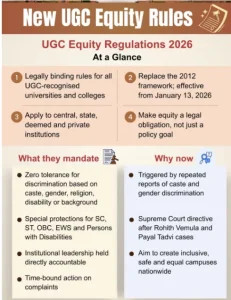 High-profile tragedies like Rohith Vemula (2016) and Payal Tadvi (2019) exposed institutional failures, prompting the UGC (Promotion of Equity in Higher Education Institutions) Regulations, 2026, to enforce equity as a regulatory obligation.
- Framework Replacement: Replaces the 2012 anti-discrimination framework, aiming to curb caste-based discrimination in universities and colleges.
- Objective: Curb caste-based discrimination in higher education, especially against SCs, STs, OBCs, and women, and convert equity into a regulatory obligation rather than discretionary moral guidance.
- Enforceable Obligation: Treats equity as an institutional responsibility, linking prevention and redressal mechanisms directly to compliance with University Grants Commission (UGC) regulations.
- Legal Perspective: Implemented following Supreme Court directives and petitions highlighting repeated failures to address caste-based harassment.
Key Provisions of UGC Equity Regulations 2026
- Institutional Mechanisms: Mandatory establishment of Equal Opportunity Centres (EOCs), Equity Committees, monitoring cells, and grievance pathways in all Higher Education Institutions (HEIs).
- Redressal and Support: 24/7 helpline, equity squads, and equity ambassadors to handle complaints, promote inclusion, and coordinate with non-governmental organisations (NGOs), local administration, and media.
- Leadership Accountability: Institutional heads are responsible for implementation and oversight of equity policies.
- Inclusion Mandates: Ensure representation and support for Scheduled Castes (SCs), Scheduled Tribes (STs), Other Backward Classes (OBCs), Persons with Disabilities (PwDs), and women.
- Enforcement: University Grants Commission (UGC) empowered to treat non-compliance as a regulatory violation with documented consequences.
Significance of UGC Equity Regulations 2026
- Campus Experience Focus: Moves beyond access to how students live, study, and work, ensuring equity in daily campus life.
- Accountability and Timelines: Provides clear definitions, reporting structures, and timelines, addressing historic denial, delay, and deflection in grievance handling.
- Shift from Moral to Regulatory Duty: Strengthens institutional responsibility, transforming equity from moral exhortation to enforceable governance.
Challenges Arising
- Administrative Burden: Heavy reliance on committees may overstrain state universities and affiliated colleges with limited resources.
- Procedural Gaps: Lack of clarity on investigative methods, evidence standards, witness handling, anti-retaliation safeguards, and privacy protocols.
- Institutional Independence: Equal Opportunity Centres (EOCs) are institution-led, creating potential conflicts of interest in hierarchical campus ecosystems.
- Definition Ambiguity: Narrow caste definitions may leave marginalized or general-category complaints unaddressed, giving institutions excessive interpretive discretion.
- Social Controversy: Protests by groups like Savarna Sena highlight perceived exclusion of general-category students, although the government plans corrective provisions.
Way Forward
- Strengthen Operational Clarity: Specify investigative procedures, evidence standards, and safeguards for complainants and witnesses.
- Capacity Building: Train institutional staff and invest in administrative support for effective Equal Opportunity Centre (EOC) functioning.
- Inclusive Approach: Ensure provisions for all students, including general-category grievances, while maintaining focus on historically disadvantaged groups.
- Sustained Oversight: University Grants Commission (UGC) should conduct continuous, transparent monitoring rather than episodic enforcement.
- Culture Change: Foster an ethos of equity and inclusion beyond paperwork, embedding fairness into campus life.
Conclusion
The University Grants Commission (UGC) Equity Regulations 2026 are a landmark initiative to institutionalize equity in higher education. Their success depends on administrative clarity, sustained oversight, inclusive implementation, and cultivating a campus culture of fairness, dignity, and trust.


 27 Jan 2026






.png)






 Current Affairs






 GS Foundation
 Optional Course
 Combo Courses
 Degree Program