Summary of Union Budget 2026-27: Key Highlights and Analysis

Union Minister Nirmala Sitharaman presented the Union Budget 2026-27, focusing on three 'Kartavyas' to drive economic growth, fulfil aspirations, and ensure inclusive development. This summary covers major announcements for MSMEs, infrastructure, and the new Income Tax Act.

The Union Minister for Finance and Corporate Affairs, Smt Nirmala Sitharaman, presented the SUMMARY OF UNION BUDGET 2026-27 in Parliament on February 1, 2026. This budget, the first to be prepared in the newly named Kartavya Bhawan, is a roadmap toward ‘Viksit Bharat’ (Developed India). Guided by the principle of “Yuva Shakti,” the budget emphasises the government’s commitment to the poor, underprivileged, and disadvantaged sections of society.

Summary of Union Budget 2026-27

The Union Minister for Finance and Corporate Affairs, Smt Nirmala Sitharaman, presented the SUMMARY OF UNION BUDGET 2026-27 in Parliament on 1 February 2026. This is the first budget prepared in the newly inaugurated Kartavya Bhawan and represents a roadmap toward Viksit Bharat (Developed India).

Guided by the principle of “Yuva Shakti”, the Union Budget 2026–27 summary highlights the government’s commitment to social inclusion, economic growth, and fiscal prudence. The budget is anchored on three key “Kartavyas” (duties):

  1. Economic Growth: Accelerating productivity and building resilience against global volatility.
  2. Capacity Building: Fulfilling citizen aspirations and enabling shared prosperity.
  3. Inclusion: Ensuring equitable access to resources in line with Sabka Sath, Sabka Vikas.

This Union Budget brief overview 2026–27 outlines strategic reforms, sector-wise allocation, fiscal measures, tax proposals, and social initiatives, aimed at long-term development.

Also Read | Download- Budget 2026 PDF

Union Budget Highlights 2026–27

The Union Budget highlights 2026–27 focus on growth, infrastructure, and citizen-centric welfare. Key highlights include:

  • Public Capital Expenditure: ₹12.2 lakh crore allocated to strengthen infrastructure and public services.
  • New Income Tax Act, 2025: Coming into effect from April 2026, simplifying tax rules, and reducing litigation.
  • Biopharma SHAKTI: ₹10,000 crore to position India as a global hub for biologics and biosimilars.
  • High-Speed Rail Corridors: Seven new corridors including Mumbai-Pune and Delhi-Varanasi to enhance connectivity and act as “growth connectors.”
  • MSME Growth Fund: ₹10,000 crore to promote “Future Champions” in the SME sector.
  • AVGC Labs in Education: 15,000 schools and 500 colleges to develop Animation, Visual Effects, Gaming, and Comics (AVGC) skills.
  • Tourism Upskilling: 10,000 tourist guides to be trained at 20 tourist sites through IIM collaboration.
  • Bharat-VISTAAR: AI-powered multilingual tool offering customized advisory to farmers.
  • Khelo India Mission: Transforming India’s sports ecosystem over the next decade.

These Union Budget major highlights 2026–27 demonstrate the government’s focus on inclusive development, technological innovation, and human capital growth.

Enroll now for UPSC Online Course

Union Budget Sector-Wise Allocation 2026–27

A detailed Union Budget sector wise allocation 2026–27 shows a strategic focus on infrastructure, MSMEs, education, health, and rural development:

Union Budget Sector-Wise Allocation 2026–27
Sector Key Initiative Allocation/Target
MSME SME Growth Fund for “Future Champions” ₹10,000 Crore
Health Biopharma SHAKTI & Regional Medical Hubs ₹10,000 Crore (Biopharma)
Infrastructure Public Capital Expenditure ₹12.2 Lakh Crore
Education AVGC Labs in Schools/Colleges 15,000 Schools & 500 Colleges
Tourism Upskilling 10,000 Guides via IIMs 20 Tourist Sites

Infrastructure and Connectivity:

The Union Budget 2026–27 emphasises green and sustainable cargo movement, operationalising 20 new National Waterways and expanding Dedicated Freight Corridors (Dankuni to Surat).

Agriculture and Rural Development:

  • Bharat-VISTAAR: A multilingual AI platform integrating agricultural portals for customised farmer advisory.
  • SHE Marts: Community-owned retail outlets empowering women entrepreneurs.

Union Budget Tax Proposals 2026–27

The Union Budget tax proposals 2026–27 focus on ease of compliance, foreign investment, and taxpayer relief:

  • TCS Reduction: Overseas tour packages and education/medical remittances under LRS reduced to 2%.
  • Foreign Asset Disclosure: One-time 6-month window for students and young professionals to declare foreign assets under a specified threshold.
  • Customs Duty: Exemption for 17 essential medicines; personal import tariffs reduced from 20% to 10%.
  • STT Changes: Security Transaction Tax on futures increased from 0.02% to 0.05%.
  • Tax Holidays & Incentives: Foreign cloud service providers exempted till 2047; MAT exemptions for non-residents.

These measures are key Union Budget economic reforms 2026–27 targeting growth, investment, and social welfare.
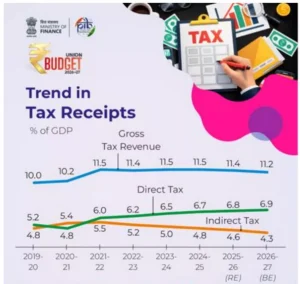
Summary of Union Budget 2026-27- Tax Receipts

Union Budget Fiscal Deficit Targets 2026–27

Maintaining fiscal prudence remains a core pillar of the Union Budget important points 2026–27:

  • Fiscal Deficit: 4.3% of GDP, reduced from 4.4% in FY 2025-26.
  • Debt-to-GDP Ratio: 55.6% projected, down from 56.1%.
  • Revenue and Expenditure Summary: Total expenditure projected at ₹53.5 lakh crore, net tax receipts estimated at ₹28.7 lakh crore.

These Union Budget key points 2026–27 show a balanced approach between development spending and fiscal responsibility.
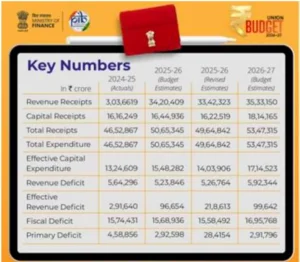
Summary of Union Budget 2026-27- Key Numbers

Union Budget Schemes and Initiatives 2026–27

The Union Budget schemes and initiatives 2026–27 prioritise social inclusion, technology adoption, and youth empowerment:

  • Girls’ Hostels: One per district to boost STEM education access.
  • Khelo India Mission: Nationwide sports ecosystem development over the next decade.
  • Digital Cargo Clearance: Single interconnected digital window by FY end.
  • Tourism & Skill Development: Upskilling 10,000 tourist guides across 20 sites.

Union Budget Revenue and Expenditure Summary 2026–27

The Union Budget revenue and expenditure summary 2026–27 provides a clear picture of fiscal planning:

  • Total Expenditure: ₹53.5 lakh crore across key sectors.
  • Net Tax Revenue: ₹28.7 lakh crore supporting public services and welfare programs.
  • Sectoral Focus: MSMEs, infrastructure, health, education, and rural development.

Enroll now for UPSC Online Classes

Union Budget Quick Facts 2026–27

Key takeaways from the Union Budget quick facts 2026–27 include:

  • Fiscal deficit targeted at 4.3% of GDP.
  • New Income Tax Act, 2025 implemented from April 2026.
  • Biopharma SHAKTI and seven high-speed rail corridors announced.
  • TCS reductions, customs exemptions, and foreign asset disclosure window for young professionals.
  • Bharat-VISTAAR AI platform for farmers and SHE Marts to empower women.

Union Budget Analysis 2026–27

The Union Budget analysis 2026–27 highlights the government’s strategic focus on inclusive growth, infrastructure, and fiscal prudence:

  • MSMEs & Startups: Support for future champions drives entrepreneurship.
  • Infrastructure & Connectivity: Focus on sustainable development with waterway expansion and high-speed rail corridors.
  • Education & Skill Development: AVGC labs, girls’ hostels, and tourism skill programs enhance human capital.
  • Agriculture & Women Empowerment: Bharat-VISTAAR and SHE Marts strengthen rural economy and inclusivity.
  • Tax Reforms: Simplification of rules, TCS reduction, and customs exemptions improve the business environment.

Check Out UPSC CSE Books

Visit PW Store

online store 1

Union Budget Important Announcements 2026–27

The Union Budget 2026–27, presented by Finance Minister Smt. Nirmala Sitharaman included several transformative announcements aimed at boosting economic growth, promoting inclusivity, and strengthening India’s global competitiveness. Here are the Union Budget top announcements 2026–27:

1. New Income Tax Reforms

  • New Income Tax Act, 2025 to come into effect from April 2026.
  • Simplified Income Tax Rules and Forms for easy compliance.
  • Rationalisation of penalties and prosecution to reduce litigation.
  • TCS reductions for overseas travel and education under Liberalised Remittance Scheme (LRS) from 5%/20% to 2%.
  • One-time 6-month foreign asset disclosure window for students and young professionals.

2. Public Capital Expenditure

  • Allocation increased to ₹12.2 lakh crore for FY 2026–27, up from ₹11.2 lakh crore in BE 2025–26.
  • Investments focus on infrastructure, sustainable cargo movement, and city economic regions.

3. Biopharma SHAKTI

  • Outlay of ₹10,000 crore to establish India as a global hub for biologics and biosimilars.
  • Includes creation of 3 new NIPER institutes, upgrading 7 existing ones, and over 1,000 accredited clinical trial sites.

4. MSME Growth

  • SME Growth Fund of ₹10,000 crore to create “Future Champions.”
  • Incentives based on performance criteria to promote entrepreneurship and innovation.

5. High-Speed Rail & Connectivity

  • 7 high-speed rail corridors planned as growth connectors (e.g., Mumbai-Pune, Delhi-Varanasi).
  • Expansion of Dedicated Freight Corridors and operationalisation of 20 new National Waterways.

6. Education & Skills Development

  • AVGC Labs to be set up in 15,000 secondary schools and 500 colleges.
  • Girls’ hostels in every district to encourage STEM education.
  • Upskilling 10,000 tourist guides across 20 key tourist sites in collaboration with IIMs.

7. Agriculture & Rural Development

  • Bharat-VISTAAR: Multilingual AI tool integrating AgriStack and ICAR resources for farmers.
  • SHE Marts: Community-owned retail outlets for women entrepreneurs.

8. Sports & Youth Empowerment

  • Khelo India Mission to transform the sports ecosystem over the next decade.
  • Integrated pathways for talent development, coaching, infrastructure, and competitions.

9. Ease of Doing Business & Digital Governance

  • Single-window digital cargo clearance by the end of FY 2026–27.
  • Simplified customs and duty processes, electronic tracking, and risk-based audit.
  • Duty-free imports for fish caught by Indian vessels in EEZ or high seas.

10. Customs & Trade Facilitation

  • Reduction in tariff rates on personal imports from 20% to 10%.
  • Customs exemptions for 17 essential medicines and critical minerals processing.
  • Warehouse operator-centric customs system with self-declarations.

11. Social Inclusion & Health

  • Regional Medical Hubs for medical tourism, combining AYUSH, research, and rehabilitation facilities.
  • Expansion of veterinary colleges and hospitals to increase availability of veterinary professionals.
  • Mental health infrastructure: NIMHANS-2 and regional apex institutions in Ranchi and Tezpur.

12. Fiscal Prudence

  • Fiscal deficit target: 4.3% of GDP for FY 2026–27.
  • Debt-to-GDP ratio: 55.6%, down from 56.1% in RE 2025–26.
  • Revenue & expenditure balance: Total expenditure estimated at ₹53.5 lakh crore; net tax receipts at ₹28.7 lakh crore.

These Union Budget important announcements 2026–27 collectively focus on economic reforms, social welfare, infrastructure development, and fiscal prudence, reinforcing India’s path toward Viksit Bharat.

Ready to boost your UPSC preparation? Join PW’s UPSC online courses today!


Frequently Asked Questions

What is the fiscal deficit target in the Union Budget 2026-27?

The government has targeted a fiscal deficit of 4.3% of GDP for the financial year 2026-27, continuing its path of fiscal consolidation.

What are the main tax changes in the 2026-27 budget summary?

Key changes include the introduction of the New Income Tax Act 2025, a reduction in TCS rates for overseas travel and education to 2%, and customs duty exemptions on 17 life-saving drugs.

What is Bharat-VISTAAR mentioned in the budget?

Bharat-VISTAAR is a multilingual AI tool designed to integrate agricultural portals and provide AI-based customised advice to farmers to improve productivity.

What is the Union Budget revenue and expenditure summary 2026–27?

The Union Budget revenue and expenditure summary 2026–27 outlines the government’s projected income from taxes and other sources, and planned spending across sectors like infrastructure, healthcare, education, and welfare programs for FY 2026–27.


Summary of Union Budget 2026-27: Key Highlights and Analysis

Enroll in SRIJAN Prelims Crash Course

Need help preparing for UPSC or State PSCs?

Connect with our experts to get free counselling & start preparing

Aiming for UPSC?

Download Our App

      
Quick Revise Now !
AVAILABLE FOR DOWNLOAD SOON
UDAAN PRELIMS WALLAH
Comprehensive coverage with a concise format
Integration of PYQ within the booklet
Designed as per recent trends of Prelims questions
हिंदी में भी उपलब्ध
Quick Revise Now !
UDAAN PRELIMS WALLAH
Comprehensive coverage with a concise format
Integration of PYQ within the booklet
Designed as per recent trends of Prelims questions
हिंदी में भी उपलब्ध

<div class="new-fform">


    </div>

    Subscribe our Newsletter
    Sign up now for our exclusive newsletter and be the first to know about our latest Initiatives, Quality Content, and much more.
    *Promise! We won't spam you.
    Yes! I want to Subscribe.