India’s Budget Journey: 75 Years of Growth

India’s Budget Journey: 75 Years of Growth 2 Feb 2026

India’s Budget Journey: 75 Years of Growth

The 2026-27 Union Budget represents a significant milestone in India’s economic journey, marking a shift towards a duty-based philosophy and strategic self-reliance in manufacturing.
Budget Overview and Historical Context

India’s Budget Journey

  • Backdrop of Budgetary Expansion: The 2026 budget was presented against a backdrop of immense growth.
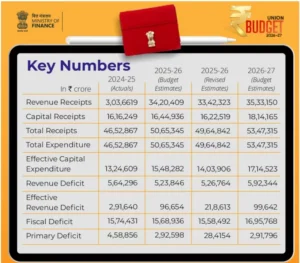
    • In 1947, India’s first budget, presented by RK Shanmukham Chetty, was only about ₹197 crore. The 2026-27 budget has grown to ₹53.5 lakh crore, representing a 27,000-fold increase over 75 years.
  • Continuity in Fiscal Leadership: Notably, Finance Minister Nirmala Sitharaman set a record by presenting her ninth consecutive budget.
  • Administrative Shift to Kartavya Bhavan: This is also the first budget from Kartavya Bhavan, the Finance Ministry’s new building, inaugurated in 2025.
  • Core Philosophy: The budget’s core philosophy is built around three “Kartavyas” (Duties):
    • First Kartavya (Duty 1): Increasing economic growth and productivity.
    • Second Kartavya (Duty 2): Fulfilling the aspirations of citizens (middle-class housing/cars and the basic needs of the poor).
    • Third Kartavya (Duty 3): Inclusive Growth (Sabka Saath Sabka Vikas), ensuring development reaches every family, community, and region.

Key Budgetary Concepts

  • Budget Estimate (BE) vs. Revised Estimate (RE): BE represents the government’s projected financial plan for the upcoming financial year (e.g., April 2026–March 2027), while RE reflects reality-based adjustments made to the previous year’s estimates in light of actual revenue and expenditure trends.
  • India’s Budget JourneyRevenue Receipts: These are government earnings that do not create repayment liabilities, comprising Tax Revenue (such as GST and Income Tax) and Non-Tax Revenue (including PSU dividends, user charges, fees, and fines).
  • Capital Receipts: These include inflows that either create liabilities or reduce assets, such as borrowings, disinvestment proceeds, and recoveries of loans previously extended.
  • Capital Expenditure (Capex): Capex refers to spending that results in the creation of productive assets like roads, railways, and hospitals, and has a strong multiplier effect, where ₹1 of public investment can generate up to ₹3 in economic output
  • Fiscal Deficit: The fiscal deficit is the gap between total government expenditure and non-loan receipts, financed through borrowing. For 2026–27, the fiscal deficit target is 4.3% of GDP.
  • Fiscal Responsibility and Budget Management (FRBM) Act, 2003:
    • 1990s Fiscal Stress: High fiscal deficits and the 1991 balance-of-payments crisis exposed India’s vulnerability and the absence of fiscal discipline.
    • FRBM Act, 2003: Enacted to institutionalise fiscal prudence by targeting a 3% fiscal deficit, a 40% debt-to-GDP ratio and eliminating revenue deficits.
    • Pre-GFC Consolidation (2007–08): A successful fiscal correction reduced the deficit to 2.7%, before it was derailed by the global financial crisis.
    • COVID-19 Shock (2020–21): Extraordinary pandemic spending led to a historic spike in fiscal deficit to 9.2%, temporarily overriding FRBM limits.
  • NK Singh Committee (2016): Fiscal Deficit Target: Recommended reducing the fiscal deficit to 2.5% of GDP by 2023 to ensure medium-term macroeconomic stability.
    • Debt-to-GDP Framework: Proposed a ceiling of 40% for the Centre and 20% for States to anchor debt sustainability within a rules-based system.
    • Escape Clause: Allowed a temporary deviation of up to 0.5% of GDP during exceptional circumstances such as national security threats or severe economic shocks.

Post-COVID Fiscal Recovery Journey

  • The fiscal deficit declined steadily from 9.2% in FY21 (COVID peak) to 6.7% (FY22), 6.4% (FY23) and 5.6% (FY24), with further consolidation projected at 4.8% (FY25 target), 4.4% (FY26 RE) and 4.3% (FY27 BE), aiming to reach 3.5% by FY 2027–28 and eventually the 3% FRBM mandate.

Debt-to-GDP & Government Borrowings

  • Debt-to-GDP Ratio: FY 26–27: 55.6%; FY 25–26: 56.1%; FRBM target: 40%.
  • Market Borrowings: Gross: ₹17.2 lakh crore; Net: ₹11.7 lakh crore (Gross – loan repayments = Net).
  • Why Government Borrowings Matter: Crowding-out effect on private sector credit; upward pressure on interest rates; future burden on subsequent generations.

Yuva Shakti–Driven Budget- Government’s ‘Sankalp’

  • First Kartavya: Accelerate and sustain economic growth by enhancing productivity and competitiveness and building resilience to volatile global dynamics.
  • Second Kartavya: Fulfil aspirations of our people by building capacity and making them strong partners in India’s path to prosperity.
  • Third Kartavya: Vision of Sabka Saath, Sabka Vikas, ensuring access to resources, amenities and opportunities for every family, community, region and sector.
  • Supporting Pillars: A continuous, adaptive, and forward-looking approach; a robust and resilient financial sector; sustaining momentum for structural reforms; mobilising savings and efficient capital allocation; cutting-edge technologies, including AI applications; and force multipliers for better governance.

First Kartavya (Duty 1)- Strategic Focus on 7 Manufacturing Sectors

  • Bio-Pharma Shakti: Unlike traditional chemical-based medicines, bio-pharma medicines are derived from living organisms (e.g., insulin, cancer drugs, gene therapy).
    • Goal: Increase India’s global market share from the current 2-3%.
    • Action: Upgrade 7 existing NIPERs (National Institutes of Pharmaceutical Education and Research) and establish 3 new ones.
    • SHAKTI Impact: Expansion to 1,000+ clinical trial sites attracts global pharma, enables faster drug approvals, provides early patient access, and reduces import dependence.
    • Current Challenges: High R&D costs ($1–2 billion per drug), shortage of skilled workforce, weak clinical trial infrastructure, and complex regulatory processes.
    • COVID-19 Lesson: mRNA vaccines (Pfizer, Moderna) were biopharma products. India initially couldn’t produce them. Covaxin & Covishield used traditional platforms. With biopharma capability, a faster response would have been possible.
    • Policy Relevance: Aligns with Make in India, Atmanirbhar Bharat, PLI Pharma, reducing API dependence on China and the National Biopharma Mission
  • Semiconductor Mission 2.0: Semiconductors are the building blocks of modern technology, currently dominated by Taiwan and South Korea.
    • Mission 1.0 Results: 10 projects approved with ₹1.6 lakh crore investment, including plants in Gujarat by Tata and Micron.
    • Mission 2.0 Focus: Moving to advanced capabilities, such as producing manufacturing equipment/machinery within India and securing design patents.
    • Electronics: ₹400 crore allocated for components like Printed Circuit Boards (PCBs) and resistors.
  • Rare Earth Corridors: Rare earth elements (17 elements, including Scandium) are vital to EVs, wind turbines, and missiles. China currently controls 90% of global processing.
    • The Corridor: Established across Odisha, Kerala, Andhra Pradesh, and Tamil Nadu to manage the entire value chain from mining to manufacturing.
    • Goal: Produce 6,000 metric tons of permanent magnets annually.
  • Chemical Parks via Challenge Route: India is the 6th-largest chemical producer but accounts for only 3–4% of the global market.
    • Innovation: Three dedicated chemical parks will be awarded through the Challenge Route, where states compete for funding by offering the best infrastructure.
    • Plug-and-Play Model: States provide ready-to-use infrastructure (land, power, water and clearances), enabling firms to start production quickly and reducing gestation from five years to one to two years.
    • Challenge Route Model: Promotes competitive federalism by linking funding to proposal quality, as recommended by NITI Aayog.
    • Global Benchmarks: Successful chemical clusters include Germany’s Chemical Triangle, China’s Jiangsu Chemical Park, Singapore’s Jurong Island, and India’s Dahej PCPIR.
  • Capital Goods and Containers: Capital goods are machines that produce other goods; India’s high import dependence poses a strategic risk to manufacturing continuity.
    • Hi-Tech Tool Rooms: Two CPSE-led facilities will manufacture precision components, dies and moulds using CNC and 3D printing, reducing reliance on imports from Germany and Japan.
    • CIE Scheme: Focuses on indigenising construction and infrastructure equipment, such as bulldozers and excavators, of which over 70% are currently imported, in support of PM Gati Shakti.
    • Container Manufacturing: ₹10,000 crore allocated over five years to reduce dependence on China’s 96% global dominance, lower logistics costs and strengthen supply-chain resilience.
    • Overall Benefits: Reduced logistics costs, strategic autonomy, employment generation, increased steel demand, and support to PM Gati Shakti and the National Infrastructure Pipeline (NIP).
  • Textile Sector Expansion: The textile industry is India’s second-largest employer after agriculture, supporting over 100 million livelihoods.
    • National Fibre Scheme: Focuses on promoting man-made fibres, which now account for around 60% of the global textile market.
    • Global Paradox: Despite being the fifth-largest textile exporter, India holds only 4% of the global market, far behind China (35%+) and Bangladesh (7%).
    • Budget 2026 Response: A comprehensive textile push through four initiatives—National Fibre Scheme, Textile Expansion Scheme, Mega Textile Parks and Gram Swaraj Initiative—to enhance competitiveness and employment.
  • Mega Textiles Park In Challenge Mode: Mega Textile Parks (PM MITRA): Expansion through challenge mode with a focused push on technical textiles.
    • Technical Textiles: Performance-based, non-fashion textile products used in infrastructure (Geotech), agriculture (Agrotech), healthcare (Meditech) and defence (Protech).
    • Market Potential: The Indian technical textiles market is targeted to grow from ₹2 lakh crore to ₹3 lakh crore by 2030.
    • Challenge Mode: Park allocation through competitive federalism, encouraging states to offer superior infrastructure and governance.
  • Mahatma Gandhi Gram Swaraj Initiative: Objective: Strengthen Khadi, handloom and handicrafts, supporting crores of weavers and craftsmen across India while protecting India’s cultural heritage.
    • Rationale: Heritage handloom and handicraft products have a strong global appeal but lack adequate modern market access.
    • GI-Tagged Products (Premium Potential): Pashmina (Kashmir), Chanderi (MP), Pochampally (Telangana), Banarasi (UP), Kanchipuram (TN).
    • Strategy: Branding Indian handlooms for international markets and integrating artisans with digital and e-commerce platforms.
    • Initiative Focus: Global market linkages, India Handloom branding, training that blends modern design sensibilities with traditional skills, and direct-to-consumer sales through e-commerce.

India’s Semiconductor Journey

  • Early Effort (1980s): SCL Mohali initiative failed due to outdated technology and a lack of sustained investment.
  • Policy Revival (ISM 1.0, 2021): ₹76,000 crore allocated to fabs, OSAT, and the chip design ecosystem.
  • Ecosystem Expansion (ISM 2.0, 2026): Emphasis on advanced capabilities, full-stack semiconductor ecosystem and ₹40,000 crore components scheme.
  • ISM 1.0 Achievements (by 2026)
    • Tata–PSMC Fab, Dholera (Gujarat): $10 billion investment; trial production scheduled for February 2026.
    • Micron ATMP, Sanand (Gujarat): $2.75 billion investment; commercial production expected by February 2026.
    • CG Power–Renesas (Gujarat): Facility focused on manufacturing power semiconductors.
  • Outcomes by 2026: 10 projects approved with over ₹1.6 lakh crore investment, including major fab and ATMP facilities in Gujarat.

ISM (India Semiconductor Mission) 2.0- Key New Features

  • Equipment & Materials: Focus on domestic manufacturing of fab equipment, including lithography machines, to reduce dependence on imports.
  • Full-Stack Indian IP: Promotion of indigenous chip design and ownership of intellectual property, moving beyond contract manufacturing.
  • Supply Chain Development: Local sourcing of critical chemicals, gases and materials required for semiconductor fabs to ensure resilience.
  • Research & Training: Introduction of semiconductor courses in IITs and NITs with strong industry–academia collaboration to build skilled manpower.
  • Electronics Components Manufacturing Scheme: ₹40,000 crore allocation for PCBs, capacitors and resistors to strengthen the broader electronics ecosystem beyond chips.

About Rare Earth Elements (REE)

  • Rare Earth Elements (REEs): A group of 17 elements comprising Scandium, Yttrium and 15 lanthanides; geologically common but rarely found in economically viable concentrations.
  • Strategic Applications: Essential for permanent magnets (EVs, wind turbines), batteries (hybrid vehicles), screens (electronics) and defence technologies.
  • Contemporary Relevance: Green energy transition and modern technology are critically dependent on rare earth elements.

The China Problem- Dangerous Monopoly

  • China’s Dominance: Controls 60–70% of global REE mining and over 90% of global processing, creating a near-monopoly across the value chain.
  • Geopolitical Leverage: In 2010 (China–Japan dispute), export stoppage disrupted Japan’s electronics industry, and during the 2019 US–China trade war, export threats triggered concerns in the US semiconductor sector.
  • Strategic Risk: Heavy dependence on a single country turns supply chains into tools of geopolitical coercion.
  • India’s Position: India holds 7.23 million tonnes of REO reserves (6th largest globally), concentrated in monazite sands along the coasts of Odisha, Kerala, Andhra Pradesh, and Tamil Nadu.

India’s REE Challenge & Budget Solution

  • Current REE Challenge: India exports raw REE ores, lacks processing capacity, imports 85–90% of rare-earth magnets, and captures minimal domestic value addition.
  • Budget 2026 Intervention: Creation of Rare Earth Corridors across Odisha, Kerala, Andhra Pradesh and Tamil Nadu to establish an end-to-end value chain from mining to manufacturing.
  • Supporting Measures: ₹7,280 crore Permanent Magnet Scheme and an expanded role for IREL (Indian Rare Earths Ltd) through facilities such as OSCOM in Odisha.
  • Strategic Importance: Critical inputs for EVs, wind energy, and defence platforms underline REEs as strategic minerals.

Check Out UPSC CSE Books

Visit PW Store

online store 1

Chemical Parks- Industrial Backbone of the Economy

  • Context: Despite being the 6th largest chemical producer, India’s global market share remains limited at 3–4%.
  • Budget Intervention: Establishment of three dedicated chemical parks through a challenge route to boost competitiveness.
  • Challenge Route Model: Competitive federalism where states compete for funding based on proposal quality, as recommended by NITI Aayog.
  • Plug-and-Play Infrastructure: Pre-approved land and clearances significantly reduce project gestation considerably.
  • Global Benchmarks: Successful chemical clusters in Germany, China, Singapore and India (Dahej PCPIR).

Enroll in SRIJAN Prelims Crash Course

Need help preparing for UPSC or State PSCs?

Connect with our experts to get free counselling & start preparing

Aiming for UPSC?

Download Our App

      
Quick Revise Now !
AVAILABLE FOR DOWNLOAD SOON
UDAAN PRELIMS WALLAH
Comprehensive coverage with a concise format
Integration of PYQ within the booklet
Designed as per recent trends of Prelims questions
हिंदी में भी उपलब्ध
Quick Revise Now !
UDAAN PRELIMS WALLAH
Comprehensive coverage with a concise format
Integration of PYQ within the booklet
Designed as per recent trends of Prelims questions
हिंदी में भी उपलब्ध

<div class="new-fform">


    </div>

    Subscribe our Newsletter
    Sign up now for our exclusive newsletter and be the first to know about our latest Initiatives, Quality Content, and much more.
    *Promise! We won't spam you.
    Yes! I want to Subscribe.