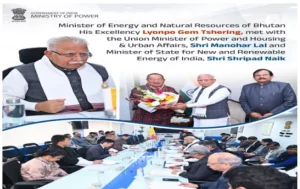
Recently, India and Bhutan reaffirmed their long-standing partnership in the power sector during senior-level talks held in New Delhi, India, focusing on strengthening hydropower development and cross-border transmission interconnections to deepen energy cooperation.
Key Outcomes of the Ministerial Meeting
The discussions centered on four primary pillars of cooperation:
- Optimizing the Punatsangchhu Corridor:
- Punatsangchhu-II (1020 MW): Located on the Punatsangchhu River, the focus is now on “commercial optimization.”
- This means streamlining how the 1020 MW of power enters the Indian grid to ensure maximum revenue for Bhutan and stable supply for India.
- Punatsangchhu-I (1200 MW): Ministers prioritized the “early commissioning” of this project.
- It has faced geological challenges, so the emphasis is now on technical resolution and fast-tracking the remaining civil works.
- The Sankosh Mega-Project: The meeting revitalized the Sankosh Hydropower Project (~2585 MW).
- This is intended to be a giant multi-purpose project.
- Beyond power, it has significant implications for irrigation and flood control in downstream Indian states like West Bengal and Assam.
- Vision 2040: Transmission Infrastructure: Consultations are officially underway for a Transmission Master Plan up to 2040.
- This involves building high-voltage lines (HVDC and 400kV) that can handle the massive influx of power from future projects, ensuring the physical “pipes” are ready before the “power” is generated.
- Lean Month Management: A critical policy shift involves streamlining approvals for power scheduling.
- During Bhutan’s “lean months” (winter), river levels drop, and Bhutan becomes a net importer. The ministers agreed to a more automated, less bureaucratic process for India to supply power back to Bhutan during these periods.
Chronology of India-Bhutan Power Cooperation
- 1961 (Jaldhaka Agreement): The cooperation began with the Jaldhaka Project, marking the first instance of cross-border power sharing where India supplied electricity to Southern Bhutan.
- 1974 (Chukha HEP Agreement): Both nations signed the agreement for the 336 MW Chukha Project, establishing the foundational 60:40 Grant-Loan financing model that defined early relations.
- 1988 (Commissioning of Chukha): With the full operation of the Chukha project, Bhutan officially transitioned into a net exporter of electricity, leading to a massive surge in its national GDP.
- 2001 (Kurichhu Commissioning): The 60 MW Kurichhu Project was commissioned, specifically designed to drive the socio-economic upliftment of the less-developed Eastern Bhutan region.
- 2006 (Umbrella Agreement): India and Bhutan signed a landmark Umbrella Agreement, which formalized a comprehensive and long-term framework for bilateral hydropower cooperation.
- 2007 (Tala Commissioning): The 1020 MW Tala Project was commissioned; as the largest project of its time, it significantly bolstered Bhutan’s export earnings and fiscal strength.
- 2009 (10k MW Protocol): A high-level protocol was signed, setting an ambitious target to develop 10,000 MW of hydropower capacity by the year 2020.
- 2019 (Mangdechhu Inauguration): The 720 MW Mangdechhu Project was inaugurated, later gaining international acclaim by winning the prestigious Brunel Medal (2020) for civil engineering excellence.
- 2023 (IEX Integration): In a shift toward market dynamics, Bhutan began selling surplus power from the Basochhu Project directly on the Indian Energy Exchange (IEX).
- 2024 (Joint Vision Document): Both governments issued a Joint Vision Document, signaling a strategic shift beyond hydropower to include Solar and Green Hydrogen in their “Clean Energy” portfolio.
- 2025 (P-II Commissioning): The 1020 MW Punatsangchhu-II Project saw the full commissioning of all six units, with bilateral focus shifting toward “Commercial Optimization” of its output.
- 2026 (Vision 2040 Meet): In February 2026, ministerial talks centered on Transmission Vision 2040, the roadmap for the Sankosh Project, and streamlining power scheduling for Bhutan’s lean winter months.


 4 Feb 2026





.png)






 Current Affairs




 GS Foundation
 Optional Course
 Combo Courses
 Degree Program