The US Supreme Court ruled that President Donald Trump did not have authority under the International Emergency Economic Powers Act (IEEPA) to impose sweeping tariffs on trade partners.
- Supreme Court Verdict: The US Supreme Court (6‑3) ruled that the President lacked authority under IEEPA to impose broad tariffs.
Why Did Donald Trump Invoke IEEPA?
- Historical Context: No US President before Trump had used IEEPA to impose tariffs.
- Trump’s Justification: In the ‘Liberation Day’ executive order (April 2, 2025), Trump declared a national emergency citing:
- Foreign trade and economic practices harming the US economy.
- Absence of reciprocity in trade relationships with other countries.
- Objective: To use IEEPA as a legal basis to impose sweeping tariffs on imports as a tool of trade policy and economic leverage.
|
-
- Implication:
- The ruling means IEEPA cannot be used as a blanket tariff tool; Congressional approval is required.
- This invalidates the “Liberation Day” tariffs imposed on 2nd April 2025, affecting global trade and India’s exports.
- Raises questions about refunds for tariffs already collected and the future of US trade policy.
About International Emergency Economic Powers Act
- Purpose: Grants the US President authority to act in case of unusual or extraordinary threats originating outside the US that affect national security, foreign policy, or the economy.
- Scope: Allows measures such as freezing assets, imposing sanctions, and controlling imports/exports during a declared national emergency.
- Key Features:
- Executive powers cannot be used for tariffs without Congressional authorization.
- Designed to respond to global economic or security threats rapidly.
- Historical Context:
- Enacted by President Jimmy Carter in 1977 to replace the Trading with the Enemy Act (1917).
- Previously used for sanctions, e.g., 1979 Iran hostage crisis.
- As of September 1, 2025, 77 national emergencies have been declared under IEEPA, of which 46 are ongoing.
Alternative Legal Routes to International Emergency Economic Powers Act
- Section 122, Trade Act 1974: It allows temporary tariffs up to 15% for up to 150 days.
- Section 338, Tariff Act 1930: It Permits tariffs up to 50% on imports from countries with “discriminatory trade practices.”
- Section 232, Trade Expansion Act 1962: It restricts imports harmful to national security.
- For Example: It is already used for steel & aluminium.
- Section 301, Trade Act 1974: It acts against unfair foreign regulations burdening US trade.
Will the US Refund Money Collected Under IEEPA Tariffs?
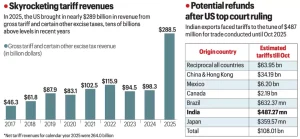
- IEEPA tariffs in 2025 were estimated to have generated $142 billion for the US federal government (US Customs & Border Protection).
- Supreme Court Ruling: SCOTUS struck down Trump’s use of IEEPA for tariffs but did not rule out refunds to importers.
- Refund Possibility:
- Importers may claim refunds for tariffs paid.
- A substantial portion of revenue is likely to be returned, according to The Budget Lab, Yale.
- Challenges: The refund process is expected to be complex, involving intricate customs procedures and administrative hurdles.

|