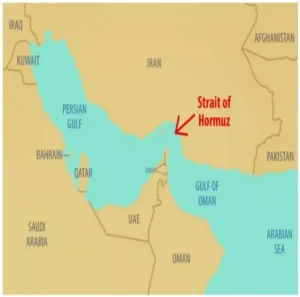
Global oil prices rose sharply after the United States moved to enforce a naval blockade around Iranian ports and Strait of Hormuz, raising concerns over supply disruptions, according to Associated Press.
- This Naval Blockade threat comes amid failed ‘Islamabad Talks’ in Pakistan between the U.S. and Iran to end the ongoing conflict associated with Operation Epic Fury.
UPSC Online Classes
About Naval Blockade
- A naval blockade is a strategic military and economic tool used to restrict maritime access to a coastline or region, typically to sever an adversary’s primary sources of revenue and supply.
- In practice, this involves deploying a concentrated military force often including aircraft carriers, guided-missile destroyers, and amphibious assault ships – to monitor and intercept all vessels entering or leaving a sanctioned zone.
- Rights of Neutral States: Neutral ships attempting to breach a lawful blockade can be captured or diverted.
- However, neutral states retain the right to freedom of navigation outside the blockade zone.
Status Under International Maritime Law
- Declaration: Under international law, it must be formally declared, notified to neutral states, and enforced impartially.
- Act of war: Under international law, a blockade is widely regarded as an act of war.
- When a country-state uses force to prevent ingress or egress of vessels to another state’s ports, it is viewed as engaging in belligerent activity.
- Declaration Respecting Maritime Law: A blockade is an act of war as per the Declaration Respecting Maritime Law adopted in Paris on 16 April 1856 and by articles 1-21 of the Declaration Concerning the Laws of Naval War adopted on 26 February 1909 in London.
- San Remo Manual on International Law: The San Remo Manual on International Law Applicable to Armed Conflicts at Sea (SRM) adopted on 12 June 1994 provides legal interpretation in paragraphs 67(a), 93-104, 146(f) and 153(f) of naval blockade.
- Compliance with International Humanitarian Law (IHL): A blockade must comply with international humanitarian law (IHL) applicable in both international and non-international armed conflicts.
- This means respecting the principles of military necessity, distinction and proportionality, while protecting civilians and civilian objects.
Key Features of the Current Blockade
- Targeting Maritime Traffic: The blockade aims to stop all ships entering or exiting Iranian ports, effectively restricting Iran’s maritime trade.
- Universal Application: It is being enforced on vessels of all nations engaged in trade with Iran, without discrimination based on nationality.
- Limited Impact on Strait of Hormuz: The blockade does not fully restrict passage through the Strait of Hormuz, allowing ships not bound for Iran to continue transit.
Reasons Behind the Naval Blockade
- Failure of Diplomatic Talks: The blockade follows the collapse of high-level US–Iran negotiations, primarily due to disagreements over Iran’s nuclear programme and related security issues.
- Economic Pressure Strategy: The United States aims to intensify economic pressure on Iran by restricting its trade and oil exports, thereby weakening its economy.
- Countering Strategic Influence: The move is also intended to curb Iran’s strategic leverage over key maritime routes, particularly in the Persian Gulf region, including areas around the Strait of Hormuz.
Best Online Coaching for UPSC
Impact of Naval Blockade
Global
- High Transportation Cost: Fewer ships moving through the region and higher risks for tankers can push up transport costs, adding pressure on countries that depend on oil from the Middle East.
- Disruption in Oil Markets: Blocking Iranian shipments would disconnect a significant source of oil from the world’s markets.
- For Example: Iran exported 1.84 million barrels per day (bpd) of crude in March 2026 and has shipped 1.71 million bpd thus far in April 2026, compared with a full-year average of 1.68 million bpd in 2025, according to Kpler data.
- Cease Fire Jeopardy: The blockade marks a shift away from diplomacy toward a more coercive approach, warning it could deepen tensions in the Middle East which may result in violation of ceasefire between Iran- USA.
India
- Rising Import Bill and Inflationary Pressure: The blockade is likely to increase global crude oil prices, thereby raising India’s import bill and contributing to inflation, given its heavy dependence on imported energy.
- Threat to Energy Security: India imports over 80–85% of its crude oil, with a significant portion passing through the Strait of Hormuz, making its energy supply vulnerable to disruptions.
- Foreign Policy Balancing Act: India faces a strategic dilemma in balancing its relations with the United States and Iran, while maintaining its policy of strategic autonomy.
- Shift in Energy Sourcing: India may need to diversify crude imports by increasing purchases from countries like Russia, the US, and Africa to mitigate risks from West Asian instability.
Timeline Of Naval Blockades: A Snap Shot
| S. No. |
Event |
Description |
| 1 |
Peloponnesian War |
Athens used its navy to blockade Spartan allies and control sea trade in the Aegean, showing early use of sea power to choke supplies. |
| 2 |
Napoleonic Wars — British Blockade of France |
The Royal Navy blockaded French ports for years, crippling Napoleon’s trade and contributing to his defeat. |
| 3 |
American Civil War — Union Blockade |
The Union’s “Anaconda Plan” sealed Confederate ports, starving the South of weapons, goods and export income. |
| 4 |
World War I — Allied Blockade of Germany |
Britain blockaded Germany, causing severe shortages that weakened the German war effort and civilian morale. |
| 5 |
World War II — Atlantic & Pacific blockades |
Allied naval power restricted Axis shipping lanes; U-boats and counter-blockades made sea control central to the war. |
| 6 |
Cuban Missile Crisis — “Naval Quarantine” |
The US avoided the word blockade (an act of war) and imposed a “quarantine” to stop Soviet missiles reaching Cuba. |
Click to Know UPSC Coaching Centres in India
Related Concept: PwonlyIAS Extra Edge
What is a Naval Quarantine?
- A naval quarantine is a targeted maritime strategy in which a nation deploys naval vessels and aircraft off a foreign coast to prevent specific goods, particularly military equipment from entering or leaving.
- Unlike a full blockade, a quarantine is a limited, coercive measure that restricts activity without formally declaring war.
- Past Instance:
-
- While a blockade is recognised as an act of war, a ‘quarantine’ was used, as in 1962 by John F Kennedy, to justify a more limited blockade of ‘offensive weapons.’
|


 13 Apr 2026




.png)






 Current Affairs




 GS Foundation
 Optional Course
 Combo Courses
 Degree Program