Thousands of workers protesting in Noida, Manesar, Gurugram, and Faridabad in April 2026 have spotlighted a deepening crisis in India’s labour relations — stagnant real wages, implementation gaps in the new Labour Codes, and rising urban living costs.
Best Online Coaching for UPSC
About the Recent Issue
- Widespread Industrial Unrest in NCR Region: Recent protests by tens of thousands of workers in Noida, Manesar, Gurugram, and Faridabad have brought labour distress to the forefront.
- These protests have, at times, escalated into violence, involving over 40,000 workers, leading to factory shutdowns and police intervention.
- The Proximity Trigger: The 35% minimum wage hike in Manesar (April 9) acted as an immediate catalyst, as workers in the contiguous NCR region perceived inter-state wage disparity in addressing a common cost-of-living crisis, triggering protests in Noida.
- Uttar Pradesh followed with an interim hike of up to 21%, yet workers continue to protest, demanding surety of ₹18,000–₹20,000/month.
- This indicates that even substantial nominal wage hikes are perceived as inadequate, given the magnitude of cost-of-living increases.
The NCR Crisis- Migrant Vulnerability and Urban Stress
Since the unrest is concentrated in hubs like Noida, Manesar, and Gurugram, the analysis must account for the unique pressures of the National Capital Region:
- Lack of Affordable Rental Housing: High industrial growth has not been matched by low-cost housing. Workers are often forced into overcrowded, informal settlements where they pay exorbitant rents, effectively negating any marginal wage hikes.
- Weak Portability of Welfare: Despite the ‘One Nation One Ration Card’ initiative, many migrant workers face hurdles in accessing healthcare (ESIC) and other subsidies outside their home states, increasing their out-of-pocket expenses.
- Information Asymmetry: Migrants often lack social networks to understand their rights under the new Labour Codes, making them more susceptible to rumors and spontaneous, leaderless protests.
|
The Core Issues behind such Protests
- Wage–Inflation Mismatch- The Erosion of Real Incomes:
- Rising Industrial Inflation Outpacing Wage Growth: The CPI-IW has increased by approximately 24.8% (2021–2026), while wage growth has remained comparatively subdued, saw increases as low as 15–20% in some cases resulting in negative real wage growth and a sustained decline in purchasing power.
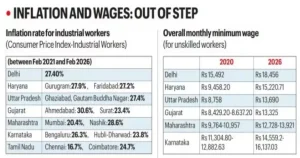 The Consumer Price Index for Industrial Workers (CPI–IW) measures the change in prices of a basket of goods and services consumed by industrial workers, and is widely used to assess cost of living and inflation for the working class.
- CPI–IW is compiled and released by the Labour Bureau, under the Ministry of Labour and Employment.
- The current base year is 2016.
- Purchasing power refers to the quantity of goods and services that a unit of income can buy, reflecting the real value of money in an economy.
- Decadal Trend of Real Wage Stagnation: Since 2016, price levels (~50% increase) have significantly outpaced wage growth (~40%), indicating a structural erosion of real incomes rather than a short-term fluctuation.
- Delay in Base Minimum Wage Revision- Institutional Inertia:
- Failure of Periodic Wage Revision Mechanism: Despite the mandate of five-year revision cycles, delays of nearly a decade (Haryana) and stagnation since 2012 (Uttar Pradesh) highlight institutional inefficiency and policy inertia.
- Over-Reliance on Variable Dearness Allowance (VDA): While VDA adjustments provide partial inflation relief, the absence of base wage revision locks workers into historically depressed income benchmarks, weakening the wage system’s responsiveness.
- Variable Dearness Allowance (VDA) is an inflation-linked component of wages provided to workers to offset the erosion of real income due to rising prices, particularly for essential commodities.
- Rising Cost of Living- Intensification of Urban Economic Stress:
- Global and Domestic Inflationary Spillovers: Geopolitical disruptions (West Asia) and energy supply shocks have increased fuel and logistics costs, amplifying inflationary pressures across sectors.
- Escalation in Essential Consumption Costs: Workers face rising costs in food, housing rents, and energy, with LPG prices touching ₹4,000 in informal markets, significantly raising the cost of urban survival.
- Essential consumption costs refer to the minimum expenditure required to meet basic human needs, including food, housing, energy, healthcare, transport, and education, necessary for a decent standard of living.
- Declining Disposable Income and Rising Vulnerability: The combined effect has resulted in shrinking disposable incomes, higher indebtedness, and increased economic precarity, especially among migrant workers.
- The Subsistence Crisis: Beyond CPI-IW, rising energy costs (Strait of Hormuz disruptions) have pushed migrant workers toward black-market LPG (~₹4,000), intensifying livelihood stress.
- The Rent Formula Gap: Official norms cap rent at ~10%, but in hubs like Noida and Manesar, it consumes 30–50% of income, making even revised wages insufficient.
- The Rent Formula refers to the normative component used in minimum wage calculations to account for housing expenditure.
- Traditionally, it assumes that a worker spends around 10% of total consumption expenditure on house rent, based on standards evolved from expert committee recommendations (e.g., Indian Labour Conference norms).
- Institutional and Policy Gaps- Transition without Clarity:
- Implementation Vacuum in Labour Codes: The partial implementation of the Labour Codes (2025) has created a legal and administrative vacuum, resulting in ambiguity, uneven enforcement, and compliance uncertainty.
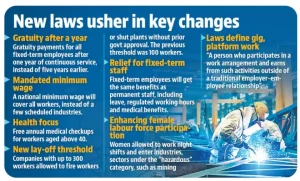 Information Asymmetry and Expectation Mismatch: Misinterpretation of policy provisions, such as the perceived ₹20,000 minimum wage, has led to inflated expectations and subsequent dissatisfaction.
- Flexibilisation without Adequate Safeguards: Provisions allowing extended work hours (12-hour spread-over) risk labour exploitation in the absence of robust overtime and safety regulations.
- Weak Collective Bargaining Mechanisms: The decline of institutionalised trade unions has weakened formal negotiation channels, leading to spontaneous and disruptive protests.
- Executive-Led Regulation: The Labour Codes (2025) shift key provisions like working hours to executive rules, creating an implementation gap and enabling perceived longer shifts without adequate overtime safeguards.
- The ₹20,000 Misconception: A Sept 2024 wage notification (~₹20,358) for Central Sphere establishments was misread as a universal minimum, creating an expectation–reality gap that fuelled protests.
- Structural Labour Market Weaknesses- Deep-Rooted Fault Lines:
- High Informalisation of Workforce: With over 90% informal workforce, workers lack social security, legal protection, and bargaining power, making them highly vulnerable.
- Regional Disparities and Competitive Federalism: Divergent state-level wage policies create inequalities and risk a “race to the bottom” in labour standards.
- Industrial Cost Pressures and Wage Suppression: Firms facing rising input costs often resort to wage suppression or delayed payments, shifting the adjustment burden onto workers.
- The Profit–Wage Squeeze: Factories face a “pincer pressure” from US trade tariffs and the West Asia crisis, leading firms to suppress wages and delay payments, thereby heightening shop-floor volatility.
UPSC Coaching Classes
The Constitutional and Legal Dimension
The current labor distress is not merely an economic issue; it represents a widening gap between India’s Constitutional Mandates and ground-level implementation.
- The Constitutional Anchor: Beyond Article 43 (Living Wage), the current crisis touches upon:
- Article 21: The Supreme Court has held that the Right to Life includes the right to live with human dignity, which is compromised by stagnant wages and poor living conditions.
- Article 39 (Directive Principles): This directs the State to ensure citizens have the right to an adequate means of livelihood and that the health of workers is not abused for economic necessity.
- Legislative Transition: The shift from the Code on Wages, 2019 to the newly notified Labour Codes (2025) aims to simplify 44 complex central laws.
- However, the lack of clear rules regarding the “social security fund” for unorganized workers remains a major point of contention.
- The Urban-Migrant Paradox: In the NCR region, industrialization is driven by rapid urbanization, yet infrastructure for the workforce remains primitive. This results in a “floating population” that contributes to the economy but remains invisible to the state’s welfare net.
|
The Wide-Ranging Effects of Labor Unrest
When there is a breakdown in the relationship between employers and employees, the consequences reach far beyond the factory gates.
- Impact on Workers- Financial Struggle and Long-term Stress: The most immediate harm is felt by the people who rely on their daily or monthly wages to survive.
- Difficulty Covering Basic Costs: When wages stop or don’t keep up with the cost of living, families struggle to pay for food, housing, and medicine. This often forces them to cut back on essentials, which hurts their overall standard of living.
- The Trap of High-interest Debt: Without a steady paycheck, many workers turn to informal moneylenders who charge very high interest. This creates a cycle where the worker stays in debt for years, even after the unrest ends and they return to work.
- Loss of Future Opportunities: Constant financial stress makes it hard for workers to invest in training or education for themselves or their children, which keeps them stuck in low-paying roles.
- Impact on Industry- Financial Loss and Damage to Reputation: For companies, unrest creates a chain reaction of costs that can take years to recover from.
- Stopping the Flow of Goods: Modern businesses rely on tight schedules. A strike or protest causes production delays, which means the company cannot fulfill its contracts with customers.
- Hidden Restart Costs: It isn’t as simple as flipping a switch. Companies face high expenses to repair machines that sit idle, pay for extra security, and handle legal battles related to the labor dispute.
- Loss of Competitive Edge: If a business is seen as “unstable,” investors and partners will take their money elsewhere. This can lead to the company shrinking or closing down entirely because it can no longer compete in the market.
- Impact on Government- Public Trust and Safety Pressures: The government is caught in the middle, trying to balance the needs of the economy with the rights of the citizens.
- Weakening of Law and Order: Large-scale unrest often requires the government to move police and resources away from other areas to manage protests. This creates tension in the streets and can lead to safety concerns for the general public.
- Loss of Investor Confidence: When a government cannot settle labor disputes effectively, it sends a signal to the world that the country is a risky place to do business. This stops foreign companies from building new offices or factories there.
- Reduced Public Funding: Because struggling businesses pay less in taxes, the government has a smaller budget. This means there is less money available for public services like roads, hospitals, and schools.
- Impact on Economy and Society- Slower Growth and Social Friction: At a national level, labor unrest can slow down the progress of the entire country.
- Lower Spending in Shops: When a large group of workers loses their buying power, they stop spending money at local businesses. This causes a drop in sales for everyone from grocery stores to clothing shops, hurting the whole economy.
- Rising Social Bitterness: When people feel they are being treated unfairly and see the gap between the rich and poor growing, it creates anger and frustration. This leads to a divided society where it is harder for people to work together.
- Fewer Jobs for the Youth: Prolonged instability makes the economy stop growing. When the economy stalls, businesses don’t hire, leading to high unemployment for young people entering the workforce for the first time.
World’s Best Practices on Workers’ Rights & Strike Regulation:
- Nordic Model (Sweden, Denmark, Norway): These countries rely on strong trade unions, high collective bargaining coverage, and continuous social dialogue, which reduce the need for frequent strikes.
- The right to strike is recognised, but it is exercised within a framework of negotiation, mediation, and mutual trust.
- Outcome: Low industrial conflict and high wage equality.
- Germany: Germany ensures worker participation through Works Councils and co-determination on company boards. Strikes are allowed, but they must be union-led and used only after negotiations fail.
- Outcome: Strong worker voice with industrial stability.
- United Kingdom: In the UK, strikes require secret ballot approval, minimum turnout, and prior notice, with added restrictions in essential services. This ensures that industrial action has a clear democratic mandate and legal legitimacy.
- Outcome: Greater accountability and regulated strike action.
- United States: The right to strike is protected under labour law, especially through the National Labor Relations Act (NLRA), but it is restricted in the public sector and essential services. Employers may also hire replacement workers during strikes.
- Outcome: Flexible labour market, but weaker and more contested worker protections.
- France: France provides constitutional protection to the right to strike, while also imposing minimum service requirements and public order safeguards in key sectors. This balances labour rights with social stability.
- Outcome: Strong worker mobilisation with institutional regulation.
- Japan: Japan’s labour relations are based on enterprise unions, long-term employment, and consensus-driven negotiations. Although the right to strike exists, it is used rarely because disputes are usually resolved through dialogue.
- Outcome: Industrial harmony with minimal disruption.
Global Initiatives:
International labor governance is built on a hierarchy of legal and ethical standards that elevate labor rights to the status of fundamental human rights.
- ILO Core Standards: The Normative Backbone The International Labour Organization (ILO) anchors global governance through its Core Conventions. While the “Right to Strike” is not explicitly written in the original treaty text, the ILO’s supervisory bodies consistently interpret it as an essential derivative of:
- Convention 87: Freedom of Association.
- Convention 98: Right to Organize and Collective Bargaining.
- UN Human Rights Framework: A Rights-Based Approach The United Nations bridges labor and human dignity through two primary instruments:
- Universal Declaration of Human Rights (1948): Establishes the right to form trade unions and enjoy fair working conditions.
- International Covenant on Economic, Social and Cultural Rights (ICESCR) (1966): Article 8 provides the most explicit international legal recognition of the Right to Strike.
- OECD, G20, and SDGs: Responsible Globalization
- OECD Guidelines: Focus on supply chain due diligence and responsible business conduct.
- G20 Labor Track: Prioritizes social protection and “Decent Work” as drivers of inclusive growth.
- SDG Linkages: Labor rights are central to SDG 8 (Decent Work) and SDG 10 (Reduced Inequalities), positioning fair dispute resolution as a prerequisite for sustainable development.
|
Click to Know UPSC Coaching Centres in India
Concerns & Challenges that need to be Tackled
The current crisis in NCR is not just about wages; it highlights several structural “traps” that could derail India’s industrial growth:
- The “Race to the Bottom”: There is a growing risk that Indian states, in a bid to attract investment, might compete by lowering labor standards.
- This “competitive federalism” can lead to a cycle where worker welfare is sacrificed for lower production costs.
- The MSME Dilemma: Small and medium businesses (MSMEs) are the backbone of these hubs but operate on thin margins.
- For them, sudden wage hikes or high compliance costs are a disproportionate burden, which may lead to business closures or a shift back to informal, “off-the-books” hiring.
- Enforcement Vacuum: Even the best-designed laws fail without oversight capacity.
- Currently, labor departments often lack the manpower to monitor the massive informal sector, leaving over 90% of the workforce without actual protection.
- Constitutional Disconnect: The persistent struggle for a “living wage” highlights the gap between Article 43 of the Constitution (which directs the State to secure a living wage) and the ground reality of urban poverty.
- This creates an ethical and governance crisis that fuels social unrest.
Way Forward
To move from conflict to collaboration, India must adopt a multi-pronged strategy:
- Wage and Income Reforms:
- Institutionalizing Fair Compensation: Move away from stagnant wage cycles by mandating periodic base wage revisions every five years. This ensures that the floor wage reflects current economic realities rather than historical benchmarks.
- Automatic Inflation Indexation: Base wages must be automatically adjusted for inflation. This prevents the “real wage erosion” that currently forces workers into debt during price spikes.
- Productivity-Linked Wage Growth: To make wage hikes sustainable, the government must invest in skill-building and technology. When workers are more productive, businesses can afford higher wages without losing their competitive edge in the global market.
- Governance and Digital Implementation:
- Clarity in Labour Code Rules: The government must notify clear, unambiguous rules across all states. Reducing legal ambiguity is the first step toward improving compliance and reducing worker anxiety.
- Compliance via Digital Trails: The focus should shift toward using digital payment trails and integrated labor databases to improve monitoring. This ensures that minimum wage increments and overtime pay actually reach the worker’s bank account.
- Leveraging e-Shram for Targeting: Databases such as e-Shram should be used to support better identification, targeting, and portability of benefits, especially for the migrant workforce who often fall through the cracks of state-specific schemes.
- Comprehensive Worker Protection:
- Universal Social Security: Social protection must be de-linked from the employer. Every worker—whether a gig worker, contractor, or permanent employee—should have access to a universal safety net including health (ESIC) and retirement (EPFO) benefits.
- Regulating “Flexibility”: While the economy requires flexible work arrangements, the state must enforce strict norms for overtime compensation and occupational safety to prevent “flexibility” from becoming “exploitation.”
- Portability for Migrant Workers: Ensure that welfare benefits are truly portable, allowing workers to access food and healthcare subsidies regardless of their home state, thereby reducing the urban cost-of-living distress.
- Strengthening Industrial Partnership:
- Supporting MSMEs in Transition: Smaller firms face higher compliance costs relative to their capacity. The government should offer compliance subsidies, tax incentives, and easier access to credit to help them adopt the new Labour Codes without reducing their workforce.
- Reviving Tripartite Dialogue: Instead of protests in the streets, grievances must be solved at the table. Re-establishing formal negotiation channels between the government, labor unions, and industry leaders is essential to prevent spontaneous and violent disruptions.
- Skilling and Formalization: A concerted effort to formalize the workforce through certification and digital registration will improve bargaining power and industrial efficiency simultaneously.
Click to Know UPSC Offline Courses
Conclusion
The surge in labour protests signals a deep structural imbalance in India’s industrial economy. While the Labour Codes (2025) aim to modernise regulation, their success hinges on credible enforcement and inclusive design. Achieving Viksit Bharat requires balancing efficiency with social justice, recognising that secure and protected workers are central to sustainable growth, not merely a cost.
 16 Apr 2026