Recently, the International Union for Conservation of Nature (IUCN) listed the emperor penguin as endangered, highlighting its role as a sentinel species for climate change.
UPSC Coaching Classes
About Sentinel Species
- Sentinel species are organisms whose health and population trends indicate the condition of an ecosystem.
- They act as early warning systems for environmental stress such as pollution, disease, and climate change.
- Their responses are often faster and more visible than other species, making them useful for monitoring ecological health.
- Features of Sentinel Species
- High Sensitivity to Environmental Changes: Possess physiological traits that make them highly responsive to toxins, pathogens, or temperature changes.
- Bioaccumulation of Toxins: Often accumulate pollutants over time due to their position in the food chain.
- Helps in detecting long-term environmental contamination.
- Clear and Measurable Responses: Show observable changes like population decline, deformities, or reproductive failure.
- Usually easy to monitor and study.
- Examples of Sentinel Species & Ecosystems
- Frogs (Freshwater ecosystems): Sensitive to pesticides and pathogens due to permeable skin.
- Honeybees (Agricultural ecosystems): Indicate pesticide load and pollination health.
- Polar bears (Arctic ecosystem): Reflect climate change and pollutant accumulation.
- Lichens (Terrestrial ecosystems): Indicators of air pollution and acid rain.
Click to Know UPSC OnlyIAS Coaching Centres
About Emperor Penguin (Aptenodytes forsteri)
- Emperor penguins are the tallest and heaviest living penguin species.
- It evolved around one million years ago and is highly adapted to extreme Antarctic conditions.
- Distribution: Found across Antarctica and surrounding sub-Antarctic islands.
- Breeding colonies occur along the Antarctic coastline (66°–78° South latitude).
- Habitat: Most ice-adapted penguin species, inhabiting pack ice and surrounding marine waters
- Emperor Penguins Spends its entire life on Antarctic ice and ocean.
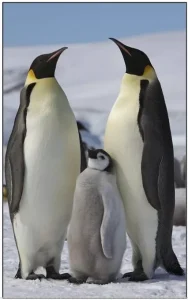 Features
-
- Physical Characteristics: Flightless bird with streamlined body and flipper-like wings for swimming.
- Distinctive black and white coloration with yellow-orange patches on head and neck.
- Adaptations for cold:
- Two layers of feathers
- Thick fat reserves
- Smaller beaks and flippers to minimise heat loss
- Distinct Abilities: Capable of diving up to ~550 metres, making it the deepest-diving bird.
- It exhibits huddling behaviour to conserve heat in extreme cold.
- It undergoes rapid weight gain/loss during breeding and feeding cycles.
- Diet: Carnivorous (piscivore and molluscivore).
- It feeds on Fish, Krill and Squid
- Reproduction: Known for unique breeding behaviour, where males incubate eggs in extreme cold.
- Its breeding season is from April to November (Antarctic winter).
- Lifespan: 15–20 years.
- Role as a Sentinel Species
- Indicator of Climate Change: Emperor penguin reflects warming trends in Antarctica.
- Decline linked to melting sea ice.
- Signal of Ecosystem Imbalance: Changes in penguin population indicate disruptions in marine food chains (krill availability).
- Long-term Environmental Monitoring: Provide insights into future climate projections, with studies suggesting significant population decline by 2080s.
- Major threats:
- Climate change and melting sea ice
- Decline in food availability.
- Conservation Status: Listed as Endangered by the IUCN


 13 Apr 2026





.png)






 Current Affairs




 GS Foundation
 Optional Course
 Combo Courses
 Degree Program