The Union Ministry of Education recently launched the CBSE Curriculum on Computational Thinking (CT) and Artificial Intelligence (AI) for Classes III to VIII.
- Aligned with National Education Policy 2020, it aims to embed AI-readiness and future skills in school education from the 2026–27 academic session.
- While the move aligns with the National Education Policy (NEP) 2020, it highlights a critical tension between India’s technological ambitions and its foundational literacy realities.
Best Online Coaching for UPSC
Key Features of the Curriculum
- Structured and Progressive Learning Framework: The curriculum adopts a stage-wise, age-appropriate design for Classes III–VIII, ensuring a gradual build-up of concepts from foundational computational thinking to applied AI, maintaining continuity and depth across grades.
- Computational Thinking as the Core Foundation: It positions Computational Thinking (CT) as a fundamental cognitive skill, focusing on logical reasoning, abstraction, pattern recognition, and problem decomposition, thereby enabling students to approach complex problems in a structured and analytical manner.
- Phased Integration of Artificial Intelligence: Artificial Intelligence is introduced in a gradual and contextual manner, enabling students to understand its real-life applications, ethical implications, and societal impact, while fostering responsible and informed digital citizenship.
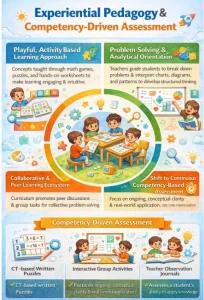
- Experiential and Activity-Based Pedagogy: The curriculum emphasizes hands-on, experiential learning through puzzles, games, simulations, worksheets, and real-life problem-solving tasks, transforming classrooms from passive content delivery to active, inquiry-driven learning environments.
- Problem-Solving and Analytical Orientation: Students are guided to break down complex problems into smaller components, interpret visual data such as charts and patterns, and develop structured thinking and analytical abilities essential for computational reasoning.
- Collaborative and Peer Learning Approach: It promotes group-based activities and peer discussions, encouraging collective problem-solving, communication skills, and shared learning experiences, thereby enhancing both cognitive and social competencies.
- Robust Academic and Teaching Support System: The framework is supported by comprehensive teacher handbooks, modular resources, and structured content, ensuring standardised implementation, scalability, and ease of adoption across diverse school settings.
- Competency-Based and Continuous Assessment: Assessment shifts from rote memorization to continuous, formative, and competency-based evaluation, focusing on conceptual understanding and real-world application.
- Utilizes multi-dimensional tools such as CT-based written tasks, group activities, and Teacher Observation Journals
- Emphasizes application, creativity, and critical thinking rather than factual recall
Alignment with National Education Reforms
- Operationalizing National Education Policy (NEP) 2020 Vision: The curriculum translates NEP 2020’s emphasis on experiential learning, critical thinking, and 21st-century skills into actionable classroom practice through CT and AI integration.
- Anchored in National Curriculum Framework (NCF) for School Education 2023: It follows a competency-based structure with clearly defined and measurable learning outcomes, ensuring clarity, consistency, and accountability in implementation.
- Phased and Conceptually Coherent Approach: The design adopts a progressive pathway, where CT precedes AI, ensuring conceptual clarity, gradual skill acquisition, and cognitive readiness among students.
Computational Thinking (CT) and Artificial Intelligence (AI)
- About Computational Thinking (CT): It is a structured problem-solving approach that enables individuals to analyse and solve problems logically and efficiently.
- It involves decomposition (breaking problems into parts), pattern recognition, abstraction, and algorithmic thinking, forming the cognitive foundation for digital literacy and programming.
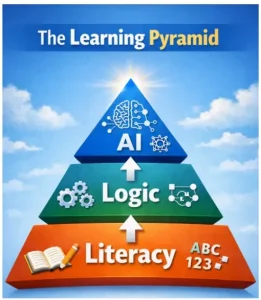
- CT is not merely a technical skill but a cognitive process dependent on comprehension, making literacy a structural prerequisite rather than a parallel objective.
- About Artificial Intelligence (AI): It refers to the capability of machines to perform tasks that typically require human intelligence, such as learning, reasoning, decision-making, and pattern recognition.
- It includes domains like machine learning, natural language processing, and computer vision, with applications across sectors.
- Interlinkage between CT and AI: Computational Thinking provides the conceptual and logical base for Artificial Intelligence, as it enables the design of algorithms, data processing methods, and problem-solving models essential for developing AI systems.
- Educational Relevance: The integration of CT and AI in school education promotes critical thinking, problem-solving ability, creativity, and digital competence, while preparing students for a technology-driven and knowledge-based economy.
|
UPSC Online Courses
Significance of Introducing AI & Computational Thinking in School Education
- Building the Foundation for a Digital Economy: The early introduction of CT and AI helps in developing a strong cognitive base required for a digital economy, where computational skills are increasingly becoming indispensable across sectors.
- Computational Thinking acts as the intellectual backbone of AI, enabling students not only to understand technology but also to design and create technological solutions, thereby transitioning from passive consumers to active innovators.
- Development of 21st-Century and Higher-Order Cognitive Skills: AI education fosters critical thinking, logical reasoning, creativity, and problem-solving abilities, which are essential for navigating complex real-world challenges.
- By encouraging structured thinking and analytical approaches, the curriculum contributes to the development of higher-order cognitive skills, moving beyond rote learning to meaningful understanding and application.
- Enhancing Workforce Preparedness and Employability: Introducing AI at an early stage contributes to building a future-ready, adaptable, and resilient workforce capable of responding to the demands of emerging industries such as data science, automation, and advanced computing.
- Example: NITI Aayog highlights that while AI may displace around 2 million jobs by 2030, it has the potential to create nearly 4 million new roles, particularly in high-skill domains, underscoring the need for early skill development.
- Bridging the Digital Divide and Promoting Inclusion: Integrating AI into school education serves as an instrument for democratising access to digital technologies, especially for students from rural and socio-economically disadvantaged backgrounds.
- By ensuring equitable exposure to digital tools and learning platforms, the reform can reduce educational inequalities and promote inclusive growth.
- Example: Atal Innovation Mission’s Atal Tinkering Labs have successfully fostered innovation and STEM learning across thousands of schools, expanding access to technology-driven education.
- Driving Pedagogical Innovation and Personalised Learning: AI enables a transition from traditional “one-size-fits-all” teaching to personalised and adaptive learning systems, where instruction is tailored to individual student needs.
 Through real-time feedback and data-driven insights, AI enhances learning outcomes, engagement, and retention, particularly benefiting multilingual classrooms and differently-abled learners.
- Promoting Interdisciplinary and Holistic Learning: The integration of CT across subjects such as Mathematics, Science, and Languages helps in breaking traditional academic silos.
- It fosters a holistic and application-oriented learning approach, where students can connect concepts across disciplines and apply them in real-life contexts.
- Fostering Ethical and Responsible Digital Citizenship: Early exposure to AI also enables students to understand its ethical dimensions, including issues of data privacy, algorithmic bias, and accountability.
- This ensures the development of responsible, aware, and ethical digital citizens, capable of engaging with technology in a human-centric manner.
- Strengthening India’s Knowledge Economy and Global Competitiveness: By embedding AI education at the school level, India can build a robust innovation ecosystem and align its human capital with the demands of emerging technologies.
- This will enhance the country’s potential to emerge as a global leader in AI and the knowledge economy, supporting long-term economic growth and technological self-reliance.
Challenges and Critical Concerns
- Foundational Learning Deficit and Language Dependency: The most significant constraint is the weak status of Foundational Literacy and Numeracy (FLN) among learners.
- Evidence from ASER 2024 indicates that a large proportion of students at the elementary level lack basic reading proficiency.
- Since CT is inherently language-mediated, requiring comprehension, interpretation, and articulation through LSRW (Listening, Speaking, Reading, Writing), inadequate literacy transforms CT into a mechanical exercise rather than a cognitive process, thereby undermining its intended objectives.
- Policy Sequencing Gap and Premature Cognitive Load: The rollout of CT–AI coincides with the target timeline of the NIPUN Bharat Mission (2026–27), despite foundational learning goals not being fully achieved.
- This creates a sequencing mismatch, where higher-order cognitive skills are introduced before establishing basic competencies, leading to premature cognitive escalation and uneven learning outcomes across students.
- Digital Divide and Structural Inequalities: Although digital access has improved, significant disparities persist in terms of device availability, internet access, and digital learning capabilities across rural–urban and socio-economic groups.
- Additionally, as education is a Concurrent subject, the predominance of such reforms within CBSE risks creating a two-tier education system, exacerbating inequalities between elite/private schools and state-run institutions.
- Teacher Capacity and Pedagogical Readiness: The effective implementation of CT–AI requires teachers equipped with both conceptual clarity and innovative pedagogical skills.
- However, existing gaps in teacher training—even in foundational learning domains—indicate limited preparedness to deliver advanced, technology-integrated curricula, making teacher capacity a critical bottleneck.
- Curriculum Overload and Cognitive Stress: India’s school system is already dealing with dense curricula and post-pandemic learning recovery.
- Introducing CT–AI without adequate rationalisation of existing content risks cognitive overload, resulting in fragmented understanding and superficial learning rather than deep skill acquisition.
- Assessment and Measurement Limitations: While the reform advocates competency-based assessment, evaluating abstract skills such as creativity, critical thinking, and problem-solving remains methodologically challenging.
- The ongoing transition from rote-based to competency-based systems may lead to inconsistencies in evaluation and learning outcomes.
- Risk of Silent Learning Gaps: Weak foundations in early grades may not be immediately visible but can surface in later stages when students are expected to engage with AI concepts, projects, and reflective tasks.
- This creates a “silent pipeline failure”, where learning deficits accumulate unnoticed, leading to long-term inefficiencies in skill development.
Ethical & Legal Safeguards
As children use AI tools in classrooms, the government must address safety and privacy:
- Data Protection: Any information collected about a student’s learning habits must be protected under the Digital Personal Data Protection Act.
- Fairness in AI: AI models should be designed for the Indian context and work well in Regional Languages so that students who don’t speak English are not left behind.
Click to Know UPSC Coaching Centres in India
Global Initiatives and Actions on CT & AI in Education
- UNESCO- Norm-Setting and Ethical Frameworks: UNESCO has led global efforts through the “AI in Education” guidelines and the Recommendation on the Ethics of Artificial Intelligence (2021), emphasizing human-centric AI, inclusivity, and ethical safeguards in education systems.
- OECD- Future Skills and Policy Guidance: The OECD promotes computational thinking and AI literacy under its Education 2030 framework, focusing on transformative competencies, critical thinking, and global benchmarking (e.g., PISA assessments integrating problem-solving skills).
- European Union- Digital Education Action Plan (2021–2027): The EU has launched a comprehensive strategy to integrate AI, coding, and digital skills into school curricula, supported by teacher training, digital infrastructure, and cross-border collaboration.
- United States- K–12 AI and STEM Integration: The U.S. promotes AI education through initiatives like “AI for K-12”, which provides guidelines for AI literacy, integrating CT, data science, and ethics into school education.
- China- Early AI Curriculum Integration: China has mandated AI education from primary school, supported by state-led curriculum design, teacher training, and strong EdTech integration, aiming to build global leadership in AI.
- World Economic Forum- Skills for the Future Workforce: Through initiatives like “Education 4.0”, the WEF emphasizes analytical thinking, problem-solving, and technology skills, identifying CT and AI as core competencies for the Fourth Industrial Revolution.
Government Initiatives & Policy Framework for CT–AI in India
- National Education Policy 2020: NEP 2020 provides the strategic foundation by emphasizing experiential learning, critical thinking, and 21st-century skills, and explicitly calls for the integration of coding, computational thinking, and emerging technologies in school education.
- NIPUN Bharat Mission: The mission aims to achieve universal Foundational Literacy and Numeracy (FLN) by 2026–27, ensuring that students possess the basic cognitive and language skills necessary for effective engagement with CT and AI.
- Central Board of Secondary Education: CBSE has introduced AI and CT modules, skill subjects, and now a dedicated CT–AI curriculum for Classes III–VIII, promoting early exposure to digital and computational skills in a structured manner.
- Ministry of Education Initiatives:
- DIKSHA Platform: Provides digital learning content, teacher training modules, and interactive resources.
- PM eVIDYA: Expands multimodal digital education access, including TV and online platforms.
- National Digital Education Architecture (NDEAR): Establishes a federated digital infrastructure for scalable and interoperable education services.
- National Curriculum Framework for School Education 2023: NCF-SE 2023 operationalizes NEP by adopting a competency-based curriculum, integrating CT and AI as cross-cutting skills with clearly defined learning outcomes.
- AICTE & Skilling Initiatives: Programs like AI for All (with Intel) and ATAL Tinkering Labs (under NITI Aayog) promote AI awareness, innovation, and hands-on learning, creating a pipeline from school to higher education and skilling ecosystems.
- Assessment Reforms- PARAKH: PARAKH aims to standardize competency-based assessment practices across boards, aligning evaluation with skills like problem-solving, creativity, and application-oriented learning.
|
Way Forward
- Strengthening Foundational Learning First: The success of CT–AI integration depends on achieving universal Foundational Literacy and Numeracy (FLN).
- The goals of the NIPUN Bharat Mission must be accelerated to ensure that all students attain basic reading, comprehension, and numeracy skills, which form the essential cognitive base for higher-order learning.
- Integrating CT with Language Learning: A pedagogically integrated approach should be adopted, where Computational Thinking is embedded within language instruction.
- This will enable simultaneous development of LSRW skills and analytical abilities, ensuring that comprehension supports computational reasoning rather than constraining it.
- Teacher Capacity Building at Scale: There is a need for continuous and large-scale professional development to equip teachers with both CT pedagogy and foundational AI concepts.
- Training must go beyond technical knowledge to include classroom innovation, activity-based teaching, and assessment of higher-order skills.
- Phased and Context-Sensitive Implementation: The rollout should be gradual and flexible, aligned with regional readiness, infrastructure availability, and student learning levels.
- A differentiated approach, rather than a uniform nationwide implementation, will help avoid uneven outcomes and ensure effective adoption.
- Bridging the Digital Divide with Inclusive Infrastructure: While CT can be taught through low-tech methods like puzzles and worksheets, AI learning requires basic digital infrastructure.
- Many schools, especially in rural areas, still face constraints such as unreliable electricity and limited internet access.
- Therefore, alongside infrastructure expansion (as reflected in UDISE+ data), the curriculum should incorporate “low-tech and offline-compatible models” to ensure universal accessibility.
- Robust Monitoring and Feedback Mechanisms: Effective implementation requires continuous monitoring and evidence-based policy adjustments.
- Frameworks like PARAKH should be leveraged to track competency-based learning outcomes, identify gaps, and guide timely interventions.
- Equity-Centric Approach to Implementation: Targeted efforts must be made to support government schools, rural regions, and socio-economically disadvantaged groups through investments in infrastructure, teacher support, and digital access.
- This will ensure that the reform promotes inclusion rather than deepening existing inequalities.
- Ensuring Proper Sequencing of Reforms: Global experience suggests that AI and CT integration is most effective after achieving strong foundational learning outcomes.
- India must therefore ensure correct sequencing—FLN first, followed by advanced cognitive skills—to prevent the reform from remaining ambitious in design but uneven in impact.
Conclusion
India’s CT–AI curriculum is a forward-looking reform, but its success will depend on correct sequencing, strong foundational literacy, teacher preparedness, and equitable access. Only a phased and inclusive approach can ensure that technological ambition translates into meaningful learning outcomes.


 7 Apr 2026




.png)






 Current Affairs




 GS Foundation
 Optional Course
 Combo Courses
 Degree Program