After threats by Donald Trump, Iran warned it would target US and Israeli desalination infrastructure in West Asia if its energy facilities are attacked.
- In 2018, Gulf Cooperation Council countries had 172 desalination plants—led by Oman (65), followed by Saudi Arabia (44), United Arab Emirates (40), Qatar (9), Kuwait (8), and Bahrain (6).
- In 2018, Saudi Arabia launched the AlKhafji Desalination Plant, which was termed the world’s largest solar-powered water desalination project.
Why does the Gulf need so many desalination plants?
- Scanty Rainfall: The Gulf countries, covering an area of 2.67 million square km (about 81% of India’s geographic area), receive very low rainfall, ranging from 4 to 30 cm.
- For instance, the total precipitation was just 281.91 billion cubic metres in 2018 — just 7% of what India receives in a year (about 4,000 billion cubic metres).
- Lack of Rivers: The GCC countries do not have rivers, but wadis, which have water available only during rainfall.
- Continued Urbanisation: As per the GCC Statistical Centre, the six Gulf Cooperation Council countries had a combined population of about 5.7 crore in 2020 led by Saudi Arabia and rising population, urbanisation, and economic growth continue to drive increasing water demand.
|
About Desalination Plants
- Desalination plants are facilities that remove salts and impurities from seawater or brackish water to produce freshwater suitable for human consumption and industrial use.
- Major Technologies
- Thermal Methods: Include Multi-Stage Flash (MSF) and Multi-Effect Distillation (MED), widely used in Gulf countries.
- Membrane Methods: Reverse Osmosis (RO) is the most common and energy-efficient modern technique.
Working of Desalination Plants
- Intake of Seawater: Seawater is drawn from the ocean through intake pipes, often fitted with screens to remove large debris and marine organisms.
- Pre-Treatment: Water is filtered to remove suspended particles, sediments, and microorganisms using chemicals and physical filters to prevent damage to membranes or equipment.
- Desalination Process (Core Stage)
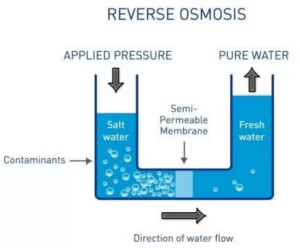
- Reverse Osmosis (RO): High pressure is applied to force seawater through semi-permeable membranes, which block salts and impurities, allowing only freshwater to pass.
- Thermal Methods (MSF/MED): Seawater is heated to produce steam, which is then condensed to obtain freshwater, leaving salts behind.
- Post-Treatment: The produced freshwater is treated by adding essential minerals (like calcium and magnesium) and disinfected to make it suitable for drinking and use.
- Storage and Distribution: The treated freshwater is stored in tanks and then supplied to households, industries, and agriculture through pipelines.
- Brine Disposal: The leftover concentrated saline solution (brine) is discharged back into the sea, usually after dilution to reduce environmental impact.
Limitations of Desalination Plants
- High Energy Consumption: Desalination, especially Reverse Osmosis (RO) and thermal methods, requires large amounts of energy, making it costly and heavily dependent on fossil fuels in many regions like Gulf Cooperation Council countries.
- Environmental Impact (Brine Disposal): Desalination produces highly concentrated saline waste (brine), which is discharged into the sea.
- This raises local salinity levels, reduces dissolved oxygen, and harms marine ecosystems, including fish and coral reefs.
- Carbon Emissions: When powered by fossil fuels, desalination contributes significantly to greenhouse gas emissions, contradicting climate goals and sustainability commitments.
- High Capital and Maintenance Costs: Setting up desalination plants involves huge initial investments in infrastructure, technology, and pipelines.
- Regular maintenance, membrane replacement, and skilled workforce further increase costs.
- Geopolitical and Strategic Vulnerability: Desalination plants are critical infrastructure, especially in West Asia.
- Their coastal location and importance make them potential targets during conflicts, increasing security risks.
Enroll now for UPSC Online Course
Benefits of Desalination Plants
- Water Security: Desalination plants ensure water security by providing a reliable and climate-independent source of freshwater, especially in arid regions like Gulf Cooperation Council countries.
- Reduced Dependence on Rainfall: They reduce dependence on rainfall and monsoon variability, ensuring a stable water supply even during droughts.
- Utilisation of Abundant Resources: They utilise abundant seawater, which is virtually unlimited, making desalination a viable long-term solution.
- Groundwater Conservation: Desalination reduces excessive groundwater extraction, helping prevent depletion of aquifers.
- Strategic Importance: They ensure continuous water supply during conflicts, emergencies, and natural disasters, enhancing national resilience.
About Reverse Osmosis (RO)
- Reverse Osmosis is a water purification process in which saline or impure water is forced through a semi-permeable membrane to remove dissolved salts, impurities, and contaminants.
- Principle: It works on the principle of applying pressure greater than osmotic pressure to push water from a region of higher solute concentration (seawater) to lower solute concentration (freshwater), reversing natural osmosis.
|


 24 Mar 2026







.png)






 Current Affairs




 GS Foundation
 Optional Course
 Combo Courses
 Degree Program