UPSC PYQs

Prelims, Mains & Optional PYQs

UPSC Notes

Comprehensive & Short Notes

Magnetic Fields in Molecular Clouds: ARIES Study on Star Formation

21 Mar 2026

Scientists have “seen” the skeleton of the magnetic field surrounding small molecular clouds L1604 and L121 for the first time.
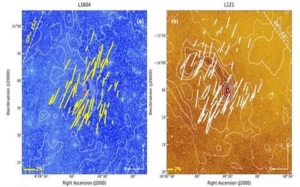
Magnetic Fields in Molecular Clouds

  • Study conducted by Aryabhatta Research Institute of Observational Sciences (ARIES), Department of Science and Technology (DST)  in collaboration with Assam University.
  • Methodology: R-band polarimetry using ARIES Imaging Polarimeter (AIMPOL) on the 104-cm ARIES telescope, Nainital.

Key Findings

  • Magnetic field strength: Both clouds are sub-critical, meaning magnetic energy dominates over turbulence and gravity at the envelope scale.
  • Dense cores: Despite overall magnetic protection, gravity may dominate in the dense cores, making them sites for star formation.
  • Differences between clouds:
    • L1604: Massive and dense, magnetic field less ordered.
    • L121: Less dense, magnetic field strong and orderly, less affected by gravitational collapse.
  • Magnetic fields act as an invisible hand, slowing star formation and preventing rapid gas depletion in the galaxy.

Significance of the Study

  • Star formation regulation: Shows that magnetism controls the pace of star birth in molecular clouds.
  • Galaxy evolution: Prevents all gas from collapsing into stars simultaneously, maintaining a stable star formation rate.
  • Observational breakthrough: First direct mapping of magnetic skeleton in small molecular clouds.
  • Future research: Helps understand the interplay of gravity, turbulence, and magnetic fields in star formation.

About Molecular Clouds

  • Molecular clouds are cold, dense regions of interstellar gas and dust where molecules, especially molecular hydrogen (H₂), form and survive.
  • They are often called “stellar nurseries” because they are the primary sites of star formation in galaxies.

Types of Molecular Clouds

  1. Bok Globules: These are Small, dense clouds, often sites of single star formation.
  2. Dark Clouds: They appear as dark patches in the sky; dense enough to block starlight.
  3. Giant Molecular Clouds (GMCs): These are Large clouds containing thousands of solar masses, often forming star clusters.

  • For Example:
    • Orion Molecular Cloud Complex – Nearby star-forming region.
    • Taurus Molecular Cloud – Rich in low-mass star formation.
    • L1604 and L121 – Small molecular clouds recently studied for magnetic fields.

Enroll now for UPSC Online Course

L1604 and L121: Molecular Clouds

Cloud Location Distance Mass & Density Magnetic Field Features
L1604 Galactic anticenter ~816 parsecs High density, massive Magnetic field weaker, less orderly; gravity dominates in dense cores
L121 Toward Galactic center 124 parsecs Less dense, less massive Stronger and more orderly magnetic field; resists gravitational collapse

Key Features

  • Temperature: Very cold, typically 10–30 K, allowing molecules to exist.
  • Density: High compared to other interstellar regions, typically 100–1,000,000 particles per cm³.
  • Composition: Mainly molecular hydrogen (H₂), with helium, CO, and traces of other molecules; dust grains make up 1% of the mass.
  • Size: Range from small Bok globules (1–5 light-years) to giant molecular clouds (GMCs, 10–100 light-years).
  • Mass: Can range from a few solar masses (small clouds) to millions of solar masses (GMCs).

Check Out UPSC CSE Books

Visit PW Store

online store 1

Importance of Molecular Clouds 

  • Birthplace of Stars: Molecular clouds act as stellar nurseries, where gravitational collapse of dense regions leads to star formation.
    • They are essential for the continuous creation of new stars in galaxies like the Milky Way.
  • Role in Planetary System Formation: The same collapsing cores that form stars also lead to the formation of protoplanetary disks, which eventually give rise to planets and solar systems.
  • Regulation of Star Formation: Molecular clouds regulate the rate of star formation through the interplay of gravity, thermal pressure, turbulence, and magnetic fields.
    • This prevents rapid depletion of galactic gas reserves.
  • Contribution to Galactic Evolution: They serve as reservoirs of gas and dust, influencing the structure and evolution of galaxies over time.
    • Star formation within these clouds determines the stellar population and lifecycle of galaxies.
  • Chemical Enrichment of the Universe: Molecular clouds contain complex molecules (e.g., CO, organic compounds) that contribute to the chemical evolution of the universe.
    • They are sites where prebiotic molecules may form.
Magnetic Fields in Molecular Clouds: ARIES Study on Star Formation

Need help preparing for UPSC or State PSCs?

Connect with our experts to get free counselling & start preparing

Free Counselling for UPSC Aspirants

Connect with our experts and take the right next step.

Expert Guidance
Personalized Strategy
100% Free

Book Your Free Session

NEED ASSISTANCE?

Request a Callback

Our counsellor will connect with you and help you choose the right course and centre.

  • Expert Guidance
  • Course & Fee Information
  • Quick Callback Support

Request a Callback

Books
UPSC PYQs
UPSC Notes
Current Affairs
Quick Revise Now !
AVAILABLE FOR DOWNLOAD SOON
UDAAN PRELIMS WALLAH
Comprehensive coverage with a concise format
Integration of PYQ within the booklet
Designed as per recent trends of Prelims questions
हिंदी में भी उपलब्ध
Quick Revise Now !
UDAAN PRELIMS WALLAH
Comprehensive coverage with a concise format
Integration of PYQ within the booklet
Designed as per recent trends of Prelims questions
हिंदी में भी उपलब्ध

<div class="new-fform">


    </div>

    Subscribe our Newsletter
    Sign up now for our exclusive newsletter and be the first to know about our latest Initiatives, Quality Content, and much more.
    *Promise! We won't spam you.
    Yes! I want to Subscribe.