Fiscal Health Index 2026: NITI Aayog Ranking of Indian States’ Fiscal Performance

12 Mar 2026

Fiscal Health Index 2026: NITI Aayog Ranking of Indian States’ Fiscal Performance

Recently, the NITI Aayog released the second annual edition of the “Fiscal Health Index 2026” in New Delhi.

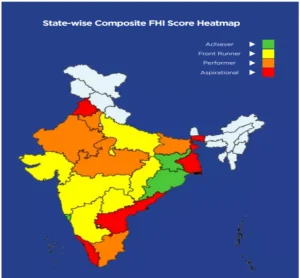
  • The first edition assessed the fiscal performance of 18 major states, this edition includes the 10 North-Eastern and Himalayan states, making the Index more inclusive and representative of India’s fiscal diversity. 

About Fiscal Health Index 

  • The Fiscal Health Index provides a comprehensive and comparable assessment of the fiscal performance of Indian states. 
  • It has been designed as a data-driven framework to evaluate fiscal soundness, guide reforms, and promote evidence-based fiscal policymaking across states.
  • Five Pillars: The index, which covers financial year 2023-24 and uses audited data from the Comptroller and Auditor General of India, scores states across five pillars: 
    • quality of expenditure, revenue mobilisation, fiscal prudence, debt levels and debt sustainability. 
  • The index classifies states into four tiers namely:
    • ‘Achievers’ are states with strong fiscal discipline, high own-tax revenues, low deficits, and manageable debt;
    • ‘Front Runners’ maintain broadly sound finances but fall short of the top tier on one or more indicators; 
    • ‘Performers’ occupy the middle ground, with mixed results across the five pillars;. 
    • ‘Aspirational’ states are those facing the most significant fiscal stress, characterised by persistent deficits, high debt, and limited revenue capacity. 

Also Read | UPSC Result 2025

Key Highlights of Fiscal Health Index 2026

Major States

  • Top Achiever States: Odisha remains the top performer, improving its score over the previous year, with Goa and Jharkhand also featuring among the top Achiever states. 
  • Fiscal Health Index 2026Gujarat and Maharashtra continue in the top five, while Haryana records a notable year-on-year improvement of three ranks. 
    • Bihar, Karnataka and Telangana show a mild recovery, whereas Punjab, West Bengal and Kerala remain at the bottom of the rankings.
    • Overall, higher-ranked states display stronger fiscal discipline and resource mobilisation efforts, while lower-ranked states exhibit higher revenue-developmental expenditure and less sustainable fiscal patterns.
  • Strong Fiscal Indicators of Achiever States: Odisha, Goa and Jharkhand are characterised by high own-tax shares (above 60%), relatively large capital outlay (around 4–5% of GSDP), low fiscal deficits (below 3% of GSDP), moderate debt levels (under 25% of GSDP) and contained interest burdens.
  • Stable Performance of Front-Runner and Performer States: Front-Runner states (Gujarat, Maharashtra, Chhattisgarh, Telangana, Uttar Pradesh and Karnataka) and Performer states (Madhya Pradesh, Haryana, Bihar, Tamil Nadu and Rajasthan) broadly maintain their positions with minor reshuffling, though their scores moderate slightly compared to the previous year.
  • Fiscal Stress and Debt Burden in Aspirational States: Aspirational states (West Bengal, Kerala, Andhra Pradesh and Punjab) face persistent revenue and fiscal deficits often breaching FRBM norms, elevated debt levels of roughly 35–45% of GSDP, committed expenditure accounting for about 50–60% of revenue receipts, large interest payments exceeding 15–20%, and relatively low developmental spending.
  • Category Shifts Among States: Most states strengthened on Quality of expenditure, with Jharkhand and Uttar Pradesh moving from Front Runner to Achiever, and Gujarat, Rajasthan, Andhra Pradesh improving from Performer to Front Runner. 
    • The majority of states retained their earlier category.
  • Minor Ranking Changes Among States: Goa and Odisha continue to record high State Own Revenue ratios, reflecting strong tax bases and greater fiscal autonomy. 
    • Jharkhand slipped from Front Runner to Performer, while most others witnessed only marginal reshuffling within the same category.
  • Shifts in State Rankings Reflecting Changing Fiscal Performance: Bihar improved from Aspirational to Performer, signalling better deficit management. 
    • Karnataka and Telangana moved from Front Runner to Performer;
    • Kerala and Tamil Nadu slipped further to the Aspirational group, highlighting emerging fiscal pressures.
  • Debt Sustainability: Odisha, Gujarat and Maharashtra maintain low debt levels and contain interest burdens, supporting fiscal sustainability.
    • Punjab, Kerala and West Bengal continue to face elevated debt and interest commitments, and several mid-tier states show rising leverage, though many remain within their existing category bands.

North Eastern (NE) /Himalayan States

  • The North Eastern (NE) /Himalayan States have been ranked separately from the major states and classified into three groups i.e. Achiever (Arunachal Pradesh, Uttarakhand), Performers (Assam, Meghalaya, Mizoram, Sikkim, Tripura) and Aspirational (Himachal Pradesh, Manipur, Nagaland).
  •  Achiever States: Arunachal Pradesh ranks highest, followed by Uttarakhand and Tripura, reflecting stronger expenditure quality, revenue capacity and debt management, whereas Himachal Pradesh and Manipur remain at the bottom due to weak revenues and persistent fiscal stress.
  • Uneven Fiscal Performance Among Several NE States:
    • Meghalaya and Assam occupy upper middle positions with mixed indicator performance
    • Mizoram, Nagaland and Sikkim display uneven performance across different fiscal metrics. 
    • Mizoram has low score under debt sustainability, Sikkim scores low on Fiscal Prudence and Nagaland has lower scores on Quality of Expenditure and Revenue Mobilisation.
  • Impact of Capital Outlay: Arunachal Pradesh and Meghalaya improved through higher capital outlay and developmental spending exceeding two-thirds of total expenditure, whereas Tripura, Himachal Pradesh and Manipur face crowding-out from large salary and pension commitments.
  • Dependence on Central Transfers: Uttarakhand and Himachal Pradesh exhibit relatively stronger own-revenue capacity, while Tripura, Nagaland and Manipur have weaker revenue mobilisation and depend on central transfers for over 80% of revenue.
  • Fiscal Deficit Trends: Arunachal Pradesh maintains lower deficits and occasional surpluses through controlled revenue spending, but several states continue to run deficits around 4–5% of GSDP due to rigid expenditure structures.
  • Debt Burden and Servicing Pressures Across States: Assam, Tripura and Uttarakhand maintain moderate debt burdens, whereas Manipur and Himachal Pradesh carry high debt levels of roughly 40–50% of GSDP with rising servicing pressures.

Check Out UPSC CSE Books

Visit PW Store


online store 1

Recommendations

  • The index recommends that states broaden their GST base, improve own-tax collection, rationalise subsidies, adopt medium-term fiscal plans, and exercise tighter control over off-budget borrowings — debt incurred through state-owned entities that does not always appear in headline deficit figures.

Need help preparing for UPSC or State PSCs?

Connect with our experts to get free counselling & start preparing

Aiming for UPSC?

Download Our App

      
Quick Revise Now !
AVAILABLE FOR DOWNLOAD SOON
UDAAN PRELIMS WALLAH
Comprehensive coverage with a concise format
Integration of PYQ within the booklet
Designed as per recent trends of Prelims questions
हिंदी में भी उपलब्ध
Quick Revise Now !
UDAAN PRELIMS WALLAH
Comprehensive coverage with a concise format
Integration of PYQ within the booklet
Designed as per recent trends of Prelims questions
हिंदी में भी उपलब्ध

<div class="new-fform">


    </div>

    Subscribe our Newsletter
    Sign up now for our exclusive newsletter and be the first to know about our latest Initiatives, Quality Content, and much more.
    *Promise! We won't spam you.
    Yes! I want to Subscribe.