Recently, the United Nations Office of the High Commissioner for Human Rights has officially launched the Global Alliance for Human Rights in Geneva, Switzerland.
- This new global platform aims to place basic human freedoms at the absolute center of international decision-making at a time when global conflicts and structural inequalities have hit record highs.
UPSC Online Coaching
About the Global Alliance for Human Rights
- The Mandate: Launched by the United Nations High Commissioner for Human Rights, it acts as a broad-based, long-term global platform designed to rebuild international commitment toward protecting human freedoms.
- The Timeline Anchor: The roadmap of this initiative is directly tied to a major historical milestone—the 80th anniversary of the Universal Declaration of Human Rights on 10 December 2028.
 Institutional Tracking: Although anchored administratively in Geneva, it functions as a globally distributed movement. Progress will be audited every year during the Annual Global Alliance Human Rights Forum held on 10 December (Human Rights Day).
Rationale Behind the Initiative
- Rising Global Disarray: The platform responds directly to an unprecedented rise in armed conflicts, humanitarian crises, and mass displacement in active war zones like Ukraine, Gaza, Lebanon, Myanmar, Sudan, and Haiti.
- Erosion of Multilateralism: Sovereign nation-states are increasingly backing out of shared international legal commitments, leaving international monitoring institutions facing severe operational and financial constraints.
- Systemic Impunity: The framework addresses the rapid shrinking of domestic civic spaces, rising democratic backsliding, and a growing global culture of impunity, where gross human rights violations go unpunished due to geopolitical gridlocks.
Core Operational Structure- The “Whole-of-Society” Model
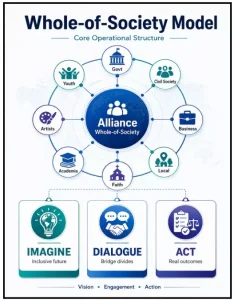
Rejecting traditional, slow-moving state-centric diplomacy, the Alliance brings together a wide network of actors—governments, civil society organizations, corporate entities, local authorities, faith leaders, academics, artists, and youth groups. It operates via three foundational pillars:
- Imagine: Promoting and designing a progressive vision for a more inclusive, equitable, and rights-based global society.
- Dialogue: Encouraging meaningful, non-polarized engagement among diverse stakeholders to resolve complex cross-border human rights challenges.
- Act: Translating diplomatic pledges into practical, measurable field actions and concrete legal outcomes.
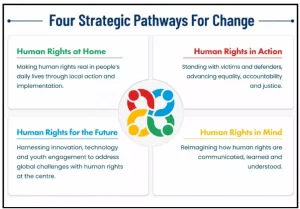
Major Initiatives Under the Alliance
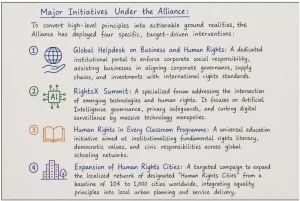
To convert high-level principles into actionable ground realities, the Alliance will deploy four specific, target-driven interventions:
- Global Helpdesk on Business and Human Rights: A dedicated institutional portal to enforce corporate social responsibility, assisting businesses in aligning corporate governance, supply chains, and investments with international rights standards.
- RightsX Summit: A specialized forum addressing the intersection of emerging technologies and human rights. It focuses on Artificial Intelligence governance, privacy safeguards, and curbing digital surveillance by massive technology monopolies.
- Human Rights in Every Classroom Programme: A universal education initiative aimed at institutionalizing fundamental rights literacy, democratic values, and civic responsibilities across global schooling networks.
- Expansion of Human Rights Cities: A targeted campaign to expand the localized network of designated “Human Rights Cities” from a baseline of 104 to 1,000 cities worldwide, integrating equality principles into local urban planning and service delivery.
Significance
- Centrality of Rights: It reinforces human rights not as an afterthought, but as a core guiding principle for international governance, economic development, and security cooperation.
- Interlinkage of Agendas: It directly binds human rights to contemporary global issues, creating clear linkages with the Sustainable Development Goals, climate action, and digital sovereignty.
- Victim-Centered Justice: The initiative places a strong emphasis on strengthening accountability mechanisms, ensuring that victims of conflict receive international recognition, justice, and effective legal remedies.
Challenges that need to be addressed
- Sovereignty vs. International Oversight: Many states perceive international human rights monitoring and accountability mechanisms as an infringement on national sovereignty, often limiting cooperation with global human rights initiatives.
- Compliance and Enforcement Deficit: The Office of the United Nations High Commissioner for Human Rights (OHCHR) lacks independent enforcement and punitive powers, making the implementation of human rights commitments largely dependent on the political will of member states.
- Corporate Accountability Gap: Regulating transnational technology companies, digital platforms, and complex global supply chains remains difficult due to jurisdictional limitations, fragmented regulatory frameworks, and significant corporate influence.
- Politicisation and Double Standards in Human Rights Governance: Global human rights mechanisms are frequently criticised for being shaped by geopolitical interests, resulting in selective scrutiny, uneven application of sanctions and diplomatic pressure, and perceptions of double standards that undermine their credibility and universality.
India’s Initiatives & Actions
India’s domestic architecture aligns strongly with the core values of the Alliance through robust constitutional and legal protections:
- Constitutional Safeguards:
- Part III (Fundamental Rights): Formally guarantees basic freedoms, including the Right to Equality (Article 14), Prohibition of Discrimination (Article 15), and the Right to Life and Personal Liberty (Article 21), which the judiciary treats as the bedrock of human dignity.
- Part IV (Directive Principles of State Policy): Directs the State to secure a just social order, optimize welfare, and minimize economic inequalities (Article 38).
- Article 51 (Promotion of International Peace): Expressly commits India to foster respect for international law and treaty obligations.
- Article 51A(e) (Fundamental Duties): Explicitly places a duty on every citizen of India to renounce practices that are derogatory to the dignity of women.
- Legislative & Institutional Mechanisms:
- The Protection of Human Rights Act, 1993: Established the National Human Rights Commission and State Human Rights Commissions as independent oversight watchdogs.
- Rights-Based Legislations: Enactment of progressive, target-driven welfare laws such as the National Food Security Act, the Right to Education Act, and the Mahatma Gandhi National Rural Employment Guarantee Act to guarantee economic and social rights.
Global Initiatives & Actions
The Alliance operates alongside long-standing, verified international legal frameworks:
- The Universal Declaration of Human Rights, 1948: Adopted by the United Nations General Assembly on 10 December 1948, this foundational text contains 30 Articles detailing indivisible civil, political, economic, and cultural rights based on universality and non-discrimination.
- UN Interagency Mandates: Combined directives by the World Health Organization, United Nations Population Fund, United Nations Children’s Fund, and UN Women designed to counter systemic social biases and gender-biased exclusions.
- ICPD Programme of Action: Driven by the International Conference on Population and Development (ICPD), binding over 180 nations to implement state policies that actively eliminate inherited discrimination against vulnerable populations.
|
Way Forward
- Strengthening Institutional Accountability: The Alliance should move beyond voluntary commitments by establishing a binding multilateral human rights compliance framework with periodic reviews, transparent reporting mechanisms, and corrective measures for serious violations.
- Ensuring Financial Sustainability: Member states should provide predictable and assessed financial contributions to reduce the dependence of human rights institutions on voluntary funding and shield them from geopolitical pressures and donor-driven priorities.
- Developing a Global Digital Rights Framework: A binding international treaty on digital rights should be developed to regulate digital surveillance, data exploitation, algorithmic discrimination, online civic space restrictions, and the growing influence of Big Tech platforms.
- Establishing Human Rights-Centred AI Governance: A UN-led AI governance framework should set global standards on algorithmic transparency, bias mitigation, privacy protection, accountability, and human oversight to ensure that emerging technologies remain aligned with human rights principles.
- Strengthening Corporate Accountability: Uniform and enforceable Environmental, Social and Governance (ESG) standards should be promoted to ensure that corporations respect labour rights, privacy, non-discrimination, and community welfare across global supply chains.
- Localising Human Rights Commitments: Human rights principles should be integrated into the functioning of city governments, local authorities, and grassroots institutions to ensure effective implementation in areas such as housing, sanitation, public services, migrant welfare, and social inclusion.
- Integrating Human Rights with Sustainable Development: Municipal and local governance systems should embed Sustainable Development Goal (SDG)-based indicators into planning, budgeting, and service delivery processes to translate global commitments into measurable grassroots outcomes.
Click to Know UPSC Coaching Centres in India
Conclusion
The Global Alliance for Human Rights reflects a vital structural pivot to reclaim the universal promise of the Universal Declaration of Human Rights. Its ultimate success will depend on moving past the diplomatic spheres of Geneva and building a truly distributed, whole-of-society movement capable of localizing international law inside municipal corporations, corporate boardrooms, and digital spaces alike.
 13 Jun 2026