Recently, the Supreme Court of India dismissed a medical practitioner’s appeal challenging charges under Section 23 of the Pre-Conception and Pre-Natal Diagnostic Techniques Act.
- The Court observed that deep-rooted patriarchal biases continue to sabotage the execution of national gender welfare programs.
| Section 23 of the PCPNDT Act prescribes penalties for illegal sex selection and prenatal sex determination, including imprisonment, fines, suspension/cancellation of medical registration, and punishment for persons seeking such services, while protecting coerced women from liability. |
UPSC Coaching Classes
Key Highlights by the Supreme Court
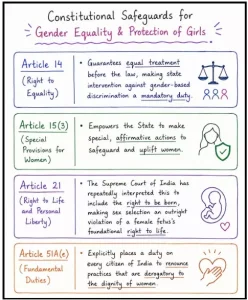
- Societal Pathology: The apex court voiced severe concern over a persistent, cross-class societal son preference and the ongoing resort to clandestine sex-selective measures.
- Welfare Subversion: It highlighted that extensive state-led female development frameworks face a structural bottleneck due to deeply entrenched patriarchal attitudes.
- Judicial Non-Leniency: The Court sent an uncompromising message to medical professionals, affirming that procedural delays or technical loopholes will not be permitted to shield those accused of facilitating female foeticide.
About the Pre-Conception and Pre-Natal Diagnostic Techniques (PCPNDT) Act
- Background: India has witnessed a declining child sex ratio due to persistent gender discrimination and a strong preference for male children.
- Practices such as female infanticide, female foeticide, and neglect of girls in nutrition, education, health care, and development have contributed to an adverse sex ratio.
- Advances in prenatal diagnostic technologies enabled misuse for sex determination and sex-selective abortions, aggravating the problem.
- Need for the Act: The misuse of pre-conception and prenatal diagnostic techniques led to widespread sex selection, adversely affecting the child sex ratio.
- To address this issue, the Pre-Conception and Pre-Natal Diagnostic Techniques (Prohibition of Sex Selection) Act, 1994 was enacted.
- Objectives of the Act: Prohibit sex selection before and after conception.
- Prevent the misuse of diagnostic techniques for sex determination.
- Eliminate female foeticide and promote gender balance.
 Regulate the use of prenatal diagnostic technologies for legitimate medical purposes.
- Punishment under the PCPNDT Act, 1994:
- Punishment for Medical Practitioners/Clinics: Violation of the Act can attract imprisonment up to 3 years and fine up to ₹10,000 for the first offence, and up to 5 years imprisonment with higher fines for subsequent offences.
- Suspension/Cancellation of Medical Registration: The registration of the concerned doctor can be suspended when charges are framed and may be removed for 5 years on first conviction and permanently for subsequent convictions.
- Punishment for Seeking Sex Determination: Any person seeking or encouraging sex selection/sex determination can face up to 3 years imprisonment and ₹50,000 fine for the first offence, and up to 5 years imprisonment and ₹1 lakh fine for repeat offences.
- Ban on Sex Selection Advertisements: Advertising services related to sex selection or prenatal sex determination is prohibited and punishable under the Act.
- Implementation Mechanism: The Act contains several deterrent legal provisions and penalties.
- Its success depends on effective enforcement and monitoring.
- Implementation is carried out through statutory bodies such as:
- State Supervisory Board
- State Advisory Committee
- State Appropriate Authority
- District Appropriate Authority
- District Advisory Committee
- Significance:
- Helps curb sex-selective practices and illegal abortions based on sex determination.
- Aims to improve the child sex ratio and promote gender equality.
- Encourages public awareness and community participation against sex selection.
- Serves as a key legal instrument to protect the rights and dignity of the girl child.
Core Issue- The Declining Child Sex Ratio (CSR)
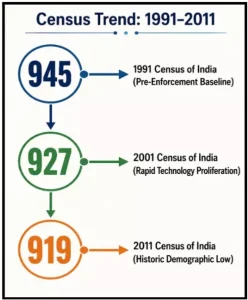
- The Child Sex Ratio (CSR) tracks the number of females per 1,000 males in the 0–6 age bracket. Decadal Census of India data illustrates a sharp structural collapse, proving how quickly technology outpaced legislative enforcement.
- Government Data Insight: While the Sample Registration System (SRS) Statistical Report 2024 released by the Office of the Registrar General of India (ORGI) indicates that India’s Sex Ratio at Birth (SRB) has marginally improved to 918 (for the 2022–24 period), it remains critically below the natural biological benchmark of roughly 950.
Reasons for the Inverted Sex Ratio
- Patriarchal Son Preference & Old-Age Security: Culturally, sons are seen as essential for ancestral lineage.
- Economically, they function as a traditional insurance policy for old-age financial support.
- Marriage Customs and Liabilities: The illegal but widespread persistence of dowry and the tradition of patrilocality (daughters relocating to their husband’s home) lead households to view the birth of a girl child as an acute economic burden.
- Systemic Gender Inequality: Deep gaps in female ownership of property, employment, and safety lower women’s perceived societal value.
- This structural gap is visible globally:
- The World Economic Forum’s Global Gender Gap Report continues to rank India poorly in economic participation and health parameters.
- India’s position in the Global Gender Gap Report 2025 declined from 129th to 131st among 148 countries, highlighting persistent gender disparities.
- Weaponization of Medical Technology: Compact, portable ultrasound scanners and advanced genetic tests designed for fetal health tracking are instead subverted into tools for selective female elimination.
- Lax Criminal Enforcement: Legal machinery under the newly implemented Bharatiya Nyaya Sanhita (BNS) remains heavily underutilized. Cases suffer from poor evidence gathering, leading to low conviction rates and weak legal deterrence.
Initiatives & Actions Taken by India
- Beti Bachao Beti Padhao (BBBP): Launched to tackle declining CSR at the roots, it is now strategically integrated into the Ministry of Women and Child Development’s Mission Shakti to streamline protection and education funding.
- Sukanya Samriddhi Yojana (SSY): A high-interest, tax-free retail savings framework designed to guarantee the long-term financial empowerment of the girl child and offset future higher education and marriage costs.
- Pradhan Mantri Matru Vandana Yojana (PMMVY): To actively drive behavioral change, this conditional cash-transfer program was updated to provide direct financial support to a mother if her second child is a girl.
UPSC Online Courses
Global Actions & Initiatives
- UN Interagency Statement: A combined global mandate by the World Health Organization (WHO), United Nations Population Fund (UNFPA), UNICEF, and UN Women specifically addressing the human rights violations caused by gender-biased sex selection.
- ICPD Programme of Action: Under the International Conference on Population and Development (ICPD), member nations are bound to enact policies that completely eliminate inherited discrimination against female infants.
- Sustainable Development Goal (SDG) Target 5.1: The United Nations tightly monitors global biological sex ratios at birth as a primary metric for evaluating progress toward global Gender Equality.
Why Need to Control Gender Imbalance
- Demographic Distortion: A heavily skewed male-to-female ratio triggers a severe “marriage squeeze” (an excess of unmarried men unable to find partners).
- Escalation of Gender Violence: Deficits in female populations are directly linked by the United Nations Office on Drugs and Crime (UNODC) to surges in cross-border bride buying, abduction, and female trafficking.
- Socio-Economic Stagnation: Excluding or eliminating women limits a nation’s human capital. The International Monetary Fund (IMF) notes that closing the gender employment gap can boost India’s Gross Domestic Product (GDP) significantly.
Way Forward
- Strengthen Legal Enforcement & Monitoring:
- Mandatory Digital Audit Trails: Implement centralized real-time monitoring of all ultrasound machines through digital tracking systems, recording patient details, scan indications, operator information, and timestamps to prevent misuse under the PCPNDT Act.
- Improve Investigation and Conviction Rates: Establish dedicated fast-track courts for PCPNDT cases and leverage electronic medical records, forensic audits, and AI-based anomaly detection to strengthen evidence collection and ensure swift prosecution of offenders.
- Promote Social Norm Transformation:
- Gender Sensitisation through Education: Integrate modules on gender equality, constitutional values, and the rights of the girl child into school curricula to challenge son preference and patriarchal stereotypes from an early age.
- Community-led Behavioural Change: Mobilise Panchayati Raj Institutions (PRIs), Self-Help Groups (SHGs), and local leaders to drive awareness campaigns, community monitoring, and incentive-based recognition programmes for improving the Child Sex Ratio (CSR).
- Enhance Economic Value and Security of the Girl Child:
- Strengthen Girl Child Welfare Schemes: Expand the reach and effectiveness of schemes promoting the education, health, and welfare of girls to reduce socio-economic biases against daughters.
- Boost Women’s Economic Participation: Increase access to skill development, employment opportunities, entrepreneurship support, and financial inclusion to enhance women’s socio-economic status.
- Adopt a Data-Driven Governance Approach:
- Identify and Target High-Risk Areas: Use data from the Census, Civil Registration System (CRS), and Health Management Information System (HMIS) to detect districts with skewed sex ratios and implement focused corrective measures.
- Capacity Building of Enforcement Agencies: Regularly train Appropriate Authorities, police personnel, prosecutors, and judicial officers to improve implementation of the PCPNDT framework.
- Strengthen Women’s Rights and Public Awareness:
- Ensure Effective Property and Inheritance Rights: Promote enforcement of legal rights related to inheritance and asset ownership to address economic motivations behind son preference.
- Sustained Mass Awareness Campaigns: Engage media, civil society, educational institutions, and community influencers to promote the value of the girl child and foster gender-equitable social norms.
Click to Know UPSC OnlyIAS Coaching Centres
Conclusion
The Supreme Court’s strong stance proves that deep-seated social problems cannot be fixed by legal frameworks alone. To secure the survival of India’s female population, the state must balance its strict administrative zero tolerance against technology misuse with a massive cultural shift that values daughters as equal, independent economic and social assets.
 13 Jun 2026