Recently, during the 14th Foundation Day event of Biotechnology Industry Research Assistance Council (BIRAC), the India Bioeconomy Report 2026 was released.
- The 14th Foundation Day of Biotechnology Industry Research Assistance Council was held in New Delhi, where the Union Minister highlighted the rapid expansion of India’s bioeconomy.
- The development comes in the backdrop of India’s push towards innovation-led growth, deep-tech development, and Atmanirbhar Bharat.
About the India Bioeconomy Report (IBER) 2026
- Comprehensive Sectoral Assessment: The IBER 2026 provides a holistic and data-driven evaluation of India’s bioeconomy, capturing growth trends, sectoral contributions, innovation dynamics, and policy outcomes.
- Multi-Stakeholder Perspective: Prepared under the Department of Biotechnology (DBT), the report integrates insights from academia, industry, startups, and policymakers, ensuring a broad-based and inclusive analytical framework.
- Strategic Roadmap for Growth: It serves as a policy guidance document, enabling targeted interventions in research funding, industrial scaling, regulatory reform, and global integration.
Key Highlights of the India Bioeconomy Report (IBER) 2026
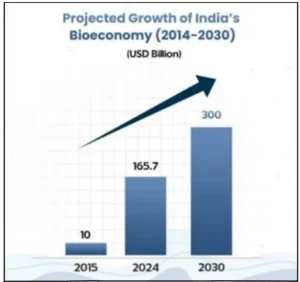
- Massive Scale Expansion and Structural Growth: The nearly 20-fold increase from ~$10 billion (2014) to ~$195 billion (2025) reflects not only policy support and scientific advancements, but also a surge in domestic and global demand for bio-based solutions.
- It signifies a structural deepening of biotechnology across multiple sectors, transforming it into a mainstream economic driver.
- Sustained High Growth Momentum: Consistent annual growth rates of 17–18% highlight strong synergies between research institutions, industry, and policy frameworks.
- This sustained momentum underscores the sector’s resilience, scalability, and capacity for continuous innovation-led expansion.
- Increasing Economic Integration and Mainstreaming: With a contribution of nearly ~5% to GDP, the bioeconomy is no longer a peripheral domain but is becoming deeply embedded within India’s macroeconomic structure.
- It reflects the growing centrality of biotechnology in driving productivity, competitiveness, and diversification of the economy.
- Innovation-Led and Startup-Driven Growth Model: The emergence of over 11,800 biotech startups indicates a shift toward a bottom-up, entrepreneurship-driven innovation ecosystem.
- This trend highlights the increasing role of private sector dynamism complementing public investment, accelerating the commercialisation of research and technology diffusion.
Analytical Insights and Strategic Significance of the India Bioeconomy Report (IBER) 2026:
- Indicator of Structural Economic Transformation: The report captures a fundamental shift in India’s development paradigm, moving from a resource-intensive and factor-driven model toward a knowledge-based, innovation-centric bioeconomy.
- It highlights how biotechnology is emerging as a key enabler of sustainable and inclusive growth, reshaping the foundations of economic development.
- Evidence of Exponential and Systemic Sectoral Deepening: The expansion from USD 10 billion (2014) to USD 195 billion (2025) reflects not just quantitative growth, but a deeper qualitative transformation of the economy.
- It signifies the integration of biotechnology across diverse sectors, including healthcare, agriculture, industrial manufacturing, and environmental sustainability.
- Strategic Alignment with National Development Objectives: The growth trajectory of the bioeconomy is closely aligned with India’s goals of Atmanirbhar Bharat, sustainable development, and global technological leadership.
- It positions the sector as a critical instrument for achieving the $300 billion bioeconomy target by 2030, while enhancing India’s strategic autonomy in emerging technologies.
|
About Bioeconomy
- Conceptual Scope and Definition: The bioeconomy refers to economic activities based on the sustainable utilization of biological resources, processes, and systems, spanning sectors such as healthcare, agriculture, bioenergy, and industrial production.
- It encompasses the application of biotechnology, bio-based materials, and life sciences innovations to generate economic value while addressing societal challenges.
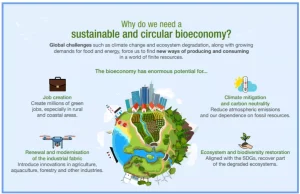
- Sustainability-Oriented Economic Model: The bioeconomy represents a systemic shift toward renewable, bio-based inputs, reducing dependence on fossil fuels and extractive industrial models.
- It promotes the transition to a circular, low-carbon economy, enabling resource efficiency, waste valorisation, and climate resilience.
- Interdisciplinary and Integrative Nature: The bioeconomy is inherently cross-sectoral, integrating life sciences, engineering, digital technologies (AI, big data), and environmental sciences.
- This convergence acts as a powerful driver of innovation, fostering new products, processes, and sustainable development pathways.
Sectors of India’s Bioeconomy
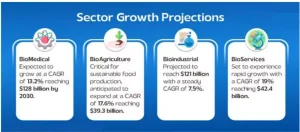
- Biopharmaceuticals and Healthcare Sector:
- Strengthening Healthcare Systems: This sector plays a pivotal role in producing affordable vaccines, biosimilars, and diagnostics, thereby enhancing public health accessibility and resilience, particularly in a country with vast population needs.
- Global Leadership Role: India’s capacity to supply cost-effective medicines globally reinforces its position as the “pharmacy of the world”, contributing to global health equity.
- Bio-Agriculture Sector:
- Enabling Climate-Resilient Agriculture: By promoting genetically improved crops, biofertilizers, and biopesticides, the sector helps mitigate the adverse impacts of climate change and soil degradation.
- Ensuring Food and Nutritional Security: It supports higher productivity and sustainable practices, addressing both food availability and nutritional challenges.
- Industrial Biotechnology Sector:
- Driving Green Industrialization: The use of bio-based inputs in industrial processes reduces reliance on petrochemicals, contributing to low-carbon industrial growth.
- Supporting Circular Economy Models: Industrial biotechnology enables waste-to-resource conversion, enhancing resource efficiency and sustainability.
- Bio-Services Sector:
- Enhancing Global Competitiveness: India’s expertise in contract research, clinical trials, and bioinformatics makes it a preferred destination for global R&D outsourcing.
- Knowledge Economy Expansion: This sector contributes to the growth of high-value services and intellectual capital, strengthening India’s position in global innovation networks.
- Environmental Biotechnology Sector:
- Addressing Environmental Challenges: This sector focuses on bioremediation, waste treatment, and carbon capture technologies, playing a crucial role in combating pollution and climate change.
Key Opportunities in India’s Bioeconomy
- Leveraging Demographic Dividend: India’s vast pool of young, skilled, and scientifically trained human capital provides a strong foundation for research excellence, innovation, and biotech entrepreneurship.
- This demographic advantage enhances the country’s capacity to scale knowledge-driven industries and sustain long-term technological competitiveness.
- Expanding and Dynamic Startup Ecosystem: The rapid rise of biotech startups is fostering a culture of disruptive innovation, agile experimentation, and faster commercialization of research outputs.
- This ecosystem is enabling India to integrate with global value chains while strengthening domestic innovation capabilities.
- Rising Global Demand for Sustainable Solutions: The increasing global shift toward green technologies, bio-based products, and climate-resilient solutions presents significant opportunities for India to expand exports and lead in sustainable innovation markets.
- It also opens avenues for international collaborations, technology transfer, and participation in global sustainability initiatives.
- Convergence with Digital and Emerging Technologies: The integration of artificial intelligence, machine learning, and big data with biotechnology is driving advancements in precision medicine, genomics, drug discovery, and smart biomanufacturing systems.
- This convergence is enhancing efficiency, accuracy, and scalability, thereby transforming the overall innovation landscape.
- Strategic Global Positioning and Leadership Potential: India has the potential to emerge as a global hub for affordable, scalable, and inclusive biotech solutions, particularly for developing nations.
- This positions India as a key player in addressing global health, food security, and environmental challenges, especially across the Global South.
Major Scientific Breakthroughs Driving the Bioeconomy
- Indigenous Vaccine Development and Biopharma Leadership: India’s capability in end-to-end vaccine development and large-scale manufacturing has significantly strengthened health security and resilience against pandemics.
- It has also enabled India to emerge as a global supplier of affordable vaccines, reinforcing its role in global health diplomacy and supply chain stability.
- Advances in Precision Medicine and Genomic Technologies: Progress in gene editing, genomics, and personalized therapeutics is transforming healthcare into a more targeted, predictive, and patient-centric system.
- These innovations are improving diagnostic accuracy, treatment efficiency, and long-term health outcomes, redefining healthcare delivery models.
- Innovations in Alternative Proteins and Food Biotechnology: The development of plant-based, cultured, and microbial proteins is addressing critical issues of food security, nutritional adequacy, and environmental sustainability.
- These solutions reduce reliance on resource-intensive livestock systems, thereby minimizing carbon emissions and ecological degradation.
- Carbon Capture and Bio-Based Material Innovations: Advances in carbon capture, biofuels, and biodegradable materials are facilitating the transition toward a low-carbon and circular economy.
- These technologies contribute to climate mitigation, waste reduction, and sustainable industrial production systems.
- Bio-AI Integration and Biofoundries: The emergence of Bio-AI hubs and automated biofoundries reflects the convergence of artificial intelligence with biological sciences, accelerating innovation cycles.
- This integration enhances drug discovery, synthetic biology, and industrial biotechnology, improving precision, scalability, and efficiency.
Enroll now for UPSC Online Course
Why is India’s Bioeconomy Critically Needed?
- Strengthening Healthcare Infrastructure: The bioeconomy enables the development of affordable, accessible, and indigenous healthcare solutions, reducing dependence on imports.
- It enhances public health resilience and preparedness against emerging diseases and health crises.
- Ensuring Agricultural Sustainability and Food Security: Biotechnology addresses challenges such as climate variability, soil degradation, and declining productivity.
- It supports the development of climate-resilient crops, bio-fertilizers, and sustainable farming practices.
- Facilitating Energy Transition and Security: Biofuels and bio-based energy solutions help reduce dependence on fossil fuels and diversify the energy mix.
- This contributes to energy security and supports India’s climate commitments.
- Promoting Environmental Sustainability: The bioeconomy enables pollution control, waste recycling, and circular economy practices.
- It plays a crucial role in reducing environmental degradation and achieving climate action goals.
- Driving Economic Growth and Employment Generation: The sector generates high-value jobs across research, manufacturing, and services, contributing to economic expansion.
- It fosters innovation-led growth and enhances global competitiveness.
- Enhancing Strategic and Technological Autonomy: By reducing reliance on foreign technologies and critical imports, the bioeconomy strengthens national resilience and self-reliance.
- It also enhances India’s strategic positioning in emerging technologies.
Key Initiatives Related to Bioeconomy
- Core Policy & Strategic Frameworks:
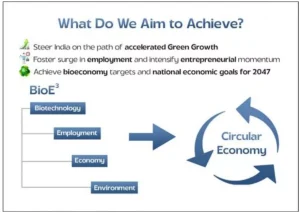
- BioE3 Policy: The BioE3 Policy provides a comprehensive and integrated framework that aligns economic growth with environmental sustainability and employment generation, thereby embedding biotechnology at the core of India’s development strategy.
- It promotes the transition toward sustainable biomanufacturing, bio-based industries, and circular economy models, while prioritising frontier technologies such as synthetic biology, smart proteins, and carbon capture.
- National Biotechnology Development Strategy: This strategy serves as a long-term roadmap for positioning India as a global biotechnology leader, focusing on innovation, competitiveness, and sustainability.
- It emphasizes strengthening research infrastructure, fostering industry-academia collaboration, and developing a skilled human resource base to support future growth.
- Financing & Innovation Support Mechanisms:
- Research, Development and Innovation (RDI) Fund: With a substantial corpus of ₹1 lakh crore, the fund addresses the critical need for long-term, patient capital in deep-tech sectors like biotechnology, which typically involve high risk and long gestation periods.
- It aims to bridge the funding gap between research and commercialization, while also catalysing private sector participation and venture capital investment.
- Biotechnology Ignition Grant: This scheme provides seed funding, mentorship, and incubation support to early-stage biotech startups, enabling them to translate innovative ideas into proof-of-concept models.
- It plays a crucial role in strengthening the innovation pipeline and nurturing grassroots entrepreneurship in biotechnology.
- Flagship Missions & National Programs:
- National Biopharma Mission: This mission focuses on accelerating indigenous biopharmaceutical innovation and manufacturing, particularly in areas like vaccines, biosimilars, and diagnostics.
- It enhances India’s ability to reduce import dependence, improve healthcare access, and strengthen global competitiveness in pharmaceuticals.
- Genome India Project: Aims to build a comprehensive genomic database representing India’s diverse population, enabling breakthroughs in precision medicine, disease prediction, and personalized healthcare.
- It also contributes to strengthening India’s capabilities in advanced genomics research and public health planning.
- Mission COVID Suraksha: Launched to accelerate indigenous vaccine development and manufacturing capacity, this mission significantly strengthened India’s biopharma ecosystem and pandemic preparedness.
- It has long-term implications for vaccine self-reliance and global supply chain resilience.
- Industrial & Manufacturing Promotion:
- Production Linked Incentive Scheme for Pharmaceuticals: This scheme incentivizes domestic production of critical drugs, APIs, and biopharmaceuticals, thereby reducing import dependence and enhancing supply chain security.
- It also promotes large-scale manufacturing and integration into global pharmaceutical value chains.
- Make in India: Encourages the development of indigenous manufacturing capabilities in biotechnology and related sectors, fostering self-reliance and industrial growth.
- It supports the creation of a robust domestic industrial base for bio-based products and technologies.
- Startup & Entrepreneurship Ecosystem:
- Startup India: This flagship initiative promotes a vibrant startup culture by providing regulatory easing, funding access, and incubation support, particularly benefiting biotech entrepreneurs.
- It enables innovation-led growth and the rapid scaling of startups within the bioeconomy ecosystem.
- Biotech Parks & Clusters Development: The establishment of biotech parks, incubators, and innovation clusters facilitates technology transfer, collaboration, and commercialization of research.
- These clusters also promote regional development and decentralization of innovation ecosystems, especially in emerging cities.
- Sustainability, Agriculture & Energy Initiatives:
- National Bioenergy Mission: Focuses on promoting biofuels, biomass utilization, and waste-to-energy technologies, contributing to energy security and reduction in fossil fuel dependence.
- It also supports rural income generation and climate change mitigation efforts.
- GOBAR-Dhan Scheme: Aims to convert organic waste into biogas, bio-CNG, and bio-fertilizers, promoting circular economy practices and sustainable rural development.
- It enhances resource efficiency while addressing waste management challenges.
- National Mission on Sustainable Agriculture: Encourages the adoption of bio-fertilizers, climate-resilient crops, and sustainable agricultural practices.
- It integrates biotechnology into agriculture to ensure long-term food security and ecological balance.
- Advanced Research & Future Technologies:
- Biofoundries and Bio-AI Hubs: These are state-of-the-art automated research platforms that integrate artificial intelligence with biological sciences, enabling high-throughput experimentation and rapid innovation cycles.
- They significantly reduce the time and cost of translating laboratory discoveries into industrial applications, especially in drug discovery and synthetic biology.
- Role of Department of Biotechnology: DBT acts as the nodal agency driving policy formulation, funding, and coordination, ensuring a coherent and well-integrated development of the biotechnology sector.
- It supports research institutions, infrastructure development, and international collaborations.
- Institutional Support Mechanism:
- Biotechnology Industry Research Assistance Council: Functions as a critical bridge between scientific research and industrial application, enabling the commercialization of innovations and scaling of startups.
- Through funding, incubation, and mentorship, BIRAC strengthens the entire innovation value chain from lab to market.
About Biotechnology Industry Research Assistance Council (BIRAC)
- The Biotechnology Industry Research Assistance Council (BIRAC) is a non-profit, Public Sector Enterprise (PSE) established by the Department of Biotechnology (DBT), Government of India.
- It functions as an interface agency to strengthen and empower emerging biotech enterprises to undertake strategic research and innovation.
- As of March 2026, BIRAC remains the primary architect of India’s biotech ecosystem, which has surged to a valuation of $195.3 billion.
Key Pillars of BIRAC
- Comprehensive Funding Ecosystem: BIRAC manages a suite of grants and equity schemes, including the Biotechnology Ignition Grant (BIG) for ideation, the Small Business Innovation Research Initiative (SBIRI) for early-stage research, and the Biotechnology Industry Partnership Programme (BIPP) for high-risk advanced development.
- National Infrastructure Network: Through the BioNEST (Bioincubation Nurturing Entrepreneurship for Scaling Technologies) program, BIRAC supports 100 bio-incubators nationwide, providing over 10.45 lakh sq. ft. of specialized lab space, instrumentation, and pilot plants.
- Strategic Fund Management: Under the government’s new ₹1 lakh crore initiative, BIRAC has been appointed as a second-level fund manager for the BIRAC-RDI (Research, Development, and Innovation) Fund, with a mandate to deploy ₹2,000 crore over five years to support deep-tech startups.
- BioE3 Policy Implementation: BIRAC is the lead agency for the BioE3 (Biotechnology for Economy, Environment, and Employment) Policy, focusing on high-performance biomanufacturing in sectors like green chemicals, smart proteins, and carbon capture.
- Emerging Technology Hubs: The council has recently launched Bio-AI Hubs to integrate Artificial Intelligence and Machine Learning into drug discovery, precision agriculture, and genomic diagnostics, aiming to reduce the time-to-market for bio-based products.
- Intellectual Property & Technology Management: It provides end-to-end support for IP (Intellectual Property) protection, including patentability searches and freedom-to-operate (FTO) analysis, helping innovators navigate complex global regulatory landscapes.
- Social Innovation & Global Partnerships: Through initiatives like Grand Challenges India (GCI)—a partnership with the Bill & Melinda Gates Foundation—BIRAC funds solutions for maternal health, infectious diseases, and climate-resilient agriculture.
|
Challenges with Bioeconomy in India
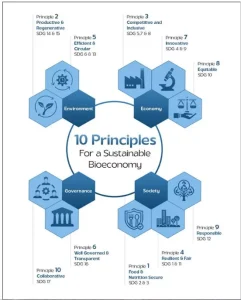
- Translational and Commercialization Gap: There exists a gap in scaling laboratory innovations into industrial production, limiting commercialization potential.
- This affects the conversion of research outputs into economic value.
- According to the India Bioeconomy Report 2026, a significant proportion of biotech research remains confined to early-stage (TRL 1–4), with limited transition to industrial-scale deployment.
- Skill Deficit in Emerging Domains: There is a shortage of highly specialized talent in areas such as synthetic biology, bioinformatics, and computational biology.
- This constrains the sector’s innovation capacity and global competitiveness.
- The World Economic Forum has flagged that India faces shortages in advanced interdisciplinary talent across synthetic biology, bioinformatics, computational biology, and biology-digital convergence domains.
- Funding and Investment Constraints: Limited access to venture capital and long-term risk financing hampers innovation.
- This particularly affects deep-tech and high-risk research-driven startups.
- The OECD notes that biotech and bio-based innovation often face financing gaps because of high risk, long development cycles, and the need for specialized de-risking and blended-finance instruments.
- Regulatory and Procedural Bottlenecks: Complex and time-consuming approval processes create barriers to rapid innovation and global market entry.
- This reduces ease of doing business in the biotech sector.
- Regulatory and procedural bottlenecks persist due to fragmented approvals, multiple compliance requirements, and uneven integration of clearance mechanisms, despite reforms such as the National Single Window System.
- Ethical, Biosafety, and Data Concerns: Issues related to genetic modification, biosecurity, and data privacy require robust governance frameworks.
- Ensuring ethical standards and public trust remains a key challenge.
- The rise of genomic data platforms has triggered concerns flagged by NITI Aayog regarding data privacy, consent, and biosecurity risks.
- Regional Disparities in Ecosystem Development: Unequal distribution of infrastructure, funding, and research institutions leads to imbalanced growth.
- This limits inclusive and nationwide expansion of the bioeconomy.
- The India Bioeconomy Report 2026 shows that biotech clusters are heavily concentrated in states like Karnataka, Telangana, and Maharashtra, with limited presence in eastern and northeastern regions.
Global Bioeconomy Policy Frameworks
- Group of Twenty (G20) Bioeconomy Action Agenda: The G20 has developed a coordinated bioeconomy action agenda emphasizing sustainability, innovation, and inclusive economic growth across member countries.
- It promotes technology transfer, capacity building, and resilient bio-based value chains, with a special focus on bridging gaps between developed and developing economies.
- Organisation for Economic Co-operation and Development (OECD) Bioeconomy Framework: The OECD advances evidence-based policy frameworks and data-driven governance mechanisms for bioeconomy development.
- It facilitates international cooperation in biotechnology innovation, regulatory harmonization, and alignment with sustainable development and green growth strategies.
- European Union (EU) Bioeconomy Strategy Implementation: The European Union (EU) is actively implementing its bioeconomy strategy through research funding programs, biorefinery development, and regional innovation clusters.
- These initiatives promote circular use of biomass, waste-to-resource conversion, and transition toward climate-neutral and resource-efficient industrial systems.
- Global Bioeconomy Summit (GBS) and Knowledge Platforms: The Global Bioeconomy Summit (GBS) serves as a high-level platform for policy dialogue, knowledge exchange, and international collaboration on bioeconomy issues.
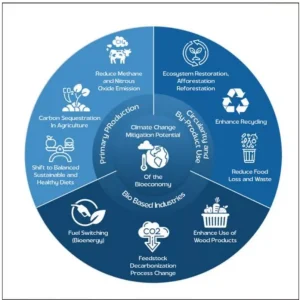 It enables multi-stakeholder engagement, sharing of best practices, and development of coordinated global action agendas.
- Mission Innovation (MI) Bioenergy and Clean Technology Initiatives: Mission Innovation (MI) is a global initiative that promotes clean energy innovation, including bioenergy, biofuels, and low-carbon technologies.
- It accelerates research and development investments, technology deployment, and international collaboration for sustainable energy transitions.
- Food and Agriculture Organization (FAO) Bioeconomy Programs: The Food and Agriculture Organization (FAO) promotes bioeconomy through sustainable agriculture, efficient bioresource utilization, and climate-resilient farming systems.
- Its initiatives integrate food security objectives with bio-based innovations to enhance rural livelihoods and ecological sustainability.
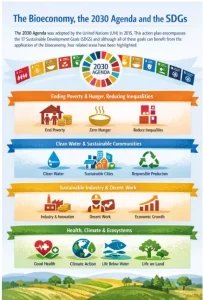 United Nations Sustainable Development Goals (UN SDGs) Integration: Bioeconomy initiatives are closely aligned with the United Nations Sustainable Development Goals (UN SDGs), particularly those related to climate action, responsible consumption, and life on land.
-
- This alignment ensures holistic development by integrating economic growth with environmental protection and social equity considerations.
- Global Biotechnology and Biomanufacturing Partnerships: Countries are increasingly engaging in cross-border collaborations in biotechnology, vaccine development, and biomanufacturing ecosystems.
- These partnerships strengthen global health security, supply chain resilience, and diffusion of advanced bio-based technologies.
- Public-Private Partnerships (PPP) in Bioeconomy: Governments and private sector entities are forming Public-Private Partnerships (PPP) to accelerate innovation in bio-based products, alternative proteins, and sustainable materials.
- Such collaborations facilitate commercialization, scaling of technologies, and creation of competitive bio-based markets.
- Integration with Climate Change and Circular Economy Frameworks: Global bioeconomy initiatives are increasingly integrated with climate change frameworks such as the Paris Agreement and circular economy models.
- They contribute to carbon emission reduction, waste minimization, and development of regenerative and sustainable production systems.
Way Forward
- Strengthening Technology Translation and Commercialization: There is a critical need to bridge the “lab-to-market gap” by enhancing technology transfer mechanisms, incubation ecosystems, and industry-academia partnerships.
- This will ensure that scientific research is effectively converted into scalable, market-ready products and industrial solutions.
- Augmenting Long-Term Financing and Risk Capital: Expanding access to patient capital, venture funding, and blended finance models is essential for supporting high-risk, high-reward biotech innovations.
- Strengthening instruments like the RDI Fund can help de-risk investments and attract private sector participation.
- Building Advanced Human Capital and Skills Ecosystem: India must invest in specialized education, interdisciplinary training, and skill development in emerging areas such as synthetic biology, bioinformatics, and Bio-AI.
- This will create a globally competitive, innovation-ready workforce to sustain long-term growth.
- Regulatory Reforms and Ease of Doing Business: Streamlining approval processes, standardizing regulations, and ensuring faster clearances while maintaining biosafety and ethical standards is crucial.
- A predictable and transparent regulatory framework will enhance innovation speed and global competitiveness.
- Promoting Regional Innovation Clusters and Inclusive Growth: Establishing biotech hubs, bio-clusters, and incubation centres in Tier-2 and Tier-3 cities can decentralize innovation.
- This will ensure balanced regional development, wider participation, and inclusive growth of the bioeconomy ecosystem.
- Scaling Advanced Infrastructure and Research Platforms: Expanding biofoundries, genomic labs, and Bio-AI hubs will accelerate high-throughput research and rapid prototyping capabilities.
- Such infrastructure is essential for cutting-edge innovation and global leadership in biotechnology.
- Strengthening Global Collaboration and Value Chain Integration: India should enhance international partnerships, technology transfer agreements, and participation in global biotech value chains.
- This will improve access to advanced technologies, markets, and research networks, boosting global competitiveness.
- Embedding Sustainability and Circular Economy Principles: Integrating green technologies, bio-based materials, and circular economy practices across sectors will ensure environmentally sustainable growth.
- This aligns the bioeconomy with climate commitments and long-term ecological balance.
- Enhancing Governance, Ethics, and Biosecurity Frameworks: Developing robust frameworks to address ethical concerns, data privacy, biosafety, and biosecurity risks is essential.
- This will build public trust and ensure responsible innovation in biotechnology.
Conclusion
India’s bioeconomy reflects a strategic transition toward innovation-driven, sustainable, and inclusive growth, powered by strong policy support and a dynamic ecosystem. Achieving the $300 billion target by 2030 will enhance economic resilience, generate employment, and position India as a global leader in equitable biotechnology advancement.


 21 Mar 2026



.png)




 Current Affairs




 GS Foundation
 Optional Course
 Combo Courses
 Degree Program