Recently, the Indian Prime Minister visited Oman as part of a three-nation tour (Jordan, Ethiopia, Oman), coinciding with the 70th anniversary of India–Oman diplomatic relations, established in 1955.
- The visit underscored India’s integrated approach to the Mediterranean and the Western Indian Ocean.
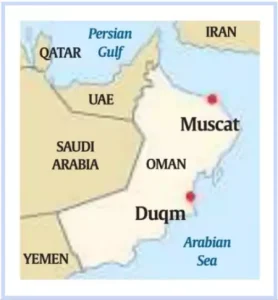
About Duqm Port
- It is situated on the southeastern seaboard of Oman, overlooking the Arabian Sea and the Indian Ocean.
- India has secured access to the key Port of Duqm in Oman for military use and logistical support.
- This is part of India’s maritime strategy to counter Chinese influence and activities in the region.
- The Port of Duqm also has a special economic zone, where about $1.8 billion investments are being made by some Indian companies.
|
Key Outcomes of the Visit
The visit transformed India–Oman ties into a comprehensive strategic partnership spanning trade, services, maritime security, defence, and diaspora welfare.
- Comprehensive Economic Partnership Agreement (CEPA): Both signed a landmark Free Trade Agreement, under which Oman granted zero-duty access on ~98% of tariff lines, covering nearly all Indian exports such as textiles, engineering goods, pharmaceuticals, and gems & jewellery.
- While India offers reciprocal concessions on approximately 80% of lines (primarily benefiting Omani petrochemicals and fertilizers).
- This CEPA is India’s second in the Gulf region (after the UAE CEPA of 2022) and marks Oman’s first bilateral FTA since the US-Oman FTA of 2006.
- Services and Labour Mobility Liberalisation: Oman opened 127 services sub-sectors to Indian professionals in Information Technology, healthcare, education, and business services.
 It also increased the quota for Indian intra-corporate transferees from 20% to 50%, easing skilled mobility.
- Maritime and Strategic Cooperation: A Joint Vision Document on Maritime Cooperation was adopted, strengthening collaboration on regional security, blue economy, and anti-piracy.
- The agreement ensures India’s continued strategic access to Duqm Port, located near the Strait of Hormuz.
- Sectoral Agreements for Future Growth: Multiple Memoranda of Understanding (MoUs) were signed in millet cultivation and agri-food innovation.
- Additional MoUs were concluded in higher education and research and maritime heritage and museums, supporting India’s National Maritime Heritage Complex at Lothal.
- Innovation Bridge: The proposal for the “Oman–India Innovation Bridge,” with a specific target to connect 200 startups from both nations over the next two years.
- Five-in-Five Green Energy Target: PM Modi proposed a “5-in-5” goal—launching five major green projects in the next five years, specifically in Green Hydrogen, Green Ammonia, Solar Parks, Energy Storage, and Smart Grids.
- Agri Innovation Hub: Include the proposal for an India–Oman Agri Innovation Hub to strengthen Oman’s food security while scaling Indian agri-tech solutions globally.
- Strategic and Defence Partnership: During the visit, the Indian Prime Minister was conferred Oman’s highest civilian honour—the First Class of the Order of Oman (Civil), reflecting deep strategic trust, alongside strengthened defence cooperation, including reports of Oman supplying Jaguar aircraft spares to the Indian Air Force
- Regional and Geopolitical Alignment: Both leaders expressed deep concern over the humanitarian situation in Gaza and reaffirmed support for a two-state solution, highlighting Oman’s mediation-oriented foreign policy as a key asset for India’s balanced engagement in West Asia.
- Diaspora-Centric Outcomes: With nearly 700,000 Indians in Oman, the visit strengthened people-to-people ties. CEPA introduced a liberalised mobility framework, extending the permitted stay for contractual service suppliers from 90 days to two years, extendable up to four years, enhancing employment security.
- Cultural & Soft Power- Reviving Ancient Legacies:
- Academic Institutionalization: The establishment of an Indian Council for Cultural Relations (ICCR) Chair of Indian Studies at Sohar University to formalize high-level Academic and Cultural Exchanges.
- Intellectual Bridge: This initiative creates a dedicated platform for research into India’s Civilizational Heritage and Modern Growth within the Omani education system.
- Maritime Reenactment: The maiden Trans-Oceanic Voyage of the Indian Navy Sailing Vessel (INSV) Kaundinya, a Stitched Wooden Replica of a 5th-Century Indian Ship.
- Ancient Technology: The vessel is constructed using traditional Mala-style Stitching Techniques (building ships without nails) to honor ancient Indian Naval Architecture.
- Historic Connectivity: Scheduled for December 2025, the voyage from Mandvi, Gujarat, to Muscat, Oman, relives the Ancient Maritime Trade Routes that have linked the two regions for two millennia.
- Shared Heritage: This odyssey serves as a high-profile Soft Power Diplomatic Tool, celebrating the deep-rooted Indo-Omani Civilizational Ties and the Indian Ocean Rim connectivity.
- Ayush Integration: Proposal noted for establishing an Ayush Chair at Oman’s National University of Science and Technology.
About India-Oman Relations
- Civilisational and Historical Foundations:
- Ancient Maritime Bridge: India–Oman ties date back to Harappan times, embedded in the Indian Ocean trade network. Ships from Lothal and Dholavira sailed to ancient Magan (Oman) carrying beads, pottery, cotton, and rice.
- Reciprocal Exchange: Oman supplied copper, frankincense, dates, and stones, while acting as a trans-shipment hub for Indian goods to Mesopotamia. Archaeological evidence such as seals, weights, and measures confirms organised trade.
- Navigation and Global Trade: Omani sailors mastered monsoon navigation and dhow shipbuilding, linking India to the Roman world and global spice routes.
- People-to-People Continuity: Gujarati traders settled in Oman, while Omani Muslims lived along India’s western coast, sustaining mobility through commerce and religious travel.
- Anti-Colonial Cooperation: Indian and Omani rulers cooperated to counter Portuguese dominance, strengthening early political trust.
- Geostrategic and Political Significance:
- Closest Gulf Neighbour: Oman is India’s closest neighbour in the Arabian Gulf, enhancing strategic proximity.
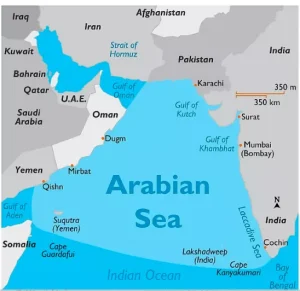 Strait of Hormuz Stability: Oman’s commitment to keeping the Strait of Hormuz open is critical for India’s energy security and trade flows.
- Trusted and Neutral Partner: Oman maintained cordial ties with India even when parts of West Asia leaned towards Pakistan. Its moderation and mediation-oriented foreign policy makes it a stable partner.
- Pillar of India’s West Asia Policy: Diplomatic relations were established in 1955 and upgraded to a Strategic Partnership in 2008. Oman was also a guest country during India’s G20 Presidency (2023).
- Regional Groupings: Oman is an integral member of the Gulf Cooperation Council (GCC), Organisation of Islamic Cooperation (OIC), and Arab League, amplifying its diplomatic reach.
- Defence and Maritime Security Cooperation:
- Institutional Defence Framework: Defence cooperation is anchored in a 2005 MoU on military cooperation.
- Closest Defence Partner in the Gulf: Oman is the only Gulf country to conduct regular tri-service exercises with India.
- Military Exercises: Includes Exercise Al-Najah (Army) and naval exercises such as Eastern Bridge and Naseem-al-Bahr.
- Maritime Security Collaboration: Indian naval deployments in the Gulf of Oman since 2012–13 for anti-piracy; coordination in the Indian Ocean Region.
- Operation Sankalp (2019): Joint efforts ensured safe passage of Indian merchant vessels during the Persian Gulf crisis.
- Duqm Port Agreement (2018): Provides Indian Navy access to logistics, basing, replenishment, and turnaround facilities, enhancing reach near the Strait of Hormuz.
 Operational Access: Oman provides overflight and transit facilities for Indian military aircraft.
- Defence Procurement Milestone: Oman became the first Gulf country to procure India’s INSAS rifles (2010).
- Strategic Surveillance Value: Oman’s location helps India monitor regional naval activity, including the growing Chinese presence.
- Economic, Trade, Investment and Digital Cooperation:
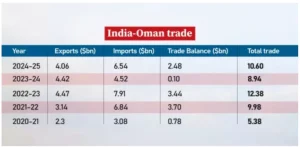
- Trade Volume: Bilateral trade reached USD 10.613 billion in FY 2024–25, making Oman India’s third-largest GCC export destination.
- Trade Composition:
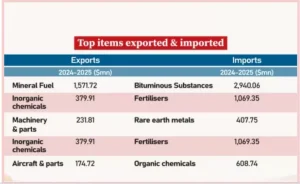
- Imports: Petroleum products and urea (over 70%), along with polymers, pet coke, gypsum, chemicals, iron & steel, aluminium.
- Exports: Mineral fuels, chemicals, precious metals, iron & steel, cereals, ships & boats, electrical machinery, boilers, tea, coffee, spices, apparel.
 CEPA Breakthrough (2025): India–Oman Comprehensive Economic Partnership Agreement grants zero-duty access on ~98% of tariff lines, covering almost all Indian exports. Oman becomes India’s second CEPA partner in the Gulf after the UAE.
- Investment Ecosystem: Over 6,000 India–Oman joint ventures operate in Oman, with estimated investments of USD 7.5 billion+.
- FDI Flows: Cumulative FDI from Oman to India stood at USD 605.57 million (2000–March 2025).
- Oman–India Joint Investment Fund (OIJIF): A 50–50 SBI–Oman Investment Authority JV, with USD 600 million invested, including a USD 300 million tranche announced in 2023.
- Duqm SEZ Projects: Indo-Oman JV Sebacic Oman is establishing a USD 1.2 billion sebacic acid plant, the largest in the Middle East.
- Digital Public Infrastructure Diplomacy: NPCI–Central Bank of Oman MoU (Oct 2022) led to the launch of RuPay debit cards, expanding India’s fintech footprint.
- Energy, Connectivity and Emerging Sectors:
- Energy Security: India was the second-largest destination for Omani crude oil exports (after China).
- Energy Transition: Cooperation is expanding into green hydrogen, renewables, and critical minerals.
- Connectivity Corridors: Oman may play a role in the India–Middle East–Europe Economic Corridor (IMEC) announced at the G20 Summit 2023.
- Technology and Space: Discussions underway on space cooperation and joint defence production in aircraft, naval platforms, and radar systems.
- Education, Health and People-to-People Ties:
- Indian Diaspora: Nearly 700,000 Indians live in Oman, contributing significantly to its economy and bilateral goodwill.
- Education Cooperation: Prospects of offshore IIT and IIM campuses and deeper academic collaboration.
- Health Cooperation: Scope for enhanced collaboration in medical education and healthcare services.
- CBSE Link: The CBSE system completes 50 years in Oman, symbolising deep educational integration.
- Cultural Cooperation: A 2010 Cultural MoU supports exchanges in arts and heritage.
- Archival Collaboration: Cooperation between the National Archives of India and Oman’s National Records and Archive Authority (NRAA).
Significance of India–Oman Relations
- Anchor of India’s West Asia Policy: Oman’s neutral, mediation-oriented foreign policy allows India to maintain balanced ties across rival blocs (Iran–GCC–West), making Oman a reliable diplomatic gateway in a conflict-prone region.
- Maritime Security and Indian Ocean Stability: India’s access to Duqm Port, near the Strait of Hormuz (through which ~20% of global oil trade passes), enhances India’s operational reach, logistics depth, and maritime domain awareness in the western Indian Ocean Region (IOR).
- Energy Security and Transition Partner: Oman is a key crude oil supplier (India was Oman’s second-largest oil market after China in 2022) and a prospective partner in green hydrogen and renewables, supporting India’s long-term energy transition.
- Defence and Strategic Trust: Oman is India’s closest defence partner in the Gulf and the only Gulf country with tri-service military exercises, reflecting exceptional strategic trust and interoperability.
- Trade and Economic Diversification: The India–Oman CEPA (2025) positions Oman as India’s second CEPA partner in the Gulf (after UAE), supporting India’s goals of export diversification, services expansion, and MSME integration.
- Diaspora and People-Centric Diplomacy: With nearly 7 lakh Indians in Oman, the relationship directly affects remittances, labour mobility, and diaspora welfare, making it socially and politically consequential for India.
Challenges in India–Oman Relations
- Regional Security Volatility: Conflicts such as the Israel–Hamas war and tensions in the Gulf of Oman disrupt shipping lanes.
- Example: During the 2019 Gulf crisis, India launched Operation Sankalp to protect Indian-flagged vessels near Oman.
- Overdependence on Oil-Linked Trade: Over 70% of India’s imports from Oman consist of crude oil, petroleum products, and urea, limiting diversification and exposing trade to price shocks.
- Omanisation Policy Constraints: Oman’s labour nationalisation policy fixes employment quotas for nationals.
- This creates friction in CEPA negotiations, as India seeks a freeze on current quotas to protect Indian professionals’ access to services sectors.
- Slow Progress on Connectivity Projects: The Middle East–India Deepwater Pipeline (MEIDP / Iran–Oman–India pipeline) remains stalled due to sanctions on Iran, high costs, and technological challenges, delaying energy connectivity gains.
- China’s Expanding Footprint: China was the first country to receive oil supplies from Oman and has growing economic and port-related interests.
- Oman’s strategic location near the Gulf of Oman makes it sensitive amid the PLA Navy’s expanding IOR presence.
- Geopolitical Sensitivities around Duqm: India’s logistics access to Duqm Port strengthens maritime security but may be perceived by other powers as strategic signalling, increasing regional competition.
- Implementation Gaps in Agreements: While MoUs and frameworks are strong, regulatory alignment, standards harmonisation, and customs processes often slow on-ground execution, diluting early economic gains.
Common International Memberships and Multilateral Engagements
India and Oman engage across multiple multilateral platforms that together constitute the diplomatic and institutional architecture of their regional and global cooperation:
- Indian Ocean Rim Association (IORA): As founding members, India and Oman collaborate on Maritime Domain Awareness (MDA), Blue Economy, disaster risk reduction, and secure sea lanes, reinforcing stability in the Western Indian Ocean Region (IOR).
- International Solar Alliance (ISA): Oman’s membership in this India-led initiative provides a structured platform for cooperation on solar energy deployment, financing, and capacity building, aligning with Oman’s Vision 2040 and India’s clean energy diplomacy.
- United Nations and Bretton Woods Institutions: Both are members of the United Nations (UN), World Trade Organization (WTO), International Monetary Fund (IMF), and World Bank, coordinating positions on global trade governance, development finance, and humanitarian issues, including West Asian stability.
- India-Led Climate and Resilience Initiatives (Emerging): During the December 2025 visit, India invited Oman to join the Global Biofuel Alliance and the Coalition for Disaster Resilient Infrastructure (CDRI), signalling deeper cooperation in renewable energy, climate adaptation, and infrastructure resilience.
- Bridge to Regional Groupings: Although India is not a member of the Gulf Cooperation Council (GCC) or the Arab League, Oman functions as a trusted diplomatic bridge, facilitating India’s engagement with regional blocs, including discussions on the India–GCC Free Trade Agreement.
About Gulf Cooperation Council (GCC)
- It is a political and economic union of the Middle Eastern countries bordering the Persian Gulf and constituting the Arabian Peninsula.
- Members: Saudi Arabia, United Arab Emirates (UAE), Qatar, Kuwait, Oman, and Bahrain.
- Organisation of Islamic Cooperation(OIC): The OIC aims to represent the Muslim world in order to protect and safeguard vital interests of Muslims.
- Arab League: It is a union of Arabic-speaking African and Asian countries that promotes the interests of its member countries and observers.
|
Way Forward
- Operationalizing the Comprehensive Economic Partnership Agreement (CEPA): The immediate priority is the full implementation of the Free Trade Agreement (FTA) by the first quarter of 2026.
- This aims to eliminate tariffs on over 98% of Indian exports and secure “standstill” clauses on Omanisation (employment quotas) to protect the 700,000-strong Indian Diaspora.
- Transforming Duqm into a Maritime Security Hub: Beyond mere logistical access, India and Oman will develop Duqm Port into an integrated hub for Maritime Domain Awareness (MDA) and Humanitarian Assistance and Disaster Relief (HADR).
- This includes establishing a dedicated Maintenance, Repair, and Overhaul (MRO) ecosystem for the Indian Navy in the Western Indian Ocean.
- Executing the “5-in-5” Green Energy Roadmap: Both nations will fast-track five major green projects—focused on Green Hydrogen, Green Ammonia, and Solar Energy Storage—within the next five years.
- This aligns Oman Vision 2040 with India’s goal to become a global Green Energy Exporter.
- Deepening Digital Public Infrastructure (DPI) & Fintech Integration: The next phase involves moving beyond RuPay card acceptance toward a Local Currency Settlement (LCS) mechanism.
- This will facilitate seamless, real-time cross-border payments using the Unified Payments Interface (UPI), reducing transaction costs and dollar dependency.
- Establishing a “Knowledge & Innovation Corridor”: The partnership will prioritize the setting up of offshore Indian Institute of Technology (IIT) and IIM campuses in Oman.
- This will be complemented by the India–Oman Agri Innovation Hub to leverage Indian expertise in Millet Cultivation and food security technology.
- Strategic Connectivity via the India–Middle East–Europe Economic Corridor (IMEC): Oman will be integrated as a critical gateway for IMEC, linking its industrial clusters and special economic zones to Indian ports.
- This positions Oman as a primary Redistribution Hub for Indian goods entering East Africa and the wider Gulf Cooperation Council (GCC) region.
Conclusion
The 2025 visit transformed historical ties into a Modern Strategic Synergy. By aligning Oman Vision 2040 with Viksit Bharat 2047, the Comprehensive Economic Partnership Agreement (CEPA) and maritime pacts create a resilient blueprint for inclusive growth and Indian Ocean security.


 19 Dec 2025





.png)






 Current Affairs




 GS Foundation
 Optional Course
 Combo Courses
 Degree Program